Hotel Net Operating Income
Hotel Net Operating Income (NOI): Formula, Calculation, and Why It Matters


Hotel Net Operating Income (NOI): Operating Revenue & Profitability
Hotel Net Operating Income (NOI) is a key measure of how effectively a hotel converts operating revenue into income after applicable operating expenses. While metrics such as occupancy, ADR, and RevPAR focus heavily on room performance, NOI looks at the broader financial performance of the property.
For hotel owners, investors, operators, and asset managers, hotel NOI connects revenue generation and expense management with property-level operating performance. It helps show whether stronger hotel revenue is actually translating into stronger operating economics.
What Is Hotel Net Operating Income (NOI) in Hotel Operations?
Hotel Net Operating Income (NOI) is a hotel operating performance metric that measures the income a property generates from operations after deducting applicable operating expenses. At a conceptual level, the hotel NOI formula is:
NOI = Operating Revenue − Operating Expenses
NOI is sometimes also referred to as net operating profit (NOP).
The calculation looks at two sides of hotel performance:
- Operating revenue — how much the property generates
- Operating expenses — what it costs to operate the property
This makes NOI different from metrics that focus on only one part of the hotel's performance.
A hotel can increase occupancy, ADR, or RevPAR while seeing a smaller improvement in NOI if operating expenses increase at the same time.
Likewise, reducing expenses without protecting revenue or the guest experience can create problems elsewhere in the business.
NOI therefore provides a broader view of how effectively the hotel is being operated.
Hotel NOI Formula
The basic formula is:
Hotel NOI = Operating Revenue − Operating Expenses
For example, assume a hotel generates:
- Room revenue: $1,500,000
- Food and beverage revenue: $350,000
- Ancillary and other operating revenue: $150,000
- Total operating revenue: $2,000,000
- Operating expenses: $1,300,000
The hotel's NOI would be:
$2,000,000 − $1,300,000 = $700,000
The property therefore generates $700,000 in NOI under this example.
The exact presentation of hotel NOI can vary depending on the property's reporting practices and the definition being used. Owners and investors should therefore confirm which revenues and expenses are included when comparing NOI between properties or reporting periods.
Understanding Hotel Revenue
The revenue side of the NOI equation can include considerably more than room revenue.
Hotels may generate operating revenue from:
- Room revenue
- Food and beverage
- Ancillary services
- Guest fees
- Events and other operating activities
- Other operating revenue
This creates an important hierarchy within hotel performance:
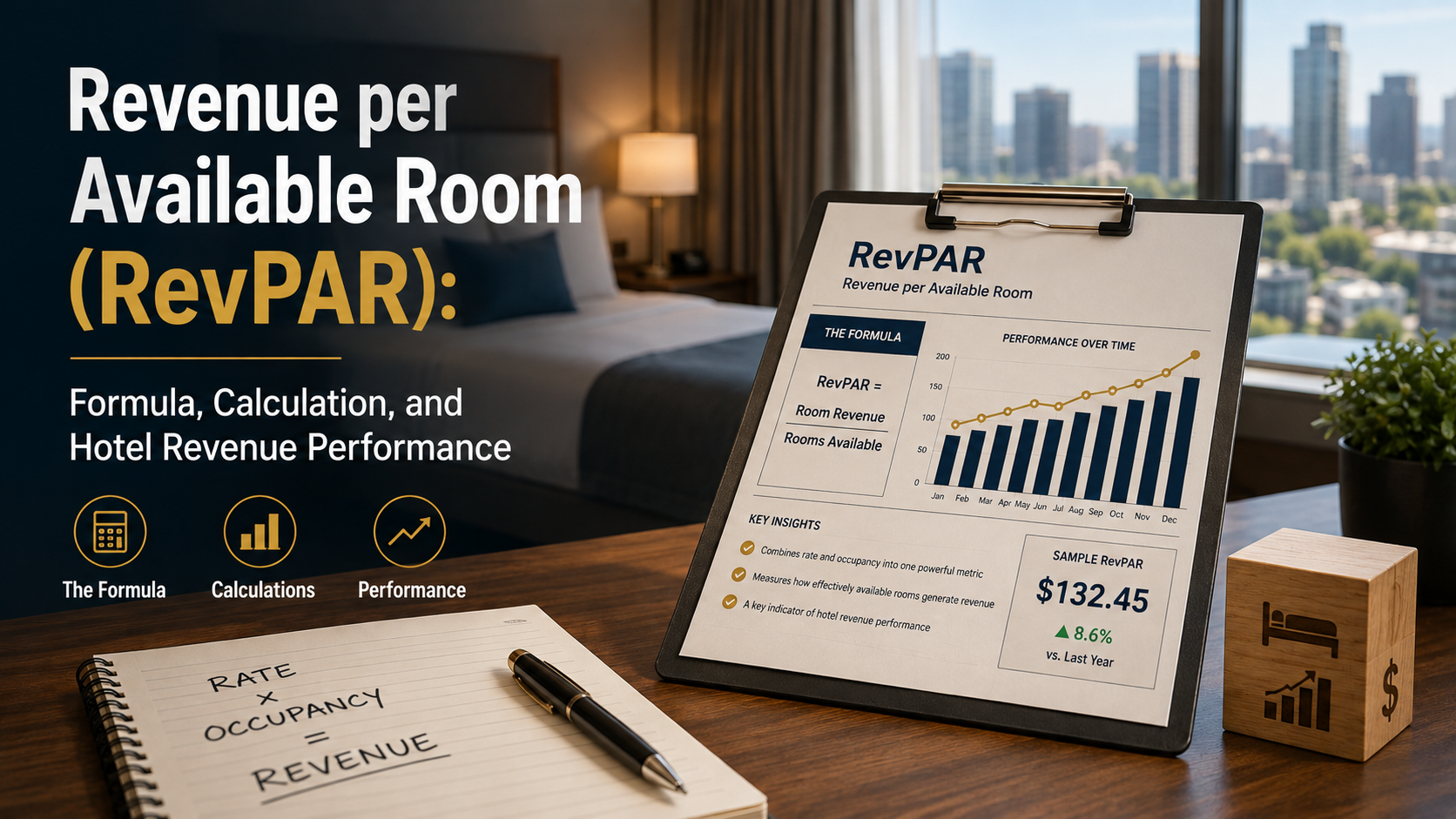
ADR + Occupancy → RevPAR → Room Revenue
Then:
Room Revenue + F&B + Ancillary Revenue + Other Operating Revenue → Hotel Operating Revenue
Finally:
Hotel Operating Revenue − Operating Expenses → Hotel NOI
Understanding this progression helps connect room-level performance metrics with property-level financial performance.
Room Revenue
Room revenue is a major source of operating revenue for many hotels.
It is influenced by factors such as:
- Occupancy
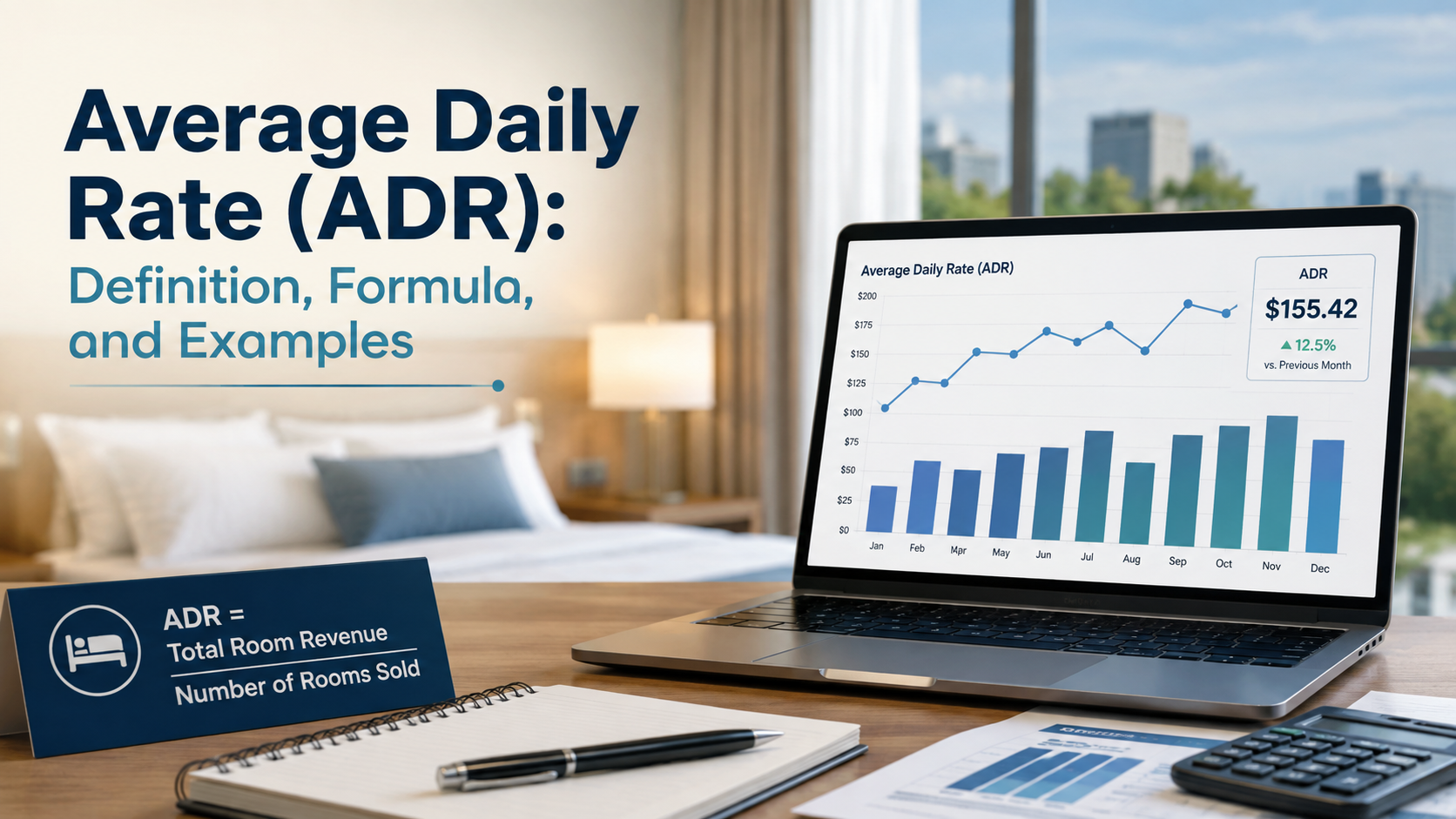
- Average Daily Rate (ADR)
- Available room inventory
- Demand
- Seasonality
- Market segment
- Distribution channels
- Length of stay
- Pricing strategy
This is where metrics such as ADR, occupancy, and RevPAR become relevant to NOI.
A hotel can improve room revenue by increasing ADR, increasing occupancy, or improving the combination of both. However, the resulting revenue needs to be considered alongside the costs required to generate and service those bookings.
Food and Beverage Revenue
Food and beverage operations can provide another significant source of hotel revenue.
Depending on the property, this may include:
- Restaurants
- Bars
- Room service
- Banquets
- Catering
- Events
- Other culinary services
F&B can contribute to NOI by increasing operating revenue, although it also creates associated expenses such as labor, food costs, supplies, utilities, and equipment.
The objective is therefore not simply to increase F&B sales, but to generate revenue efficiently.
Ancillary Revenue
Ancillary revenue comes from services and experiences beyond the basic room stay.
Examples may include:
- Spa services
- Parking
- Activities
- Recreation
- Transportation
- Resort fees
- Pet fees
- Experiences
- Packages
- Other guest services
Ancillary revenue can provide opportunities to increase total revenue without relying entirely on room-rate increases.
Hotels can also use upselling and packages to encourage guests to purchase additional services before or during their stay.
For example, a property could offer a room package that combines accommodation with dining, activities, or other services. The financial benefit depends on the additional revenue generated relative to the costs associated with delivering those services.
Hotel Operating Expenses
Operating expenses are the costs associated with running the property and delivering hotel services.
Common operating expenses include:
- Labor
- Housekeeping
- Utilities
- Maintenance
- Repairs
- Supplies
- Technology
- Marketing
- Distribution costs
- Administrative expenses
- Property operations
Other property-level operating costs may also apply depending on the hotel's ownership, management, brand, and reporting structure.
The important point is that operating expenses directly affect how much operating revenue becomes NOI.
A hotel generating $2 million in revenue with $1.2 million in operating expenses produces a very different NOI from a hotel generating the same revenue with $1.5 million in operating expenses.
Fixed and Variable Hotel Operating Costs
Not every operating expense behaves in the same way.
Some costs are relatively fixed, meaning they do not change significantly with short-term changes in occupancy or revenue.
Other expenses are more variable, meaning they tend to increase or decrease as hotel activity changes.
Examples of costs that can vary with occupancy or operating activity may include:
- Front-line labor
- Housekeeping supplies
- Linen usage
- Cleaning supplies
- Certain third-party commissions
- Guest amenities
Understanding this distinction helps hotel operators identify where operating decisions can have an immediate effect on expenses.
For example, a hotel experiencing a significant increase in occupancy may also experience higher housekeeping hours, linen usage, guest supplies, and other variable costs.
The additional revenue needs to be evaluated alongside these incremental expenses to understand its effect on NOI.
Monitoring Operating Expenses
One practical way to manage NOI is to monitor variable expenses relative to revenue.
For example, management could track certain expenses as a percentage of the revenue they support.
If a particular variable cost is increasing substantially faster than revenue, it may indicate an operational issue that requires investigation.
Possible causes could include:
- Inefficient staffing
- Excessive supply usage
- Higher distribution costs
- Poor procurement controls
- Operational waste
- Changes in demand
- Process inefficiencies
Tracking these relationships over time can help management identify cost trends before they have a larger effect on NOI.
What Does Hotel NOI Exclude?
Hotel NOI is intended to measure property-level operating performance, rather than the final amount of money available to the owner after every financial obligation.
Depending on the reporting definition, items generally outside NOI may include:
- Interest and other financing costs
- Principal debt payments
- Income taxes
- Depreciation and amortization
- Certain capital expenditures
- Other non-operating items
This distinction is important.
A hotel can generate positive NOI while the owner's actual cash flow is lower after debt service, taxes, capital investments, and other ownership-level obligations.
NOI should therefore not automatically be treated as the owner's final profit.
Hotel NOI vs. Revenue
Revenue and NOI measure different aspects of hotel performance.
Revenue measures how much the hotel generates.
NOI measures how much operating income remains after applicable operating expenses.
Consider two hotels that each generate $2 million in operating revenue.
Hotel A has $1.2 million in operating expenses:
$2,000,000 − $1,200,000 = $800,000 NOI
Hotel B has $1.5 million in operating expenses:
$2,000,000 − $1,500,000 = $500,000 NOI
Both properties generate the same revenue, but Hotel A produces $300,000 more NOI because it has a lower operating expense base.
This demonstrates why revenue growth does not automatically create equivalent NOI growth.
The quality of revenue growth matters.
Hotel NOI vs. Profit or Net Income
NOI is not the same as accounting profit or net income.
Net income is a broader measure that can incorporate financing costs, taxes, depreciation and amortization, and other items that are outside the property-level NOI calculation.
NOI instead focuses on the economics of operating the hotel.
A simplified progression is:
Operating Revenue − Operating Expenses → NOI
Additional financial and accounting items may then be considered when calculating broader measures of profitability or cash flow.
This makes NOI particularly useful when evaluating the operating performance of a property independently from its financing structure.
Hotel NOI vs. EBITDA
NOI and EBITDA are related but should not be treated as interchangeable.
NOI generally focuses on the operating performance of a specific property.
EBITDA, or earnings before interest, taxes, depreciation, and amortization, is a broader earnings measure that can be used to evaluate a business or operating company.
For a hotel company with multiple properties, EBITDA may include corporate-level costs and other items that are not part of an individual property's NOI.
The distinction is therefore partly about measurement level and purpose.
NOI helps answer:
How effectively is this hotel property generating operating income?
EBITDA can answer a broader question about the earnings performance of a business before certain financing, tax, and non-cash charges.
RevPAR vs. Hotel NOI
The relationship between RevPAR and NOI is central to understanding hotel financial performance.
RevPAR measures room-revenue productivity.
NOI measures property operating economics.
The relationship can be simplified as:
ADR + Occupancy → RevPAR → Room Revenue → Operating Revenue → NOI
However, the relationship is not perfectly linear.
A hotel can improve RevPAR while NOI grows more slowly if the additional revenue requires significantly higher operating expenses.
For example, increasing occupancy can produce more room revenue while also increasing:
- Housekeeping labor
- Laundry and linen costs
- Guest supplies
- Utilities
- Distribution expenses
- Other variable operating costs
Similarly, increasing ADR can improve RevPAR without producing the same percentage increase in NOI if acquisition, marketing, service, or operating costs rise.
Therefore:
Higher RevPAR does not automatically mean proportionally higher NOI.
The goal of revenue management is not simply to maximize occupancy or ADR independently. It is to generate sustainable and profitable revenue.
NOI Margin
NOI margin expresses NOI as a percentage of operating revenue.
The formula is:
NOI Margin = NOI ÷ Operating Revenue × 100
Using the earlier example:
- Operating revenue = $2,000,000
- NOI = $700,000
Therefore:
$700,000 ÷ $2,000,000 × 100 = 35%
The hotel's NOI margin is 35%.
NOI margin helps management and owners evaluate how much of the property's operating revenue remains after applicable operating expenses.
It can also help identify changes in operating efficiency over time.
For example, if revenue increases but NOI margin falls, the property may be generating more revenue while becoming less efficient from an operating-cost perspective.
Revenue Management and Hotel NOI
Revenue management directly influences the revenue side of the NOI equation.
Revenue managers consider factors such as:
- Demand
- Pricing
- Occupancy
- Available inventory
- Market segments
- Booking patterns
- Seasonality
- Distribution channels
The objective is not simply to fill as many rooms as possible.
Aggressive discounting may increase occupancy while weakening ADR and pricing power. Conversely, maintaining a high ADR without enough demand can leave rooms unsold.
A stronger strategy seeks the right balance between rate, occupancy, demand, and profitability.
Marketing can also support NOI when it attracts guests who are a good fit for the property's pricing strategy and revenue goals.
This is why the relationship is better understood as:
Revenue Management → Profitable Revenue → Operating Revenue → NOI
Operations Management and Hotel NOI
Operations management affects the expense side of NOI.
Labor scheduling, housekeeping, procurement, maintenance, technology, service delivery, and internal processes all influence the cost of operating the property.
For example, inefficient housekeeping processes can increase labor costs. Poor procurement controls can increase supply expenses. Reactive maintenance can result in larger repair costs.
Effective operations management can therefore improve NOI without requiring the hotel to generate substantially more revenue.
The relationship is:
Operations Management → Expense Efficiency → Operating Expenses → NOI
However, expense reduction should not be pursued blindly.
Cutting labor, maintenance, supplies, or guest services too aggressively can damage service quality and eventually affect guest satisfaction, reviews, demand, and revenue.
The objective is efficient operations, not simply the lowest possible expense level.
Asset Management and Hotel NOI
Asset management connects hotel operations with the owner's broader financial objectives.
An asset manager can evaluate property performance, monitor revenue and expenses, identify opportunities, and work with hotel management to improve operating results.
The relationship can be summarized as:
Asset Management → Revenue + Expenses → NOI
Asset management may examine questions such as:
- Is revenue growing efficiently?
- Are operating expenses increasing faster than revenue?
- Is labor productivity improving?
- Are distribution costs affecting profitability?
- Are ancillary revenue opportunities being captured?
- Are capital improvements supporting future performance?
- Is the property's operating strategy aligned with ownership objectives?
NOI provides a useful financial outcome for evaluating these decisions.
Hotel NOI and Asset Value
Hotel NOI is also important to the economics of the underlying property.
Income-producing real estate is often evaluated partly on its ability to generate sustainable operating income. Stronger and more consistent NOI can therefore contribute to stronger asset economics and may influence how investors evaluate a hotel.
However, hotel value cannot be determined by applying one universal multiplier to NOI.
Income-based valuation approaches can involve capitalization rates and other assumptions, but actual hotel valuation depends on factors such as:
- Location
- Property type
- Market conditions
- Property quality
- Revenue stability
- Expense structure
- Growth expectations
- Risk
- Capital requirements
- Comparable transactions
- Investor expectations
NOI is therefore an important component of understanding hotel asset economics, but it is not a standalone valuation formula.
The broader relationship is:
Hotel Operations → Revenue & Expenses → NOI → Asset Economics → Owner/Investor Value
Hotel NOI and Capital Improvements
Capital improvements should be distinguished from routine operating expenses.
Major renovations, building-system replacements, significant property upgrades, and other long-term investments may be treated as capital expenditures rather than ordinary operating expenses.
However, these investments can influence future NOI.
A renovation, for example, could potentially improve:
- ADR
- Occupancy
- Guest experience
- Ancillary revenue
- Operational efficiency
- Maintenance requirements
The relevant ownership question is therefore not simply how much a capital project costs, but whether the investment can improve the property's long-term operating performance and asset economics.
How to Improve Hotel NOI
There are two fundamental ways to improve NOI:
Increase operating revenue or reduce operating expenses.
The strongest strategies often address both while protecting the property's long-term performance.
Improve Room Revenue
Use demand forecasting, pricing strategies, inventory controls, and distribution management to improve room revenue without unnecessarily sacrificing ADR or profitability.
The objective is profitable demand rather than occupancy at any cost.
Increase Ancillary Revenue
Identify additional services, packages, experiences, food and beverage offerings, and other opportunities that encourage guests to spend more during their stay.
Upselling can increase total guest revenue when the additional revenue exceeds the cost of providing the service.
Improve Labor Efficiency
Align staffing with demand through scheduling, workflow improvements, training, and technology.
Labor is one of the most important expense categories for many hotels, making productivity a major factor in operating efficiency.
Monitor Variable Costs
Track variable operating costs relative to revenue and occupancy.
If expenses such as housekeeping labor, linen usage, cleaning supplies, or third-party commissions increase faster than revenue, management can investigate the cause and make adjustments.
Improve Procurement
Review purchasing practices, vendor relationships, inventory levels, and consumption patterns to reduce unnecessary supply costs without compromising service quality.
Reduce Preventable Maintenance Costs
Proactive maintenance can identify problems before they develop into larger and more expensive repairs.
It can also help protect the property's condition and guest experience.
Manage Distribution Costs
A booking that generates revenue also carries an acquisition cost.
Hotels should therefore evaluate distribution channels based on both the revenue they produce and the costs associated with generating that revenue.
Use Technology and Systems Effectively
Technology can improve forecasting, communication, reporting, workflow, guest service, and operational efficiency.
The objective is to use systems that reduce unnecessary work and improve decision-making rather than adding technology without a clear operational benefit.
Why Hotel NOI Matters for Hotel Profitability
For owners and investors, NOI provides a useful view of property-level operating performance before financing and other ownership-level considerations.
It helps answer a fundamental question:
How effectively is this property turning operating activity into income?
A hotel with strong revenue but uncontrolled expenses may produce weaker NOI than expected.
Conversely, a hotel with moderate revenue can potentially produce strong NOI when it maintains efficient operations and a healthy relationship between revenue and expenses.
NOI can therefore help owners and investors evaluate:
- Property performance
- Operating efficiency
- Revenue strategy
- Expense management
- Management effectiveness
- Asset performance
- Investment decisions
- Long-term property economics
It also provides a common metric through which ownership, asset management, and hotel operations can evaluate whether their strategies are producing the desired financial results.
Owner vs. Operator: Where NOI Fits
NOI helps clarify the relationship between hotel ownership and hotel operations.
The operator manages the property's day-to-day activities.
Those activities influence:
- Revenue
- Labor
- Guest services
- Maintenance
- Procurement
- Technology
- Other operating expenses
The resulting relationship is:
Operator → Operations → Revenue & Expenses → NOI → Owner/Investor
The owner or investor has a broader interest in the property's financial performance and long-term asset economics.
This makes NOI an important bridge between daily hotel management and ownership objectives.
Final Thoughts
Hotel Net Operating Income (NOI) brings together the major components of hotel operating performance. ADR and occupancy influence RevPAR, RevPAR contributes to room revenue, and room revenue combines with food and beverage, ancillary, and other operating revenue to create total operating revenue. Operating expenses then determine how much of that revenue becomes NOI.
For hotel owners and investors, NOI extends beyond a single financial metric. Revenue management, operations management, and asset management all influence the revenue and expense decisions that ultimately shape property-level income. Understanding those connections helps hotel teams focus not simply on generating more revenue, but on creating efficient, sustainable operating performance that supports long-term asset economics.
Frequently Asked
What is hotel NOI?
Hotel Net Operating Income (NOI) is the income generated by a hotel after subtracting applicable operating expenses from its operating revenue.
What is the formula for hotel NOI?
The basic formula is:
NOI = Operating Revenue − Operating Expenses
The exact calculation should follow the property's applicable reporting definition.
Is hotel NOI the same as revenue?
No. Revenue measures the amount generated by the hotel, while NOI accounts for applicable operating expenses and therefore measures property-level operating income.
Is hotel NOI the same as profit?
No. NOI is a property-level operating measure. It generally does not represent the owner's final profit after financing costs, taxes, depreciation, capital expenditures, and other ownership-level items.
Is NOI the same as RevPAR?
No. RevPAR measures room-revenue productivity, while NOI measures operating income after applicable operating expenses.
Can RevPAR increase while NOI decreases?
Yes. RevPAR can increase while NOI declines if the additional revenue is offset by higher labor, distribution, utilities, maintenance, or other operating expenses.
What is NOI margin?
NOI margin expresses NOI as a percentage of operating revenue.
NOI Margin = NOI ÷ Operating Revenue × 100
What expenses are excluded from NOI?
Depending on the reporting definition, NOI generally excludes items such as financing costs, debt principal payments, income taxes, depreciation and amortization, and certain capital expenditures.
How can a hotel improve NOI?
A hotel can improve NOI by increasing profitable operating revenue, controlling operating expenses, improving labor and operational efficiency, increasing ancillary revenue, managing distribution costs, and making effective revenue-management decisions.
Why is NOI important to hotel owners?
NOI helps owners and investors evaluate how effectively a property converts operating revenue into property-level operating income and provides an important measure of operating performance and asset economics.
Does higher NOI always mean higher hotel value?
Not necessarily. Stronger NOI can improve property economics, but hotel valuation also depends on factors such as market conditions, property quality, risk, growth expectations, capital requirements, and investor expectations.
More Recent Articles