Revenue per Available Room
Hotel RevPAR: Revenue per Available Room Formula, Calculation & Performance

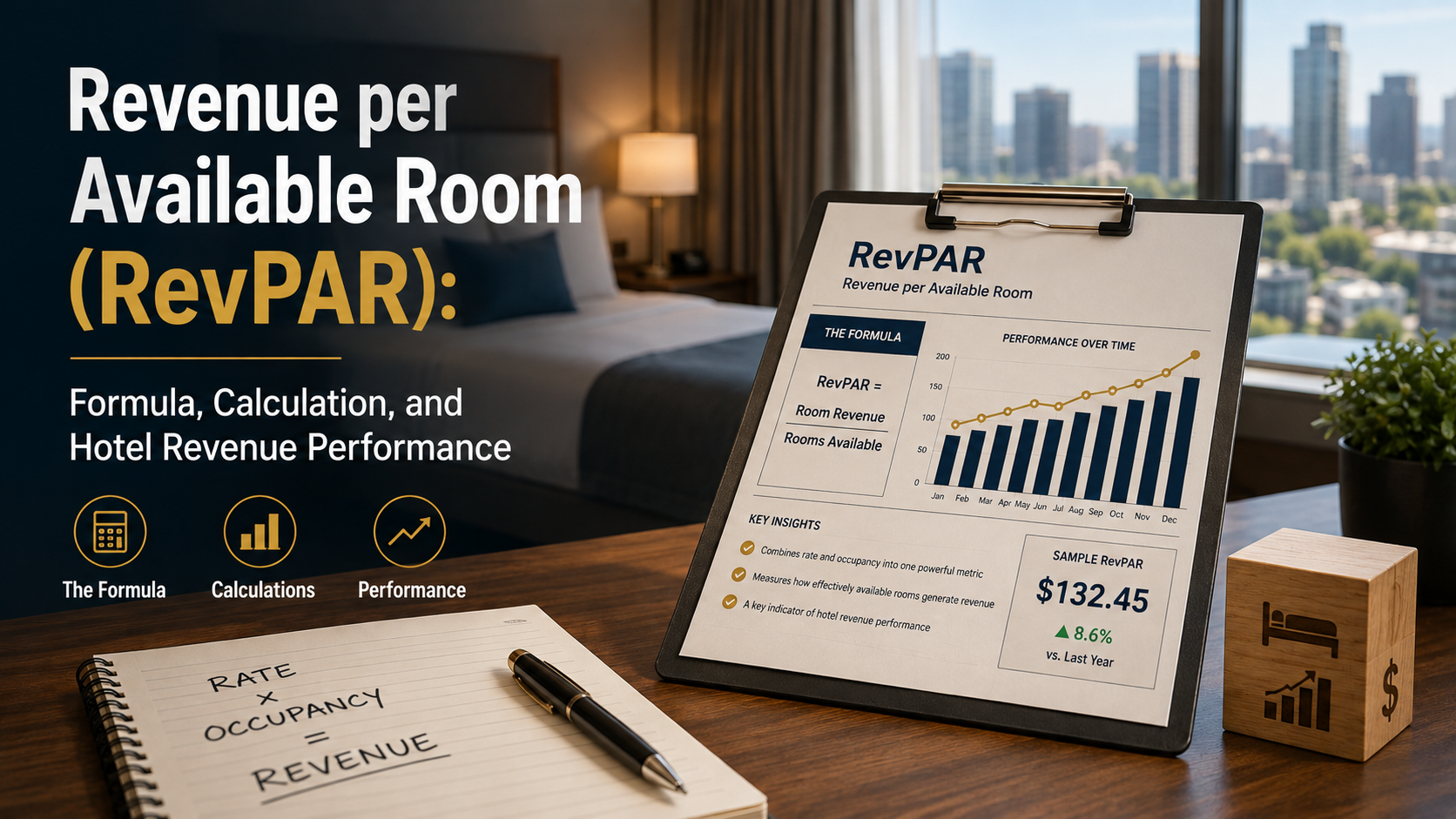
Revenue per Available Room (RevPAR): Understanding Hotel Revenue Performance
Revenue per Available Room (RevPAR) is one of the most important metrics for evaluating hotel room-revenue performance. It combines
average daily rate (ADR) and
hotel occupancy rate into a single measure, showing how effectively a property's available room inventory generates room revenue.
Unlike ADR, which only considers rooms that were sold, RevPAR considers the entire available room inventory. This makes it useful for understanding the relationship between room pricing, occupancy, revenue management, and hotel financial performance.
Understanding RevPAR also provides a clearer view of how operational decisions can influence a hotel's broader financial results, from room revenue and total hotel revenue to net operating income (NOI).
What Is Revenue per Available Room (RevPAR)?
Revenue per Available Room (RevPAR) measures the average amount of room revenue generated for each available room during a specific period.
The key term is available room. Unlike rooms sold, available rooms represent the room inventory that was available for sale during the measurement period.
For example, if a hotel has 100 rooms available for a day, it has 100 available room nights. If 75 rooms are sold, the hotel has a 75% occupancy rate.
RevPAR considers both figures by evaluating how much room revenue was generated across the hotel's entire available inventory.
This makes RevPAR a room-revenue productivity metric rather than simply a pricing or occupancy metric.
How to Calculate RevPAR
There are two standard RevPAR formulas.
Formula 1: Room Revenue ÷ Available Rooms
RevPAR = Room Revenue ÷ Available Rooms
For example, if a hotel generates $12,000 in room revenue from 100 available rooms:
$12,000 ÷ 100 = $120 RevPAR
This formula directly measures the amount of room revenue generated per available room.
The measurement period can be a day, month, quarter, or year, as long as the room revenue and available room inventory cover the same period.
Formula 2: ADR × Occupancy Rate
RevPAR can also be calculated using average daily rate and occupancy:
RevPAR = ADR × Occupancy Rate
If a hotel has an ADR of $160 and an occupancy rate of 75%:
$160 × 0.75 = $120 RevPAR
This formula demonstrates the fundamental relationship between the three metrics:
ADR + Occupancy → RevPAR
ADR determines the average price of rooms sold, while occupancy indicates how much of the available room inventory was sold. RevPAR combines these two factors to show room-revenue productivity across the available inventory.
RevPAR Calculation Example
Consider a hotel with 100 available rooms during a one-night period.
Suppose the hotel sells 75 rooms at an average daily rate of $150.
The calculation works as follows:
- Available rooms: 100
- Rooms sold: 75
- Occupancy: 75%
- ADR: $150
- Room revenue: $11,250
- RevPAR: $112.50
Step 1: Calculate Occupancy
Occupancy = Rooms Sold ÷ Available Rooms × 100
75 ÷ 100 × 100 = 75%
The hotel has a 75% occupancy rate.
Step 2: Calculate Room Revenue
Room Revenue = Rooms Sold × ADR
75 × $150 = $11,250
The hotel generates $11,250 in room revenue.
Step 3: Calculate RevPAR Using Room Revenue
RevPAR = Room Revenue ÷ Available Rooms
$11,250 ÷ 100 = $112.50
Step 4: Calculate RevPAR Using ADR and Occupancy
RevPAR = ADR × Occupancy Rate
$150 × 0.75 = $112.50
Both formulas produce the same result.
This example shows how the hotel metric system works together:
Available Rooms → Rooms Sold → Occupancy → ADR → Room Revenue → RevPAR
RevPAR vs. ADR
RevPAR and ADR are related, but they measure different aspects of hotel performance.
ADR measures the average revenue generated by rooms that were sold.
RevPAR measures room revenue generated across all available rooms.
For example, a hotel could have an ADR of $200 but only 50% occupancy:
$200 × 50% = $100 RevPAR
The hotel is achieving a strong average rate from its sold rooms, but half of its available inventory remains unsold.
RevPAR therefore provides additional context that ADR alone cannot provide.
A high ADR does not automatically mean a hotel is generating strong room-revenue productivity. The hotel also needs to consider how much of its available inventory it is selling.
RevPAR vs. Hotel Occupancy Rate
Occupancy measures the percentage of available rooms that were sold during a specific period.
For example:
75 rooms sold ÷ 100 available rooms = 75% occupancy
However, occupancy does not tell you how much revenue those rooms generated.
Consider two hotels:
Hotel A
- 90% occupancy
- $100 ADR
- $90 RevPAR
Hotel B
- 70% occupancy
- $150 ADR
- $105 RevPAR
Hotel A has higher occupancy, but Hotel B produces higher RevPAR.
This demonstrates why occupancy alone cannot establish revenue performance.
A hotel could pursue maximum occupancy by lowering rates, while another property could accept lower occupancy in exchange for a stronger ADR. RevPAR helps compare the resulting room-revenue productivity.
RevPAR vs. ADR and Occupancy Together
ADR, occupancy, and RevPAR are closely related hotel performance metrics, but each measures a different part of room-revenue performance.
ADR measures pricing performance by showing the average room revenue generated from rooms sold. Occupancy measures inventory utilization by showing the percentage of available rooms that were sold. RevPAR combines both factors to measure room revenue generated across all available rooms.
The relationship can be expressed as: ADR × Occupancy Rate = RevPAR
Because RevPAR incorporates both rate and occupancy, it provides a more complete measure of room-revenue productivity than either metric viewed independently. However, ADR and occupancy remain important because they help explain why RevPAR is increasing or decreasing.
How ADR and Occupancy Affect RevPAR
RevPAR changes when either ADR or occupancy changes.
Because:
RevPAR = ADR × Occupancy Rate
Increasing ADR can increase RevPAR if occupancy remains sufficiently strong. Likewise, increasing occupancy can increase RevPAR if the additional rooms are sold without reducing ADR too significantly.
This creates an important rate-and-occupancy tradeoff.
Strategy A: Higher ADR, Lower Occupancy
Suppose a hotel achieves:
- 80% occupancy
- $150 ADR
Its RevPAR is:
$150 × 0.80 = $120
Strategy B: Lower ADR, Higher Occupancy
Another hotel achieves:
- 95% occupancy
- $125 ADR
Its RevPAR is:
$125 × 0.95 = $118.75
Strategy B produces higher occupancy, but Strategy A produces higher RevPAR.
The comparison illustrates why the objective of revenue management is not necessarily to achieve the highest possible occupancy or the highest possible ADR independently.
The goal is to find pricing and inventory strategies that optimize overall revenue performance.
RevPAR and Revenue Management
Revenue management plays an important role in influencing the factors that determine RevPAR.
Because RevPAR depends on both ADR and occupancy, decisions involving pricing, demand, inventory, segmentation, and distribution can affect the metric.
Pricing
Room pricing directly influences ADR. Setting rates according to demand conditions can help a hotel capture higher revenue when guests demonstrate greater willingness to pay.
However, raising rates too aggressively can reduce demand and occupancy.
Revenue management therefore requires balancing price and demand rather than simply increasing room rates.
Demand Forecasting
Demand forecasting helps hotels anticipate changes in booking activity.
Historical performance, booking pace, market conditions, seasonality, and upcoming events can help revenue teams determine when demand may strengthen or weaken.
These forecasts can inform pricing and inventory decisions that ultimately influence RevPAR.
Inventory Management
Hotels have a finite number of rooms available for each night.
Inventory management involves determining how that room supply should be allocated across different guest segments, booking channels, rate plans, and demand periods.
Effective inventory management can help a property avoid selling too much inventory too cheaply when demand is strong.
Market Segmentation
Different guest segments can have different booking behaviors, price sensitivity, and booking windows.
A hotel's customer mix may include leisure travelers, business travelers, groups, extended-stay guests, and other segments.
Understanding these segments helps hotels determine which rates and inventory strategies are appropriate for different demand conditions.
Channel Strategy
Hotels can distribute rooms through direct bookings, online travel agencies (OTAs), wholesalers, travel advisors, and other channels.
Channel strategy can influence both booking volume and the economics of each reservation.
RevPAR measures room-revenue productivity, but it does not account for the cost associated with acquiring that revenue through different channels.
Booking Windows
The amount of time between booking and arrival can influence pricing decisions.
During periods of strong demand, hotels may increase rates as inventory becomes limited. During weaker periods, they may adjust pricing or promotions to encourage additional bookings.
Managing these booking windows can help optimize both occupancy and ADR.
Seasonality
Hotel demand often changes throughout the year.
High-demand periods may support higher room rates, while low-demand periods may require different pricing and promotional strategies.
Understanding seasonal patterns helps hotels make better decisions about how to balance occupancy and ADR throughout the year.
Events and Compression
Major events can create temporary periods of unusually high demand.
When available inventory becomes limited, hotels may have greater pricing power. Revenue teams can use these compression periods to optimize rates while monitoring booking patterns and remaining inventory.
Length-of-Stay Controls
During high-demand periods, hotels may use minimum length-of-stay requirements or other restrictions to manage inventory.
These controls can help protect room inventory for periods when demand is strongest and prevent fragmented bookings from reducing overall revenue opportunities.
All of these revenue-management activities ultimately connect back to the same relationship:
Revenue Management → ADR + Occupancy → RevPAR
Revenue management is therefore a contributor to RevPAR, rather than RevPAR simply being another name for revenue management.
RevPAR and Hotel Positioning
RevPAR is also connected to how a hotel is positioned in its market.
A property's concept and guest experience can influence how travelers perceive its value. Strong perceived value can support pricing power, which can influence ADR and ultimately RevPAR.
The relationship can be viewed as:
Concept → Experience → Perceived Value → Pricing Power → ADR → RevPAR
A property that offers a distinctive experience may be able to command stronger rates because guests perceive greater value in what they are purchasing.
This is particularly relevant to experiential hospitality, where the accommodation itself can become an important part of the guest experience.
However, stronger positioning does not automatically guarantee higher RevPAR. Pricing still needs to align with demand, competition, market conditions, and the property's available inventory.
RevPAR and Hotel Distribution
Distribution can create an important distinction between revenue performance and profitability.
Consider two hotels that each produce:
$120 RevPAR
One property may receive most of its bookings through direct channels, while the other relies heavily on OTAs.
Their RevPAR can be identical even though the cost of acquiring those bookings may be different.
Direct bookings can reduce certain distribution costs, while OTA reservations may involve commissions or other acquisition expenses.
This means RevPAR is useful for evaluating room-revenue productivity, but it should not be treated as a complete measure of the economics of each booking channel.
The broader relationship is:
Revenue Performance → Distribution Economics → Profitability
RevPAR vs. Hotel Revenue
RevPAR and total hotel revenue are not the same thing.
RevPAR focuses specifically on room-revenue productivity across available rooms.
For example, a hotel may generate room revenue from guestrooms while also earning revenue from:
- Food and beverage
- Parking
- Spa services
- Activities
- Resort fees
- Meetings and events
- Other ancillary services
Therefore:
RevPAR → Room Revenue
While:
Room Revenue + Other Revenue → Total Hotel Revenue
A hotel can have strong RevPAR while another property generates more total revenue because of a stronger mix of ancillary revenue.
This is why RevPAR should be viewed as one component of the broader hotel financial picture.
RevPAR vs. NOI
One of the most important distinctions to understand is that RevPAR is not profit.
RevPAR measures room-revenue productivity. It does not subtract labor, utilities, maintenance, management fees, distribution costs, supplies, or other operating expenses.
The financial relationship is:
RevPAR → Room Revenue
Room Revenue + Other Revenue → Total Revenue
Total Revenue − Operating Expenses → NOI
Net operating income, or NOI, provides a much broader view of a property's operating profitability.
A hotel can increase RevPAR without achieving the same percentage increase in NOI if its operating expenses also rise.
For example, higher room rates may increase ADR and RevPAR, but increased labor costs, utilities, distribution expenses, or other operating costs can reduce the amount of additional revenue that ultimately reaches NOI.
This distinction is essential when evaluating hotel financial performance.
Limitations of RevPAR
RevPAR is a valuable hotel performance metric, but it should not be used in isolation.
RevPAR Does Not Measure Operating Expenses
The metric considers room revenue but does not deduct the costs required to operate the property.
RevPAR Does Not Measure Profitability
A higher RevPAR does not automatically mean a higher profit or stronger NOI.
RevPAR Is Room-Revenue Focused
RevPAR primarily evaluates room-revenue productivity and does not fully represent revenue from food and beverage, activities, spa services, parking, events, or other ancillary sources.
RevPAR Does Not Independently Explain the ADR and Occupancy Mix
A RevPAR figure can result from very different combinations of ADR and occupancy.
For example:
$150 ADR × 80% occupancy = $120 RevPAR
and:
$120 ADR × 100% occupancy = $120 RevPAR
The RevPAR is identical, but the operating strategies and market circumstances are different.
RevPAR Requires Appropriate Comparisons
A RevPAR figure becomes more meaningful when compared with relevant historical performance, market conditions, competitive properties, and appropriate benchmarks.
Comparing properties with significantly different locations, positioning, room types, amenities, or demand patterns without context can produce misleading conclusions.
How to Use RevPAR to Evaluate Hotel Performance
RevPAR becomes more useful when it is evaluated alongside other hotel metrics.
Start with the RevPAR trend to determine whether room-revenue productivity is improving or declining.
Then examine ADR to understand whether changes are being driven by pricing.
Review occupancy to determine whether changes are being driven by room demand and inventory utilization.
Next, consider revenue-management decisions, including pricing, forecasting, segmentation, inventory controls, seasonality, and distribution.
Finally, move beyond room revenue and evaluate total revenue, operating expenses, and NOI.
This creates a more complete performance framework:
ADR + Occupancy → RevPAR → Room Revenue → Total Revenue → NOI
RevPAR and Hotel Asset Value
RevPAR can also play a role in understanding hotel investment performance, although it should not be treated as a direct measure of asset value.
Strong RevPAR can support stronger room revenue. Room revenue contributes to total hotel revenue, and total revenue can contribute to NOI after operating expenses are accounted for.
The broader relationship is:
Revenue Management → ADR + Occupancy → RevPAR → Room Revenue → Hotel Revenue → NOI → Asset Value
This makes RevPAR an important connecting metric between hotel operations and financial performance.
It helps translate decisions about pricing, occupancy, inventory, and guest demand into a measurable indicator of room-revenue productivity.
Ultimately, however, asset value depends on a much broader set of factors, including profitability, market conditions, property characteristics, operating performance, and investment expectations.
Final Thoughts
Revenue per Available Room provides a practical way to connect ADR and occupancy into one measure of room-revenue productivity. It shows why neither pricing nor occupancy should be evaluated independently and helps reveal whether a hotel's available room inventory is generating revenue efficiently.
More importantly, RevPAR sits within a larger hotel performance framework: revenue management influences ADR and occupancy, which drive RevPAR and room revenue; room revenue contributes to total hotel revenue, which can contribute to NOI and ultimately influence asset value. Used alongside ADR, occupancy, distribution economics, total revenue, and operating performance, RevPAR becomes much more than a hotel KPI—it becomes a bridge between hotel operations and financial performance.
What does RevPAR stand for?
RevPAR stands for Revenue per Available Room. It measures the amount of room revenue generated for each available room during a specific period.
What is the RevPAR formula?
The two standard formulas are:
RevPAR = Room Revenue ÷ Available Rooms
and:
RevPAR = ADR × Occupancy Rate
What is the difference between RevPAR and ADR?
ADR measures the average room revenue generated from rooms that were sold. RevPAR spreads room revenue across all available rooms, incorporating both room rate and occupancy.
What is the difference between RevPAR and occupancy?
Occupancy measures the percentage of available rooms that were sold. RevPAR measures room-revenue productivity by combining occupancy with ADR.
Can RevPAR be higher than ADR?
Under the standard RevPAR calculation, occupancy cannot exceed 100%, so RevPAR generally cannot exceed ADR. When occupancy is 100%, RevPAR equals ADR.
Is a higher RevPAR always better?
A higher RevPAR generally indicates stronger room-revenue productivity, but it does not automatically mean higher profitability. Operating expenses, distribution costs, ancillary revenue, and other financial factors also matter.
Does RevPAR measure hotel profitability?
No. RevPAR measures room-revenue productivity. It does not account for operating expenses and therefore is not a profitability metric.
How does revenue management affect RevPAR?
Revenue management influences pricing, demand forecasting, inventory, segmentation, distribution, booking windows, seasonality, events, and length-of-stay controls. These decisions can affect ADR and occupancy, which directly influence RevPAR.
What is a good RevPAR for a hotel?
There is no universal RevPAR number that is considered good for every hotel. A meaningful evaluation depends on the property's market, positioning, location, room inventory, seasonality, competitive set, and historical performance.
More Recent Articles