Experiential Hospitality: Designing Memorable Boutique Hotel & Resort Experiences
Experiential Hospitality: Designing Memorable Boutique Hotel & Resort Experiences

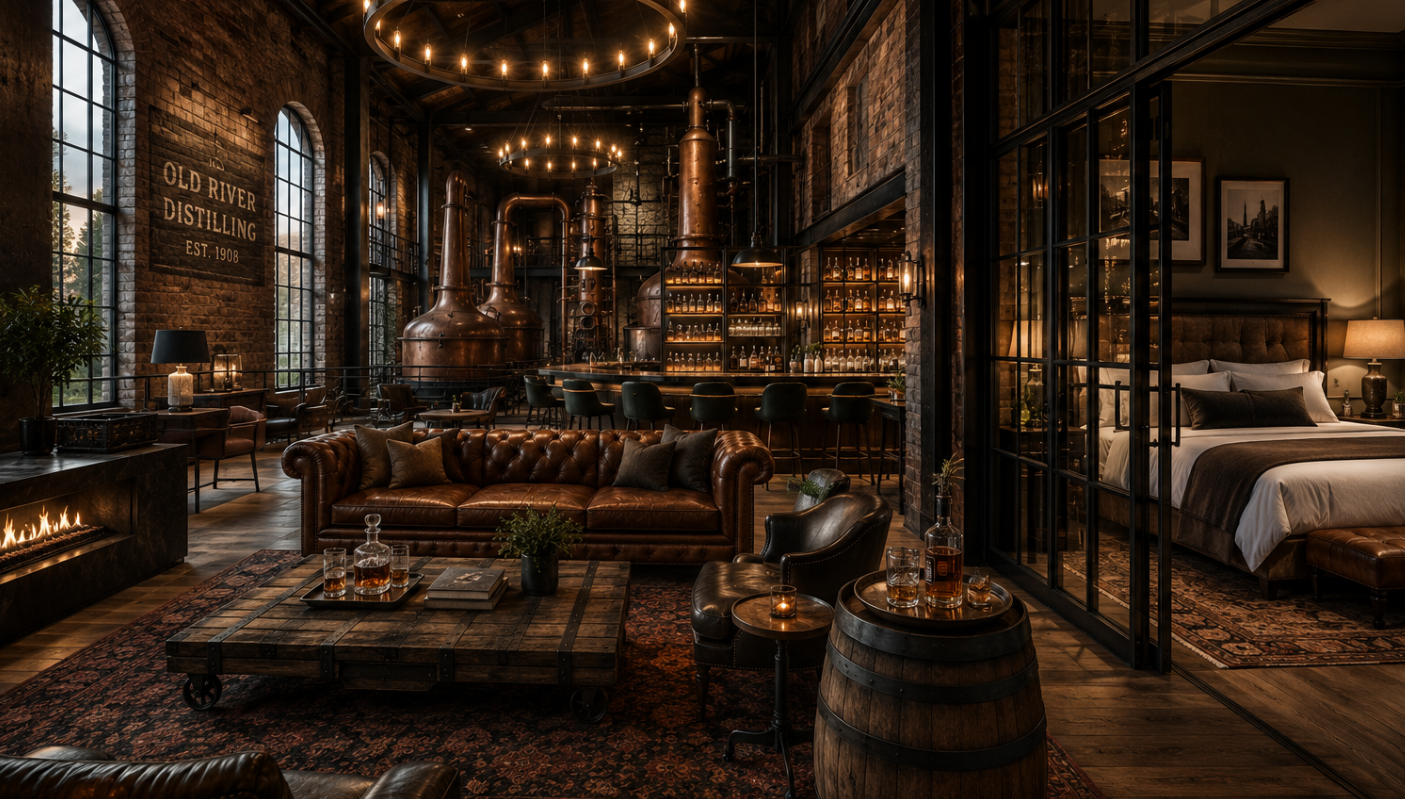
Beyond Accommodations: Designing Experiences Guests Remember
The hospitality industry has always been about serving people, but the definition of exceptional hospitality is changing. Comfortable accommodations, attentive service, and premium amenities remain essential, yet they have increasingly become baseline expectations rather than meaningful differentiators. Today's travelers have more options than ever before, and many are choosing destinations based not only on where they can stay, but on how a place makes them feel and what they'll remember after they return home.
This shift has given rise to experiential hospitality, an approach to hospitality that places the guest experience at the center of every business decision. Rather than viewing a hotel, resort, or vacation rental as simply a place to sleep, experiential hospitality asks a broader question: What experience should this property be known for, and how can every part of the business reinforce it?
The answer extends far beyond architecture or amenities. It influences concept development, interior design, guest programming, partnerships, service standards, operations, and even the way a property tells its story. Instead of optimizing these decisions independently, experiential hospitality brings them together under a single vision that shapes every stage of the guest journey.
As guest expectations continue to evolve, this philosophy has become one of the industry's most important competitive advantages. Boutique hotels, destination resorts, luxury vacation rentals, private clubs, and mixed-use hospitality developments are increasingly competing on identity rather than inventory. The properties guests remember are rarely those with the longest amenities list—they're the ones that create experiences that feel authentic, emotionally engaging, and connected to the places they're visiting.
Yet despite its growing popularity, experiential hospitality remains one of the industry's most misunderstood concepts. It is often reduced to a collection of trends—wellness retreats, glamping resorts, curated adventures, or luxury spas—when in reality those are only examples of what experiential hospitality can look like.
Experiential hospitality isn't a style of property. It's a methodology for developing one.
Understanding that distinction changes the conversation from "What experiences should we add?" to "What hospitality concept are we trying to create?" That shift forms the foundation of everything that follows.
What Is Experiential Hospitality?
Experiential hospitality is the intentional design, operation, and management of hospitality businesses around memorable guest experiences rather than accommodations alone. Instead of treating guestrooms, amenities, and services as separate offerings, experiential hospitality aligns the destination, property, design, programming, operations, and guest service around a unified hospitality concept. The goal is to create experiences that give guests a compelling reason to visit, remember, recommend, and return.
Unlike traditional hospitality, which often focuses on delivering excellent accommodations and consistent service, experiential hospitality asks a broader question: What experience should this property be known for, and how can every decision reinforce that identity?
This approach recognizes that memorable hospitality isn't created by adding more amenities. It is created by intentionally designing every stage of the guest journey to express a clear hospitality concept that feels authentic to the destination and meaningful to the people it serves.
What Is Experiential Travel?
Experiential travel is a style of travel that prioritizes meaningful experiences over simply visiting destinations. Rather than focusing only on accommodations or sightseeing, experiential travelers seek authentic connections with local culture, nature, food, wellness, adventure, education, and personal growth. The destination becomes more than a backdrop—it becomes part of the experience itself.
Examples of experiential travel include learning to cook with local chefs, exploring national parks with expert guides, wellness retreats, wine tours, cultural festivals, family adventure vacations, wildlife experiences, and immersive boutique hotel stays. While every traveler defines meaningful experiences differently, the common thread is that memories become more valuable than amenities alone.
As travelers increasingly seek experiences they cannot replicate at home, hospitality businesses have begun designing properties around those expectations rather than simply providing places to stay.
Experiential Hospitality vs. Experiential Travel
Although these terms are closely related, they describe two different aspects of the same movement. Experiential travel explains why people travel, while experiential hospitality explains how hospitality businesses respond to those evolving expectations.
Experiential travelers seek authentic, memorable, and meaningful experiences rather than simply visiting destinations. They value opportunities to immerse themselves in local culture, connect with nature, discover regional cuisine, pursue wellness, or create lasting memories with family and friends.
Experiential hospitality is the industry's response to those changing preferences. Hotels, resorts, boutique properties, luxury vacation rentals, and private clubs intentionally design every aspect of the guest journey—from concept development and architecture to programming, partnerships, operations, and service—to support a cohesive experience rather than simply provide accommodations.
Rather than viewing these ideas as competing concepts, they should be understood as complementary. Experiential travel creates the demand, while experiential hospitality is the industry's response.
Experiential Hospitality Is a Strategy, Not a Theme
One of the most common misconceptions is that experiential hospitality describes a particular category of hotel or resort. In reality, it describes a process for developing a hospitality concept.
The experience itself should never be chosen because it's fashionable or because another property has found success with it. Instead, it should emerge naturally from the unique characteristics of the business and the destination it serves.
At Roam, we believe the strongest hospitality concepts develop where four forces intersect:
- The destination: What experiences does this location naturally inspire or support?
- The property: What opportunities are created by its architecture, landscape, amenities, and physical setting?
- The market: Which guests remain underserved, and where is there an opportunity to create meaningful differentiation?
- The owner's vision: What emotional connection, memory, or transformation should guests leave with?
These forces shouldn't compete with one another. They should reinforce one another.
A mountain lodge surrounded by public lands may naturally center its experience around outdoor adventure, digital disconnection, and immersion in nature. A boutique hotel in wine country might build its identity around regional cuisine, local vineyards, and craftsmanship. A downtown hotel located steps from a major stadium could become the gathering place for sports fans through game-day programming, themed food and beverage offerings, and communal spaces designed for celebration. Likewise, a lakeside resort may focus on creating traditions for multi-generational families, while an urban lifestyle hotel might celebrate local artists, musicians, and neighborhood culture.
Each of these concepts is different, yet all can embody experiential hospitality because each grows organically from the relationship between place, property, market demand, and vision. The objective isn't to imitate another successful destination. It's to develop an experience that feels authentic to the environment and compelling to the guests it hopes to serve.
The Connection to the Experience Economy
The growth of experiential hospitality reflects a broader shift often described as the Experience Economy, in which consumers increasingly value memorable experiences alongside—or even above—products and services themselves. In hospitality, that evolution has fundamentally changed what guests associate with luxury.
Luxury is no longer defined exclusively by square footage, imported finishes, or concierge services. Those elements still matter, but they create value only when they support a larger experience that guests find personally meaningful.
Guests often remember the sunrise paddle organized by the resort more vividly than the suite they slept in. They remember learning from a local chef, gathering around a fire pit with extended family, or discovering a hidden trail recommended by the concierge. These moments become the stories they tell friends, the photos they share online, and the reasons they choose to return.
As a result, boutique hotels, destination resorts, luxury vacation rentals, wellness retreats, private clubs, and outdoor hospitality destinations are increasingly competing on the quality and authenticity of the experiences they create rather than the quantity of amenities they provide.
Why Experiential Travel Is Growing
Experiential travel is not simply another tourism trend. It's a reflection of changing traveler priorities. Today's guests increasingly want vacations that create lasting memories, deepen their connection to a destination, and give them stories worth sharing. Comfortable accommodations and exceptional service still matter, but many travelers now evaluate a trip by the experiences it provides rather than the room itself.
Industry research reflects this shift. Expedia's 2025 Traveler Value Index found that 88% of consumers plan to take a leisure trip within the next year, while 50% say travel is more important to them today than it was five years ago. Nearly 68% expect to book an international trip, a substantial increase from just a few years earlier, signaling that travel remains a major personal priority despite economic uncertainty.
Travelers Are Redefining Luxury
Luxury has evolved beyond marble lobbies, oversized suites, and premium amenities. Increasingly, travelers define luxury by access to experiences they cannot easily recreate at home.
Whether it's learning regional recipes from a local chef, hiking with an experienced naturalist, enjoying a private wine tasting, or participating in wellness retreats designed around a destination, experiences have become an important part of how travelers measure value. Boutique hotels, destination resorts, and luxury vacation rentals are increasingly competing on the quality of the memories they help create rather than simply the quality of their accommodations.
Travelers Want More Meaningful Connections
Another significant shift is that travelers increasingly want authentic connections with the places they visit. Booking.com's latest global travel research found that 69% of travelers want to leave destinations better than they found them, while 53% actively consider how their travel impacts local communities. Rather than simply seeing a destination, many travelers want to participate in it through local culture, food, outdoor recreation, conservation, and community experiences.
This growing interest in authenticity has encouraged hospitality businesses to build stronger relationships with local guides, artisans, restaurants, wineries, outdoor outfitters, and cultural organizations. These partnerships help transform a stay into something guests remember long after checkout.
Social Media Has Changed How Travelers Choose Destinations
Social media has fundamentally changed how people discover places to visit. Instead of relying solely on travel brochures or destination guides, travelers increasingly plan trips around experiences they've seen shared by others.
According to Expedia, 61% of travelers now use social media for travel inspiration, up significantly from just a few years ago, while 73% say influencer recommendations have influenced a booking decision. Experiences naturally generate compelling stories, photos, and videos, making them more likely to be shared than accommodations alone.
For hospitality businesses, memorable guest experiences have become one of the most effective forms of marketing because guests willingly become storytellers.
AI Is Accelerating Experience-Based Travel
According to Forbes, Artificial intelligence is also changing how people discover hotels and destinations. Instead of searching only for a city or hotel name, travelers are increasingly describing the experience they hope to have.
Searches are becoming more conversational:
- Boutique hotel with a wellness spa near hiking trails
- Family resort with outdoor adventures
- Romantic wine country getaway
- Luxury mountain lodge with guided excursions
Industry analysts increasingly recognize AI as one of the most significant forces reshaping travel discovery. As conversational search becomes more common, hospitality businesses with clearly defined identities and distinctive guest experiences are likely to stand out more than properties competing primarily on amenities alone.
Experiential Hospitality Is the Industry's Response
As experiential travel continues to grow, the hospitality industry has evolved alongside it. Hotels, resorts, boutique properties, luxury vacation rentals, and private clubs are increasingly designing every aspect of the guest journey around a clearly defined experience rather than treating accommodations as the final product.
This shift is what we refer to as experiential hospitality. While experiential travel describes why people travel, experiential hospitality describes how hospitality businesses intentionally create those memorable experiences. Rather than simply adding activities or amenities, experiential hospitality aligns design, operations, programming, partnerships, and service around a single hospitality concept that gives guests a compelling reason to visit, remember, and return.
Why Experiential Hospitality Is Transforming the Hospitality Industry
Several long-term trends have converged to make experiential hospitality one of the defining movements in modern lodging.
Travelers are seeking deeper connections with the places they visit, placing greater value on authenticity, personalization, wellness, cultural immersion, outdoor recreation, and opportunities to reconnect with family and friends. At the same time, digital discovery has changed how guests evaluate destinations. AI-powered travel recommendations, social media, and personalized search increasingly surface properties with distinctive identities and memorable experiences instead of simply those offering the largest rooms or the most amenities.
For hospitality operators, this represents a fundamental shift in how competitive advantage is created. Exceptional service, beautiful accommodations, and thoughtful amenities remain essential, but they have become the foundation rather than the finish line. Increasingly, what distinguishes one property from another is the clarity of its concept and the consistency with which that concept is expressed throughout the guest journey.
Experiential hospitality becomes valuable not because it adds experiences, but because it gives every business decision a shared purpose.
Experiential Hospitality vs. Traditional Hospitality
Traditional hospitality was built around delivering reliable accommodations and consistent service. Experiential hospitality retains those principles while expanding the objective. Rather than asking only how to deliver exceptional hospitality, it asks how hospitality can consistently express a property's unique identity and create experiences guests cannot find elsewhere.
| Traditional Hospitality | Experiential Hospitality |
|---|---|
| Focuses on accommodations | Focuses on memorable guest experiences |
| Prioritizes operational consistency | Aligns operations around a distinct hospitality concept |
| Adds amenities to increase value | Selects amenities that reinforce the property's identity |
| Measures guest satisfaction | Measures satisfaction, emotional connection, and lasting memories |
| Competes on features and facilities | Competes on differentiation, authenticity, and experience |
Experiential hospitality doesn't replace traditional hospitality; it builds upon it. Operational excellence remains essential because memorable experiences cannot exist without consistent execution. The difference is that every operational decision now serves a larger purpose: reinforcing a hospitality concept that is authentic to the destination, meaningful to the guest, and commercially sustainable for the business.
That realization leads to an important question.
If experiential hospitality is fundamentally about developing the right hospitality concept, how do successful operators create one in the first place?
What Makes Experiential Hospitality Successful?
If experiential hospitality is becoming one of the industry's defining competitive advantages, an important question naturally follows:
What separates the properties guests never forget from those that provide an enjoyable stay?
The answer isn't found in a single amenity, a larger renovation budget, or the latest hospitality trend. Instead, successful experiential hospitality comes from developing a clear hospitality concept and ensuring every decision supports that vision.
Many properties invest heavily in premium experiences. They renovate guestrooms, expand wellness offerings, partner with local guides, improve food-and-beverage programs, or add entertainment spaces. Individually, these investments may improve the guest experience.
Collectively, however, they only create experiential hospitality when they work together.
What Makes an Experience Memorable?
Not every activity becomes a lasting memory. Guests rarely remember a property simply because it offered more amenities than its competitors. Instead, they remember experiences that made them feel something.
The most memorable hospitality experiences often share several characteristics:
- Novelty – Guests encounter something unexpected or different from everyday life.
- Participation – Rather than observing, guests actively engage with the experience.
- Emotional Connection – Experiences create joy, wonder, nostalgia, relaxation, excitement, or personal accomplishment.
- Sense of Place – The experience feels authentic to the destination rather than interchangeable with another location.
- Storytelling – Guests leave with stories they naturally want to share with friends and family.
Whether it's preparing a meal with a local chef, watching the sunrise from a mountain summit, gathering around a fire pit with multiple generations of family, or discovering a hidden winery recommended by the concierge, memorable experiences combine these elements in ways that feel both authentic and personal.
Experiential hospitality isn't about offering more activities. It's about intentionally creating moments that guests remember long after checkout.
The Difference Between Features and a Hospitality Concept
Guests rarely remember a property because it had one exceptional feature. They remember how the entire experience made them feel. That difference may seem subtle, but it changes the way hospitality businesses approach planning.
Instead of asking:
- What amenities should we add?
- What experiences are trending?
- What are our competitors offering?
Successful operators ask a different set of questions:
- What should guests remember after they leave?
- What experience is this property uniquely positioned to deliver?
- How should every decision reinforce that experience?
Those questions shift the focus from adding experiences to designing a cohesive hospitality concept.
Why Alignment Matters
Hospitality businesses make hundreds of decisions before a guest ever arrives.
Those decisions include:
- Architectural design
- Interior design and furnishings
- Food and beverage programming
- Guest activities
- Wellness offerings
- Local partnerships
- Technology
- Staffing and training
- Brand messaging
- Service standards
When each department makes decisions independently, the guest experience often becomes inconsistent. Every element may be well executed, yet the property lacks a clear identity.
By contrast, successful experiential hospitality aligns every one of those decisions around a shared concept. Rather than operating as separate initiatives, they become different expressions of the same idea.
Experiences alone don't create experiential hospitality. Alignment does.
From Amenities to Identity
Consider two boutique hotels located in similar mountain destinations.
Both properties offer:
- Beautiful guestrooms
- A full-service spa
- Guided hikes
- Excellent dining
- Outdoor gathering spaces
- Strong online reviews
At first glance, they appear nearly identical. Yet one develops a loyal following, earns repeat guests, and becomes known as a destination in its own right, while the other remains simply another well-designed hotel.
The difference isn't the amenities. It's the identity.
The first property began with a clear concept: Help guests disconnect from everyday routines and reconnect with nature.
That single idea influences every decision the business makes. Instead of selecting amenities individually, leadership asks whether each investment strengthens the property's identity.
For example:
| Decision | Amenity-Driven Approach | Concept-Driven Approach |
|---|---|---|
| Guestrooms | Focus on luxury finishes | Create spaces that encourage rest, quiet, and connection to nature |
| Programming | Offer many activities | Curate experiences that reinforce outdoor immersion |
| Dining | Build an upscale restaurant | Celebrate regional ingredients and local culture |
| Partnerships | Add popular excursions | Work with guides and organizations that strengthen the property's story |
| Service | Deliver excellent hospitality | Deliver hospitality that reflects the property's purpose |
The amenities themselves may not differ dramatically. Their purpose does. That distinction is what guests remember.
Every Destination Has a Different Story to Tell
One of the biggest misconceptions about experiential hospitality is that every property should pursue the same type of experience.
The opposite is true.
Successful hospitality concepts emerge from the unique strengths of the destination, the property itself, and the guests it hopes to serve.
A few examples illustrate how different that can look.
Each begins with a sense of place.
Amenities, programming, operations, and design are simply tools used to express that concept more effectively.
The Hospitality Concept Alignment Framework
Many hospitality businesses recognize the growing importance of memorable guest experiences, yet relatively few have a structured process for creating them. Too often, concepts develop organically through isolated design decisions, new amenities, or changing market trends instead of following a clear strategic vision.
At Roam Hospitality, we developed the Hospitality Concept Alignment Framework™ to provide that structure. Rather than beginning with amenities or programming, the framework starts by identifying what makes a destination, property, market opportunity, and guest identity uniquely suited to a particular hospitality concept. Every decision that follows, from design and partnerships to operations and guest experience, is intentionally aligned around that concept.
The result is a hospitality business where every interaction reinforces the same identity, creating experiences that feel cohesive, authentic, and memorable from beginning to end.
The process follows a logical progression:
- Clarify the owner's vision. What should the property ultimately become?
- Evaluate the destination and property. What strengths naturally exist?
- Validate the market opportunity. Where can the property meaningfully differentiate?
- Define the ideal guest. Who is the experience designed for?
- Develop the hospitality concept. What identity brings these elements together?
- Create the experience narrative. How should guests experience that concept throughout their journey?
- Align design, programming, and operations. How does every decision reinforce the concept?
- Measure, refine, and evolve. How does the experience continue improving over time?
The framework can be visualized as a progression.
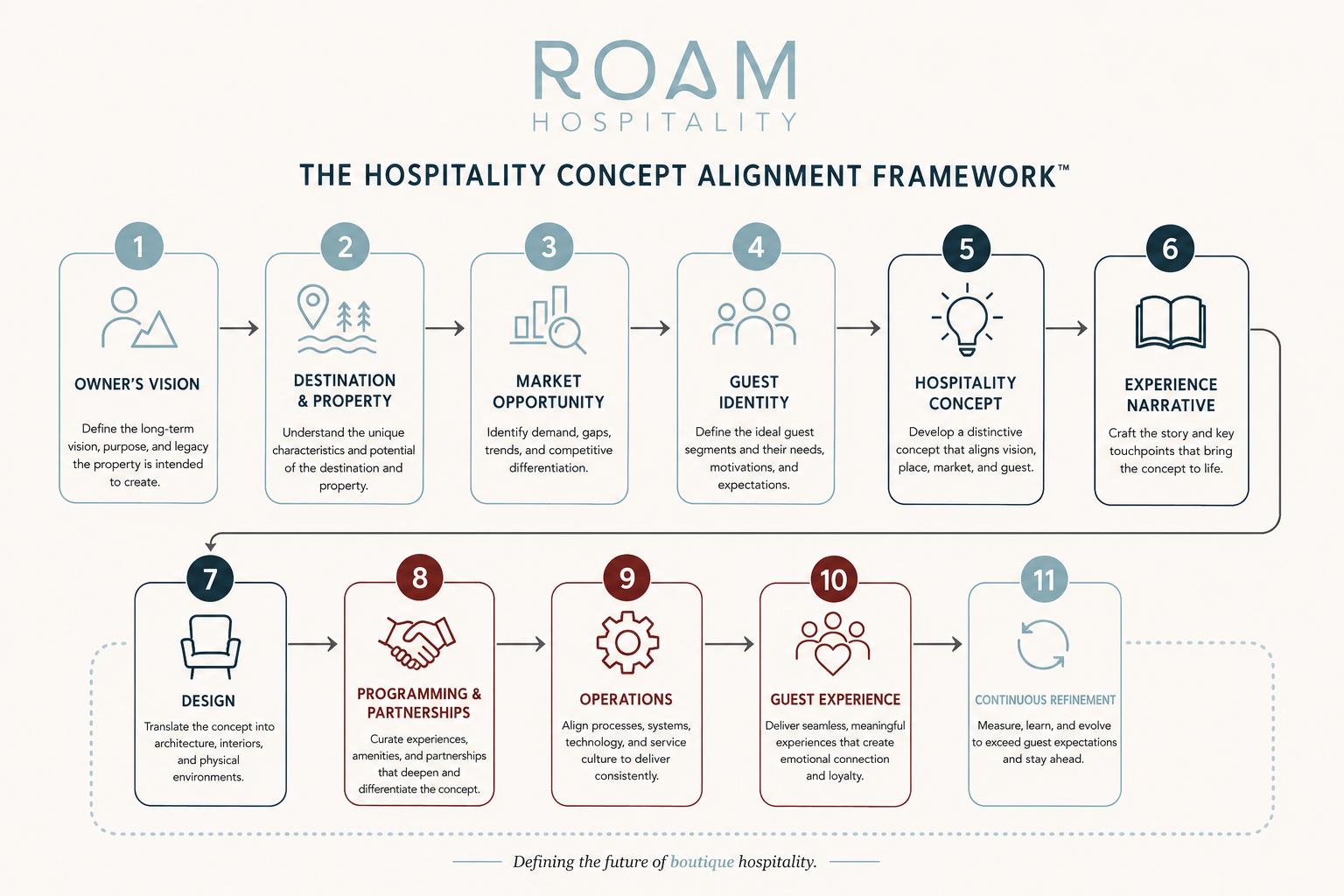
Many hospitality businesses work in the opposite direction. They begin by adding amenities, expanding activity calendars, or following industry trends, then attempt to build a brand identity afterward.
The strongest experiential hospitality concepts reverse that sequence.
They begin with a clearly defined concept and allow every subsequent decision to reinforce it. By the time guests arrive, the experience doesn't feel assembled from individual features—it feels intentional from beginning to end.
In the next section, we'll explore each stage of the Hospitality Concept Alignment Framework™ and show how hospitality leaders can transform an initial vision into a destination guests remember long after checkout.
Applying the Hospitality Concept Alignment Framework™
The Hospitality Concept Alignment Framework™ is more than a planning tool — it's a strategic decision-making process. Each stage builds on the one before it, ensuring that concept development isn't driven by assumptions, trends, or isolated ideas, but by a cohesive strategy rooted in place, purpose, and guest expectations.
Although every hospitality project is unique, the framework follows the same progression.
- Define the owner's vision.
- Evaluate the destination and property.
- Validate the market opportunity.
- Define the ideal guest.
- Develop the hospitality concept.
- Build the experience narrative.
- Translate the concept into design.
- Develop programming and partnerships.
- Align operations.
- Deliver the guest experience.
- Continuously refine the concept.
The order is intentional.
Too often, hospitality projects begin with discussions about amenities, renovations, or branding before anyone has clearly defined what the property should become. The Hospitality Concept Alignment Framework™ reverses that sequence, allowing every operational and design decision to support a clearly defined concept rather than forcing the concept to emerge after the fact.
Two Paths to Hospitality Concept Development
While every hospitality project follows the same framework, not every project begins at the same place.
Some owners already have a hotel, resort, or hospitality property they want to reposition. Others are still searching for the right investment opportunity.
That distinction has a significant impact on concept development.
Adaptive Concept Development
Most hospitality owners begin with an existing asset. The location has already been selected. The building already exists.
Guestrooms, public spaces, infrastructure, and many operational realities are fixed.
The objective isn't to create the perfect hospitality concept from scratch. Instead, it's to discover the strongest concept the property can authentically support.
That means working within existing opportunities and constraints.
Examples include:
- Repositioning an independent hotel into a boutique lifestyle property.
- Transforming a dated roadside inn into an outdoor adventure basecamp.
- Refreshing an existing resort around wellness, culinary travel, or family experiences.
- Modernizing operations while preserving a property's historic character.
This approach requires creativity because the framework begins with an existing asset rather than a blank slate. The property's architecture, location, and physical characteristics become inputs that shape the final concept.
Strategic Concept Development
The second path begins before a property is ever purchased.
Rather than adapting a concept to an existing hotel, investors define the concept first and then identify properties capable of supporting that vision.
This creates considerably more flexibility throughout the development process.
Working alongside Hotel Turnkey, investors can evaluate acquisition opportunities through the lens of the Hospitality Concept Alignment Framework™ before investing. Instead of asking,
"How can we reposition this hotel?"
They begin with a more strategic question:
"Which property naturally supports the hospitality concept we want to build?"
That shift affects nearly every acquisition decision.
Instead of focusing exclusively on financial performance or physical condition, investors can evaluate whether a property possesses the characteristics necessary to deliver the intended guest experience over the long term.
Those considerations often include:
- Destination appeal and tourism demand
- Accessibility and transportation
- Architectural style and building character
- Room mix and operational flexibility
- Existing amenities
- Expansion opportunities
- Nearby attractions and complementary businesses
- Competitive positioning within the market
Selecting a property that already aligns with the long-term vision reduces friction throughout concept development because fewer compromises are required later.
Why This Distinction Matters
Both approaches can produce exceptional hospitality businesses. The difference lies in how much influence the owner has over the alignment process.
| Adaptive Concept Development | Strategic Concept Development |
|---|---|
| Begins with an existing hotel | Begins with the desired hospitality concept |
| Works within existing constraints | Selects properties that naturally support the concept |
| Greater emphasis on repositioning | Greater emphasis on strategic alignment |
| Design adapts to the building | Building selection supports the design vision |
| Operational improvements drive differentiation | Acquisition strategy and concept evolve together |
Neither approach is inherently better. In fact, many of Roam Hospitality's most successful projects involve repositioning existing boutique hotels into stronger experiential hospitality concepts.
However, when concept development begins before acquisition, owners gain significantly more control over the variables that influence long-term success.
Rather than adapting to the property, they have the opportunity to choose a property that already aligns with the experience they hope to create.
Stage 1: Define the Owner's Vision
Whether a project begins with an existing hotel or a future acquisition, every successful hospitality concept starts with the same question:
What should this property become?
The owner's vision establishes the long-term direction for every decision that follows. It defines not only business objectives but also the emotional impact the property should have on guests and the reputation it hopes to build within its market.
At this stage, owners should explore questions such as:
- What type of hospitality experience do we want to create?
- What should guests remember after they leave?
- What values should define the brand?
- How should the property be perceived within five or ten years?
- What business outcomes must the concept support?
A clearly articulated vision becomes the filter through which every future decision is evaluated.
Stage 2: Evaluate the Destination and Property
Hospitality concepts don't exist in isolation.
They emerge from the relationship between the destination, the physical property, and the people who choose to visit.
This stage examines what the location naturally offers rather than attempting to force a concept that feels disconnected from its surroundings.
Areas to evaluate include:
- Natural landscapes and scenery
- Local culture and history
- Tourism demand generators
- Seasonality
- Accessibility
- Existing architecture
- Opportunities for partnerships
- Competitive environment
Rather than asking how to make the property resemble another successful hotel, this stage focuses on uncovering what makes the destination inherently valuable.
That understanding becomes the foundation for identifying a hospitality concept guests will perceive as authentic rather than manufactured.
Stage 3: Validate the Market Opportunity
Not every compelling idea represents a viable business opportunity.
Before investing in design, branding, or programming, it's essential to confirm that sufficient demand exists for the proposed concept and that it occupies a meaningful position within the competitive landscape.
Market validation combines hospitality analytics with strategic positioning to answer questions such as:
- Who is currently visiting the destination?
- Which traveler segments remain underserved?
- What concepts already dominate the market?
- Where can meaningful differentiation be created?
- How can the property generate revenue beyond guestrooms?
The objective isn't simply to compete. It's to compete with a concept that deserves to exist.
Stage 4: Define the Guest Identity
Only after understanding the destination and the market should attention turn to the guest. Exceptional hospitality isn't built for everyone. It's built for someone.
Guest identity extends far beyond age, income, or travel purpose. It includes motivations, aspirations, expectations, frustrations, and the kinds of experiences people hope to have during their stay.
Understanding those motivations allows operators to make better decisions across every department, from design and marketing to programming and service standards.
The next stage brings these elements together by transforming vision, place, market opportunity, and guest identity into a single hospitality concept capable of guiding every decision that follows.
Stage 5: Develop the Hospitality Concept
By the time this stage begins, the most important strategic questions have already been answered.
The owner's vision has been defined. The destination has been evaluated. Market demand has been validated, and the ideal guest has been clearly identified.
The hospitality concept is where those independent insights become one cohesive strategy.
A hospitality concept is far more than a brand name or design style. It is the central idea that explains what the property stands for, why it exists, and why guests should choose it over competing accommodations. More importantly, it becomes the standard against which every future decision is measured.
An effective hospitality concept should clearly define:
- The property's unique identity
- The emotional outcome guests should experience
- The market position the property intends to own
- The promise that every guest interaction should reinforce
- The long-term direction for future growth
When a concept is well defined, decision-making becomes significantly easier. Instead of debating whether a new amenity is attractive or whether a marketing campaign feels creative, leadership can ask a much simpler question:
Stage 6: Build the Experience Narrative
Once the concept has been established, it needs to become something guests can experience.
This is where strategy becomes storytelling.
The experience narrative defines how guests encounter the concept throughout their stay. Rather than thinking about isolated touchpoints, operators design a journey in which every interaction reinforces the property's identity.
That journey often includes:
- The first impression created by the website and photography
- Reservation and pre-arrival communication
- Arrival and check-in
- Guestroom design
- Public spaces
- Food and beverage experiences
- Programming and activities
- Staff interactions
- Departure and post-stay follow-up
Viewed individually, each touchpoint seems relatively small. Together, they create the emotional rhythm of the guest experience.
For example, a hotel built around outdoor adventure shouldn't communicate that identity only through guided hikes. Guests should begin feeling that experience while browsing the website, continue experiencing it during check-in, see it reflected in the guestrooms and communal spaces, and remember it long after returning home.
The narrative gives every interaction context.
Stage 7: Design the Property Around the Concept
Design is often where hospitality concepts become visible.
Architecture, interiors, landscaping, lighting, signage, furniture, and public spaces all communicate what a property represents before staff members say a single word. Too often, design decisions are driven primarily by aesthetics.
Experiential hospitality asks a different question: What should this environment help guests feel?
That shift changes the role of design from decoration to communication. When evaluating design decisions, consider whether they support the larger hospitality concept.
For example:
- Does the arrival experience create the intended first impression?
- Do guestrooms reinforce the property's personality?
- Are public spaces designed for the types of interactions the concept encourages?
- Do materials, colors, and furnishings reflect the destination?
- Does the physical environment support the guest journey rather than interrupt it?
Great design doesn't simply photograph well. It advances the story that the property is trying to tell.
Stage 8: Design, Programming, and Partnerships
Experiences should never feel like separate attractions operating alongside the hotel.
They should feel like natural extensions of the property's identity.
Programming transforms the hospitality concept into something guests actively participate in. Partnerships deepen that experience by connecting guests with the destination itself.
Examples include:
Rather than asking which activities are popular, operators should ask which experiences naturally reinforce the property's concept.
Programming becomes stronger when it feels inevitable rather than added.
Stage 9: Align Operations
Guests experience operations even when they don't notice them.
Reservation systems, housekeeping, maintenance, staffing, technology, food service, and communication all influence whether the intended experience feels seamless or inconsistent. This is often where hospitality concepts either succeed or begin to unravel.
Operational alignment means every department understands the concept and contributes to delivering it consistently.
That includes:
- Hiring people who fit the property's culture
- Training staff around the guest experience rather than individual tasks
- Creating service standards that reinforce the brand
- Using technology to simplify—not complicate—the guest journey
- Measuring operational performance against guest outcomes, not just efficiency
Operations shouldn't exist separately from the concept. They should make the concept reliable.
Stage 10: Deliver the Guest Experience
Guests don't experience departments. They experience one property.
That perspective is important because guests never separate marketing from operations, design from service, or programming from housekeeping. Every interaction contributes to one overall impression.
Successful experiential hospitality creates consistency across the entire journey.
When guests describe the stay afterward, they rarely mention every individual detail. Instead, they describe how the property made them feel.
That's the ultimate measure of concept alignment.
When every department reinforces the same identity, the guest leaves with one clear memory rather than a collection of unrelated experiences.
Stage 11: Continuously Refine the Experience
No hospitality concept is ever truly finished. Guest expectations evolve. Travel patterns change. Markets become more competitive. Technology reshapes how guests discover, book, and experience destinations.
The strongest hospitality brands treat concept development as an ongoing process rather than a one-time project.
Continuous refinement should include regular evaluation of:
- Guest feedback and reviews
- Staff observations
- Operational performance
- Market trends
- Competitive positioning
- New partnership opportunities
- Emerging guest expectations
Rather than reinventing the concept, successful operators continually strengthen it. Small improvements, made consistently, often produce more lasting results than dramatic overhauls every few years.
Great Hospitality Is Never an Accident
Experiential hospitality is often described as creating memorable experiences. In reality, memorable experiences are the outcome — not the starting point.
They emerge when an owner's vision, a destination, a property's unique strengths, market demand, and guest expectations are intentionally aligned through a cohesive hospitality concept. Design, programming, operations, and service then bring that concept to life, creating experiences that feel authentic rather than manufactured.
The Hospitality Concept Alignment Framework™ is built on a simple belief: exceptional hospitality isn't created by adding more amenities. It's created by making every decision support the same idea.
When that happens, guests don't simply remember the room they stayed in. They remember the place. And that's what transforms a hotel into a destination.
Where Roam Hospitality Fits Into Experiential Hospitality
Experiential hospitality is more than an emerging philosophy—it is the foundation of how we approach every property we manage, reposition, and develop.
At Roam Hospitality, we believe memorable guest experiences don't happen by accident. They are intentionally created through thoughtful concept development, operational excellence, revenue strategy, and a deep understanding of what makes both a destination and a property unique.
Whether we're helping an owner reposition an existing boutique hotel or working alongside investors before an acquisition, our goal is the same: create hospitality businesses with a clear identity that guests remember and that owners can grow for years to come.
Our work brings together every discipline required to execute a successful hospitality concept, including:
- Boutique Hotel Management
- Boutique Hotel Revenue Management
- Boutique Hotel Operations Management
- Boutique Hotel Asset Management
- Hotel Food & Beverage Services
- Membership Club Concept Development & Management
Rather than treating these as independent services, we view them as interconnected parts of the same system. Revenue management should reinforce the hospitality concept. Operations should support the guest experience. Food and beverage should strengthen the property's identity. Asset management should protect and increase long-term value while remaining aligned with the owner's vision.
That holistic approach is what inspired the Hospitality Concept Alignment Framework™ discussed throughout this guide. While every destination is different, the underlying principle remains the same: when a property's vision, location, guest expectations, operations, and business strategy work together, memorable hospitality becomes far easier to create.
As experiential travel continues to reshape the hospitality industry, we believe the most successful hotels, resorts, and hospitality destinations will be those that compete on identity rather than inventory. Our role is to help owners build those distinctive hospitality businesses through strategic planning, operational expertise, and concept-driven management that transforms great properties into memorable destinations.
Frequently Asked Questions
What is experiential hospitality?
Experiential hospitality is the intentional design and operation of hotels, resorts, boutique properties, vacation rentals, and hospitality businesses around memorable guest experiences rather than accommodations alone. Instead of viewing guestrooms, amenities, and services as separate offerings, experiential hospitality aligns every aspect of the guest journey around a unified hospitality concept.
The goal is to create authentic experiences that give guests a compelling reason to visit, remember, recommend, and return.
What is experiential travel?
Experiential travel is a style of travel that prioritizes meaningful experiences over simply visiting destinations. Travelers seek authentic connections with local culture, food, nature, wellness, history, adventure, and community rather than only sightseeing or luxury accommodations.
While every traveler defines meaningful experiences differently, experiential travel focuses on creating memories that remain long after the trip has ended.
What is the difference between experiential hospitality and experiential travel?
Although they're closely related, they describe different concepts. Experiential travel explains why people travel—they seek authentic, memorable experiences.
Experiential hospitality explains how hospitality businesses respond by intentionally designing hotels, resorts, and other properties around those expectations. Put simply, experiential travel creates the demand, while experiential hospitality is the industry's response.
What is the Experience Economy?
The Experience Economy describes a shift in consumer behavior where memorable experiences become as valuable as — or more valuable than — products and services themselves. In hospitality, this means guests increasingly evaluate destinations based on the experiences they provide rather than accommodations alone. Boutique hotels, resorts, and experiential destinations compete by creating memorable guest journeys that guests naturally share with others.
Why is experiential travel becoming more popular?
Several long-term trends have contributed to the growth of experiential travel, including changing definitions of luxury, increased interest in wellness and authenticity, social media, AI-powered travel discovery, and a growing desire for meaningful experiences.
Today's travelers often prioritize creating stories and memories over simply visiting destinations, encouraging hospitality businesses to rethink how they design guest experiences.
What makes a hospitality experience memorable?
The most memorable hospitality experiences typically combine several characteristics, including novelty, participation, emotional connection, authenticity, and a strong sense of place. Rather than simply providing activities, successful hospitality businesses create experiences that reflect the destination, encourage guest participation, and leave visitors with stories they naturally want to share.
What is a hospitality concept?
A hospitality concept is the central idea that defines what a hotel, resort, or hospitality business represents and why guests should choose it over competing properties. It guides decisions involving design, programming, partnerships, operations, branding, and guest experience. Rather than being limited to aesthetics or amenities, a hospitality concept provides the strategic direction that shapes every aspect of the property.
How do you develop a hospitality concept?
Successful hospitality concepts begin by understanding the owner's vision, the destination, the property's strengths, market demand, and the ideal guest. These elements are then combined into a unified strategy that influences design, operations, programming, partnerships, and guest experience. The objective is to create a concept that feels authentic to the destination while differentiating the property within its market.
What is the Hospitality Concept Alignment Framework™?
The Hospitality Concept Alignment Framework™ is Roam Hospitality's strategic methodology for developing experiential hospitality concepts. Rather than beginning with amenities or trends, the framework starts by aligning the owner's vision, destination, property, market opportunity, and guest identity before translating those insights into design, programming, operations, and guest experience. This structured approach helps create cohesive hospitality businesses that guests remember.
How do boutique hotels use experiential hospitality?
Boutique hotels often use experiential hospitality by creating highly differentiated guest experiences rooted in their location, culture, architecture, or story. Rather than appealing to every traveler, successful boutique hotels develop a clear identity that influences everything from interior design and food and beverage offerings to local partnerships, guest programming, and service philosophy.
More Recent Articles