Boutique Hotel Asset Management Framework
Boutique Hotel Asset Management Framework
NOI Optimization, Capital Strategy & Ownership Performance
By Elliott Caldwell —
Executive Overview: Asset Performance Infrastructure
Boutique hotel asset management governs the financial performance and long-term value of a hospitality investment. While hotel operators focus on daily execution and service delivery, asset managers represent ownership interests and ensure that operational decisions support the financial objectives of investors.
In modern hospitality structures, ownership, brand, and operations are often separated through management agreements and franchise arrangements. These agreements connect hotel operators with investors who own the real estate, creating a structure in which operational execution and ownership performance must be aligned through oversight and governance.
Asset management emerged to bridge that gap. It provides the strategic layer that connects operational activity with financial outcomes.
In practical terms, boutique hotel asset management integrates three critical disciplines:
- operational oversight
- Revenue performance monitoring
- capital planning and financial governance
This oversight becomes especially important in boutique properties. Smaller inventories and leaner operating structures mean that individual pricing, distribution, or operational decisions can materially influence financial performance.
When asset management is structured effectively, it transforms day-to-day hotel activity into predictable investment performance.
What Is Boutique Hotel Asset Management?
Boutique hotel asset management is the structured oversight of a hospitality investment designed to maximize long-term financial performance and asset value. The discipline focuses on ensuring that operational decisions, revenue strategy, and capital investments align with the financial objectives of ownership.
In the hospitality industry, asset managers effectively serve as the strategic representative of the owner. Their responsibility is to manage the lodging investment so that it achieves specific financial objectives while preserving or enhancing long-term property value.
Unlike hotel management, which focuses on running the property day to day, asset management focuses on protecting the value of the real estate asset itself. Asset managers evaluate financial performance, guide strategic decisions, and ensure that the operator’s actions remain aligned with the investment strategy.
The discipline emerged alongside the increasing separation of hotel ownership and hotel operations. As management contracts and franchise agreements became more common, investors required an independent layer of oversight to ensure that operational decisions supported long-term investment performance.
In boutique hotels, especially, where design, guest experience, and positioning directly influence pricing power, asset management ensures that operational execution translates into sustained profitability and stable asset value.
Why Asset Management Matters in Boutique Hotels
Boutique hotels operate within a unique financial environment. Their differentiated design, experiential positioning, and smaller inventory sizes create opportunities for strong pricing power, but they also increase sensitivity to operational and market fluctuations.
Without structured asset oversight, boutique hotels may experience:
- revenue volatility caused by inconsistent pricing discipline
- margin erosion from high-commission distribution channels
- delayed capital improvements that weaken market positioning
- operational decisions that prioritize occupancy rather than profitability
Asset management addresses these risks by aligning operational performance with financial objectives. The asset manager effectively becomes the “voice of the owner,” ensuring that the property’s management team executes a strategy consistent with long-term investment goals.
In institutional hospitality environments, this oversight transforms a hotel from a lifestyle business into a managed investment asset.
The Three-Layer Boutique Hotel Asset Management Model
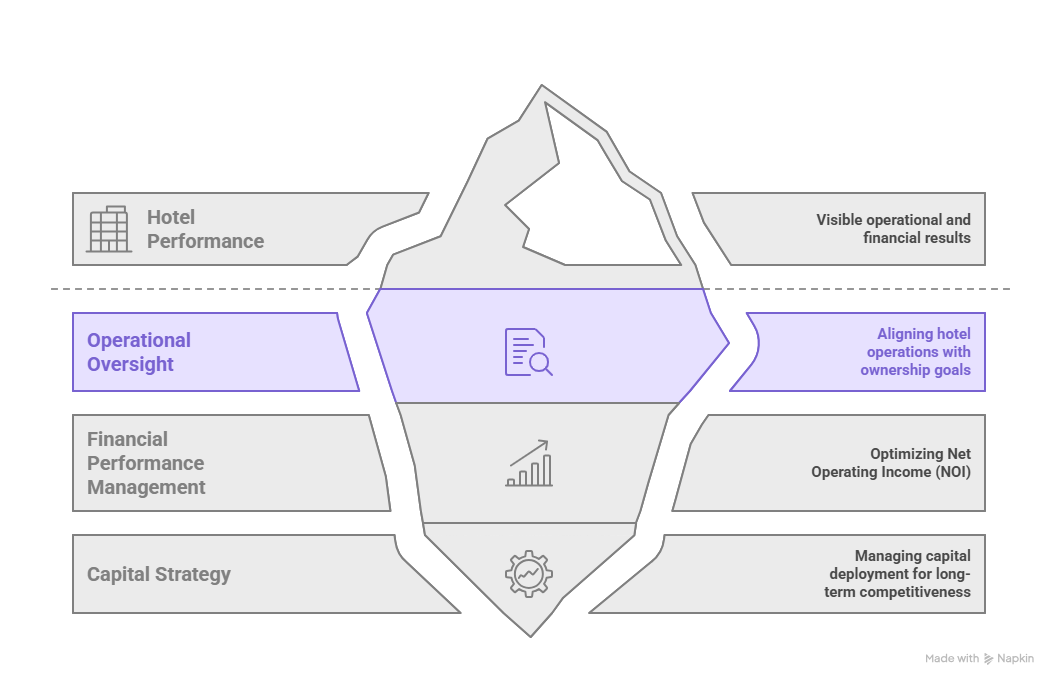
Just as boutique hotel operations and revenue performance depend on structured execution frameworks, asset management operates through layered oversight.
The asset management model typically includes three interconnected layers:
- Operational oversight, which ensures the operator’s decisions support ownership objectives
- Financial performance management, which translates operational activity into measurable profitability
- Capital strategy and asset lifecycle management, which preserves long-term competitive positioning
These layers operate together to ensure that daily hotel performance and financial governance support long-term investment value and asset management objectives.
1. Operational Oversight: Aligning Hotel Operations with Ownership Goals
Asset managers do not replace hotel operators. Instead, they provide strategic oversight to ensure that operational decisions align with the financial goals of ownership.
This oversight typically focuses on areas such as:
- revenue performance monitoring
- labor cost discipline
- operational efficiency benchmarking
- service quality consistency
- vendor and expense oversight
Asset managers review performance reports, financial statements, and market benchmarks to identify opportunities for improvement. By maintaining a strategic view of operations, they help operators adjust strategy when performance deviates from ownership expectations.
This relationship reflects the fundamental structure of the hospitality industry, where hotel operations are often conducted by a management company while the real estate asset is owned by investors.
Operational oversight ensures that the operator’s priorities remain aligned with the financial objectives of the property’s owners.
2. Financial Performance Management: NOI Optimization
While hotel operators often focus on occupancy, service quality, and guest experience, asset managers evaluate performance primarily through financial outcomes.
Key financial indicators monitored in boutique hotels include:
- Net Operating Income (NOI)
- Gross Operating Profit (GOP)
- GOPPAR
- RevPAR
- EBITDA
These metrics translate operational performance into measurable investment results.
At its core, asset management is responsible for ensuring that the owner’s investment goals are achieved through a combination of cash-flow generation and long-term value appreciation.
For boutique properties, this means balancing revenue growth with margin discipline. Strong ADR performance may indicate effective positioning, but asset managers evaluate whether that revenue translates into sustainable profit after labor costs, distribution expenses, and operating overhead are considered.
NOI stability ultimately determines the financial strength of the asset.
3. Capital Strategy & Asset Lifecycle Management
Asset management extends beyond monitoring financial performance. It also governs how and when capital is deployed to protect the long-term competitiveness of the property. In boutique hotels especially, capital planning plays a central role because design, guest experience, and physical condition directly influence pricing power.
Capital strategy generally focuses on several core planning areas:
- FF&E reserve planning
- renovation and repositioning cycles
- design modernization and guest experience upgrades
- infrastructure and systems improvements
- long-term asset lifecycle forecasting
However, capital investment decisions are rarely made in isolation. They must be evaluated against expected improvements in revenue performance, market positioning, and long-term asset value.
According to Cornell hospitality research on hotel asset management strategy, asset managers evaluate capital investments through the lens of ownership objectives and long-term market positioning rather than short-term operational convenience.
This means that asset managers are responsible for determining not only whether improvements should occur, but when they should occur to maximize financial return.
Renovation Cycles & Competitive Positioning
Boutique hotels depend heavily on differentiation. Design relevance, experiential quality, and guest perception influence ADR more directly than in standardized chain environments.
Because of this, renovation timing is often one of the most consequential decisions an asset manager makes.
A study examining hotel performance and repositioning strategies published in Cornell Hospitality Quarterly found that hotels undergoing repositioning or brand rescaling often experienced measurable financial performance improvements within two years after the change.
This finding reinforces an important principle of hospitality asset management: strategic reinvestment is not simply a maintenance expense. It can function as a revenue and valuation driver when executed correctly.
Delaying reinvestment too long, on the other hand, can gradually erode competitive positioning and suppress pricing power.
Hotel Asset Performance Metrics
While operators often track operational indicators such as occupancy and guest satisfaction scores, asset managers focus on metrics that reflect investment performance.
Typical performance metrics monitored at the asset level include:
- Net Operating Income (NOI)
- Gross Operating Profit (GOP)
- GOPPAR (Gross Operating Profit Per Available Room)
- RevPAR (Revenue Per Available Room)
- TRevPAR (Total Revenue Per Available Room)
- EBITDA
These metrics allow owners to evaluate whether operational performance is translating into financial return.
According to research on hotel asset management practices published in Hospitality Review, the primary objective of hotel asset management is to ensure that each property maintains its value relative to the market while achieving the ownership group’s financial objectives.
Because of this focus, asset managers tend to emphasize profit-oriented metrics rather than revenue indicators alone.
Profit-Focused Performance Evaluation
Revenue growth can sometimes mask underlying financial weaknesses. For example, ADR may increase while operating costs rise at an equal or faster rate.
Hospitality researchers have increasingly emphasized integrated profit metrics such as GOPPAR and TRevPAR, which evaluate the combined financial impact of pricing decisions, operating costs, and revenue diversification. According to Cornell research on total profit management, this approach represents a shift away from evaluating hotel performance solely through room revenue toward measuring total profitability across the entire operation.
This broader perspective is particularly important in boutique hotels, where ancillary experiences such as food and beverage, curated events, and experiential services can meaningfully influence total revenue.
For asset managers, these metrics provide a clearer view of whether operational strategy is creating sustainable financial value.
Revenue, Operations & Asset Integration
Hotel performance ultimately depends on the alignment of three interconnected management disciplines:
- operational execution
- revenue strategy
- asset oversight
Operations determine how the property functions daily. Revenue management determines how demand is priced and distributed. Asset management ensures that these decisions support the financial goals of ownership.
Academic research examining the evolution of hotel asset management notes that the profession has expanded significantly as hotel ownership structures have become more complex, particularly with the rise of management contracts and franchise agreements separating owners from operators.
As a result, asset managers now play an increasingly strategic role in monitoring operational performance, reviewing financial results, and guiding long-term investment decisions.
In practice, this integration means that asset managers regularly evaluate how operational changes affect financial outcomes. A shift in pricing strategy, labor scheduling, or distribution mix may appear operational in nature, but it ultimately influences the asset’s financial performance and valuation.
When these three disciplines operate in alignment, hotels are better positioned to achieve both short-term profitability and long-term asset value growth.
Boutique Asset Management Dynamics: Why Small Inventory Changes Everything
Asset management principles apply across the hospitality industry, but boutique properties operate under structural conditions that make asset oversight more sensitive and more strategic.
Unlike large chain hotels that benefit from scale, standardized operating models, and brand-driven distribution infrastructure, boutique hotels operate with smaller inventories, differentiated positioning, and greater reliance on experiential value. These characteristics change how asset performance must be monitored and managed.
In a boutique environment, each individual room night carries greater financial weight. A 120-room branded hotel can absorb operational inefficiencies or short-term pricing miscalculations more easily than a 28-room boutique property. When inventory is limited, a handful of poorly priced rooms or distribution missteps can materially influence monthly financial results.
Because of this structural sensitivity, boutique asset management tends to emphasize financial discipline, strategic positioning, and operational coordination more heavily than standardized hotel management environments.
Three structural factors shape boutique hotel asset performance:
- inventory sensitivity and ADR dependence
- brand positioning and experiential differentiation
- distribution and channel economics
Understanding these factors helps explain why boutique asset management requires a slightly different strategic lens than conventional hotel asset management.
1. Inventory Sensitivity & ADR Dependence
Boutique hotels typically operate with fewer rooms than traditional branded hotels. While definitions vary, boutique properties often fall within the range of 20 to 100 rooms.
Smaller inventory changes the financial equation.
In larger hotels, occupancy fluctuations can be absorbed through scale. A temporary drop in occupancy may still produce stable revenue if the property maintains volume across a large inventory base. Boutique hotels do not have that buffer.
Instead, financial performance often relies more heavily on average daily rate (ADR) than sheer occupancy volume.
This creates a dynamic where pricing discipline becomes critical. Discounting strategies designed to boost occupancy can quickly undermine a boutique property's financial structure if they erode ADR faster than they increase demand.
For asset managers, this means that revenue strategy must be evaluated based on contribution margin rather than on occupancy targets alone. Protecting pricing power often has a greater impact on profitability than filling every available room.
2. Brand Positioning & Experiential Differentiation
Boutique hotels compete primarily through identity and experience rather than standardized service offerings.
Design relevance, curated guest experiences, and localized storytelling frequently play a central role in how boutique hotels command premium pricing. From an asset management perspective, these intangible brand elements become part of the property’s financial infrastructure.
If the guest experience becomes outdated, inconsistent, or poorly executed, the property may quickly lose its pricing advantage.
Asset managers, therefore, monitor not only financial performance but also brand relevance and experiential consistency. Design refresh cycles, service programming, and guest experience initiatives often require strategic reinvestment to maintain market positioning.
Unlike standardized chain hotels that benefit from centralized brand updates, boutique properties must manage these reinvestment decisions independently.
This makes capital strategy a central component of boutique asset oversight.
3. Distribution & Channel Economics
Distribution strategy also affects boutique hotels differently.
Large branded hotels benefit from loyalty programs, centralized reservation systems, and a global marketing infrastructure that supports direct booking demand. Boutique hotels often rely more heavily on a combination of direct marketing, curated brand positioning, and online travel agency distribution.
While OTAs can provide important demand exposure, commission structures can materially influence profitability in smaller inventory environments.
For example, if a boutique property relies heavily on high-commission distribution channels, the margin impact can be significantly more pronounced than it would be in a larger hotel where ancillary revenue and scale help offset distribution costs.
Asset managers, therefore, pay close attention to channel mix, acquisition cost, and booking behavior when evaluating financial performance.
Distribution decisions in boutique hotels are not merely marketing choices; they are financial decisions that influence net operating income.
Strategic Implications for Boutique Hotel Owners
Because of these structural characteristics, boutique asset management tends to focus on a slightly different set of priorities than traditional hotel asset management.
Rather than optimizing scale, boutique asset managers concentrate on protecting pricing power, maintaining experiential differentiation, and ensuring that operational decisions reinforce brand positioning.
When executed effectively, this approach allows boutique hotels to achieve strong financial performance despite smaller inventories.
When poorly managed, however, boutique properties can experience revenue volatility and margin instability more quickly than larger hospitality assets.
For owners and investors, this is why structured asset oversight becomes essential.
Governance Structures in Boutique Hotel Asset Management
Asset management becomes effective only when oversight is supported by structured governance. In boutique hospitality environments, governance ensures that operational execution, financial performance, and capital planning remain aligned with ownership objectives.
Because many hotels operate under management agreements or franchise structures, governance mechanisms help establish clear accountability between ownership groups and operating teams.
Effective governance structures typically include:
- monthly financial reporting reviews
- budget variance analysis
- operational performance benchmarking
- capital planning oversight
- strategic planning sessions with management
These governance systems allow asset managers to identify deviations from expected performance early and implement corrective actions before problems compound.
Without structured oversight, operational teams may naturally prioritize short-term occupancy or service initiatives without fully evaluating their financial consequences. Governance frameworks ensure that operational decisions remain connected to financial outcomes.
For boutique hotels especially, where margins can be sensitive to relatively small operational changes, disciplined governance provides stability.
Asset management ultimately functions as a financial control system for ownership.
The Relationship Between Asset Managers & Hotel Operators
A common misconception is that asset managers replace hotel management teams. In reality, the two roles serve complementary functions.
Hotel operators are responsible for running the property daily. Their responsibilities typically include:
- staffing and operational execution
- guest service delivery
- marketing and sales initiatives
- revenue management implementation
- vendor coordination and property maintenance
Asset managers operate at a different level. Their responsibility is to evaluate how those operational decisions influence financial performance and long-term asset value.
This creates a structured relationship in which operators manage execution while asset managers monitor performance.
In well-functioning hospitality environments:
- operators focus on operational excellence
- asset managers focus on financial optimization
This separation of responsibilities helps ensure that strategic decisions remain aligned with ownership objectives while still allowing management teams to focus on delivering exceptional guest experiences.
When these roles are clearly defined, both operational performance and financial discipline improve.
Asset Value, Valuation & Investment Performance
Ultimately, the purpose of boutique hotel asset management is not simply operational efficiency. It is investment performance.
Hotel valuation is typically driven by the financial performance of the property, particularly through metrics such as Net Operating Income (NOI) and EBITDA. These financial indicators are used to estimate the value of the property through capitalization rates or earnings multiples.
In simplified terms:
- stable NOI supports stronger asset valuation
- volatile financial performance increases perceived investment risk
Because of this relationship, asset managers focus heavily on financial predictability.
Revenue strategy, operational cost control, and capital planning all influence the stability of a property’s income stream. When those systems operate in coordination, hotels tend to produce more consistent financial performance.
For ownership groups and investors, this predictability translates directly into stronger valuation outcomes.
In boutique hospitality environments where properties are often individually branded and uniquely positioned, stable financial performance becomes one of the most important signals of long-term asset quality.
When Owners Hire Boutique Hotel Asset Managers
Not every hotel owner initially employs an asset manager. However, as hospitality investments grow more complex, asset management becomes increasingly valuable.
Owners typically introduce asset management oversight in situations such as:
- portfolio expansion across multiple hotel properties
- operational underperformance or declining profitability
- major renovation or repositioning initiatives
- changes in management companies or operating structures
- long-term strategic planning for asset appreciation
In many cases, asset management becomes particularly important when the owner is not directly involved in day-to-day operations.
By introducing independent oversight, ownership groups gain a clearer understanding of how operational decisions influence financial performance and long-term investment value.
For boutique hotels, which often operate with unique design concepts and individualized service models, this oversight can provide valuable strategic clarity.
Integrated Performance Model: How Boutique Asset Management Drives Value
The framework outlined throughout this article demonstrates how boutique hotel asset management connects operational execution with long-term financial performance.
When structured properly, asset management integrates several critical disciplines:
- operational oversight
- revenue strategy evaluation
- capital investment planning
- financial governance
- performance monitoring
Together, these systems convert daily hotel activity into measurable investment performance.
Operational teams focus on delivering exceptional guest experiences. Revenue managers optimize pricing and distribution strategy. Asset managers ensure that these efforts ultimately translate into sustained financial performance.
This integrated model allows boutique hotels to maintain their distinct character while still operating with institutional financial discipline.
Conclusion: Asset Discipline Behind Boutique Hospitality
Boutique hotels are often celebrated for their individuality, design creativity, and personalized guest experiences. Yet behind this distinctive hospitality lies a structured financial system that protects long-term investment value.
Asset management provides that structure.
By aligning operational execution, revenue strategy, capital investment, and governance oversight, boutique hotel asset management transforms hospitality operations into predictable investment performance.
For owners and investors, this discipline provides clarity and stability. For operators, it creates strategic alignment. For guests, it supports the consistent experiences that define boutique hospitality.
When boutique hotels are managed with both creative vision and financial discipline, they can achieve something rare in hospitality: distinctive guest experiences supported by sustainable long-term asset performance.
Frequently Asked Questions
What does a boutique hotel asset manager do?
A boutique hotel asset manager represents the financial interests of the hotel owner and oversees the investment performance of the property. Their role is to evaluate operational results, monitor revenue strategy, guide capital investments, and ensure that the hotel operator’s decisions support long-term asset value and profitability.
Typical responsibilities include:
- monitoring financial performance and NOI
- reviewing pricing and distribution strategy
- overseeing capital improvements and renovations
- evaluating management company performance
- aligning operations with ownership investment goals
Asset managers focus on financial optimization and long-term value, while hotel operators focus on daily execution.
How is boutique hotel asset management different from traditional hotel asset management?
Boutique hotel asset management differs from traditional hotel asset management because boutique properties operate with smaller inventories and rely heavily on experiential positioning and pricing power. As a result, asset oversight must pay closer attention to brand identity, revenue discipline, and guest experience differentiation.
Key differences include:
- higher sensitivity to ADR changes
- stronger reliance on brand positioning
- greater financial impact from distribution channel costs
- smaller operational buffers due to limited inventory
These structural differences require a more strategic approach to pricing, capital planning, and operational coordination.
Why do boutique hotel owners hire asset managers?
Boutique hotel owners hire asset managers to ensure that the property’s operational strategy aligns with long-term financial performance and investment objectives. Asset managers provide independent oversight that helps owners monitor profitability, evaluate management performance, and guide strategic decisions.
Owners typically introduce asset management when:
- expanding into multiple hospitality assets
- preparing for renovation or repositioning
- experiencing declining profitability
- transitioning between management companies
- planning long-term investment strategy
Asset oversight provides financial clarity and strategic accountability.
What financial metrics matter most in boutique hotel asset management?
The most important financial metrics in boutique hotel asset management measure profitability and investment performance rather than occupancy alone.
Commonly monitored indicators include:
- Net Operating Income (NOI) – the primary driver of hotel valuation
- Gross Operating Profit (GOP) – operational profitability before fixed costs
- GOPPAR – profit generated per available room
- RevPAR – revenue performance relative to inventory
- EBITDA – earnings used in valuation and investment analysis
These metrics help asset managers determine whether operational performance is producing sustainable financial returns.
How does asset management improve boutique hotel profitability?
Asset management improves boutique hotel profitability by aligning operational decisions with financial performance goals. Through strategic oversight, asset managers ensure that pricing strategy, cost controls, and capital investments contribute to sustainable profit growth.
Asset managers typically improve profitability by:
- protecting ADR and pricing discipline
- optimizing distribution channel mix
- monitoring operating cost ratios
- guiding capital investments that improve revenue potential
- coordinating operational and revenue strategies
When these elements are aligned, hotels can increase NOI and long-term asset value.
How do asset managers work with hotel operators?
Asset managers and hotel operators perform different but complementary roles. Hotel operators manage the daily activities of the property, while asset managers evaluate how those activities influence financial performance and asset value.
In practice:
- operators manage staffing, guest service, marketing, and operations
- asset managers monitor financial performance and strategic direction
This separation ensures that operational decisions remain aligned with ownership objectives while allowing management teams to focus on guest experience and service delivery.
When should a boutique hotel consider professional asset management?
A boutique hotel should consider professional asset management when ownership requires structured oversight of financial performance or strategic investment decisions.
Asset management becomes particularly valuable when:
- a property is underperforming financially
- a renovation or repositioning is planned
- ownership is not directly involved in daily operations
- the owner manages multiple hospitality assets
- long-term valuation strategy becomes a priority
In these situations, asset oversight helps ensure that operational decisions support long-term investment performance.
How does boutique hotel asset management affect property valuation?
Boutique hotel asset management affects property valuation by improving the stability and growth of Net Operating Income (NOI). Because hospitality real estate is often valued based on income performance, stronger and more predictable NOI typically results in higher asset valuation.
Asset management contributes to valuation by:
- stabilizing revenue performance
- improving operating margins
- guiding capital investments that increase ADR potential
- reducing financial volatility
Stable income streams reduce perceived investment risk, which can support stronger capitalization rates and valuation multiples.
More Recent Articles