Hotel Occupancy Rate
Hotel Occupancy Rate: Definition, Formula, Calculation, and Examples

Hotel Occupancy Rate: How Hotels Measure and Improve Occupancy
Hotel occupancy rate is one of the most important performance metrics in the hospitality industry. It shows how effectively a hotel is filling its available rooms during a specific period.
Understanding occupancy goes beyond knowing how many rooms are sold. Hotel occupancy affects revenue, pricing decisions, distribution strategy, operating costs, and profitability. It also works closely with Average Daily Rate (ADR) and Revenue Per Available Room (RevPAR) to give hotel managers a clearer picture of overall performance.
What Is Hotel Occupancy Rate?
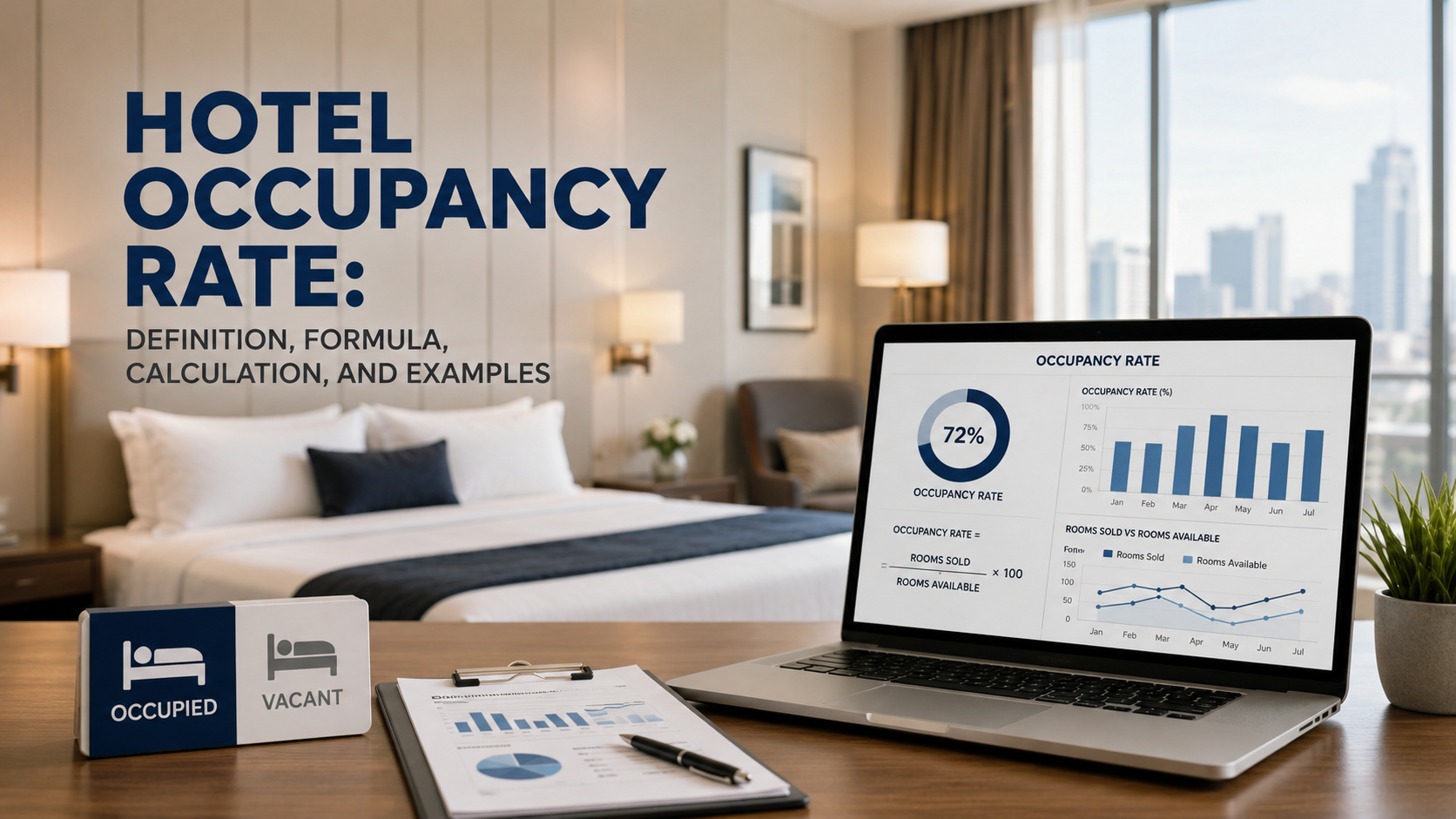
Hotel occupancy rate is the percentage of available rooms that are sold or occupied during a specific measurement period. It helps hotels determine how much of their available room inventory is being utilized.
For example, if a hotel has 100 rooms available and sells 80 rooms during a particular night, its occupancy rate is 80%.
The basic relationship is:
Demand → influences → Occupancy
When more travelers want to stay at a hotel, occupancy can increase. However, demand is only one factor. Pricing, distribution, seasonality, booking behavior, length of stay, and market positioning can also influence occupancy.
How to Calculate Hotel Occupancy Rate
The standard hotel occupancy formula is:
Occupancy Rate = (Rooms Sold ÷ Rooms Available) × 100
For example, suppose a hotel has 150 rooms available for one night and sells 120 rooms.
Occupancy Rate = (120 ÷ 150) × 100
Occupancy Rate = 80%
The hotel has an 80% occupancy rate for that measurement period.
Rooms Available vs. Rooms Sold
The two primary figures in the calculation are rooms available and rooms sold.
- Rooms available are the rooms that can be sold during the measurement period.
- Rooms sold are the rooms occupied or booked during that period.
- Occupancy rate compares rooms sold with the available inventory.
These figures must be measured consistently. A hotel should account for rooms that are unavailable for sale because of maintenance, renovation, or other operational reasons when determining its sellable inventory.
Why the Measurement Period Matters
Occupancy can be calculated for different periods, including a night, week, month, quarter, or year.
The measurement period matters because hotel demand changes over time. A property could have 90% occupancy on a Saturday but only 55% on a Tuesday. Looking at only one day could therefore provide an incomplete picture of performance.
Monthly and annual occupancy figures can reveal broader patterns involving seasonality, demand changes, pricing strategies, and booking behavior.
Hotel Occupancy Rate vs. ADR
Occupancy and Average Daily Rate (ADR) measure different aspects of hotel room performance.
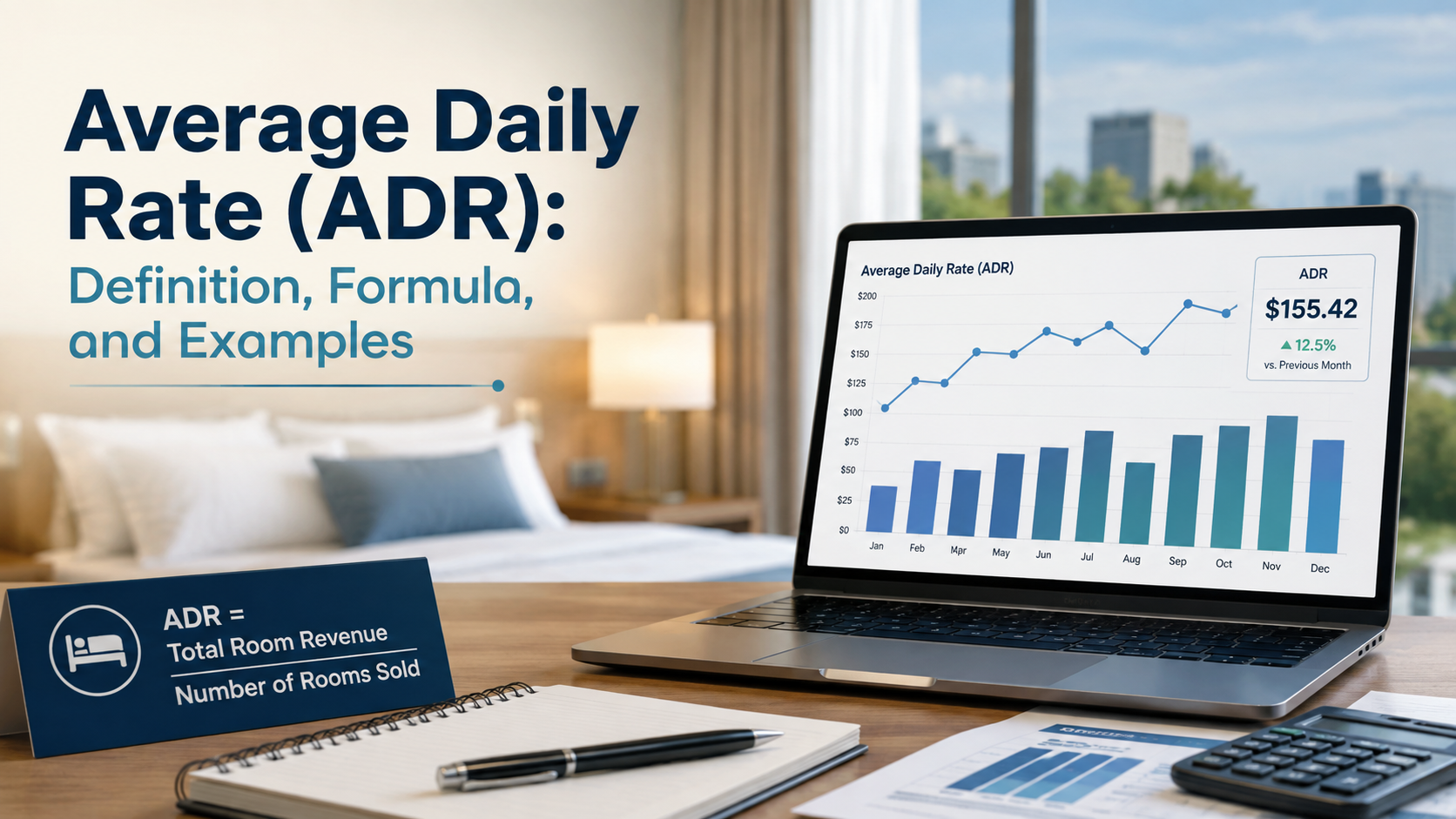
Occupancy measures how many available rooms are sold, while ADR measures the average room rate paid for rooms sold.
A hotel can have:
- High occupancy and low ADR
- Low occupancy and high ADR
- High occupancy and high ADR
- Low occupancy and low ADR
This is why occupancy should not be evaluated by itself.
A hotel might increase occupancy by reducing room rates. Although more rooms are sold, the lower ADR could limit room revenue. Conversely, a hotel could maintain a higher ADR but sell fewer rooms.
The goal of revenue management is not simply to maximize occupancy. It is to find the right balance between rate and occupancy.
Hotel Occupancy Rate vs. RevPAR
Occupancy is also closely connected to Revenue Per Available Room (RevPAR).
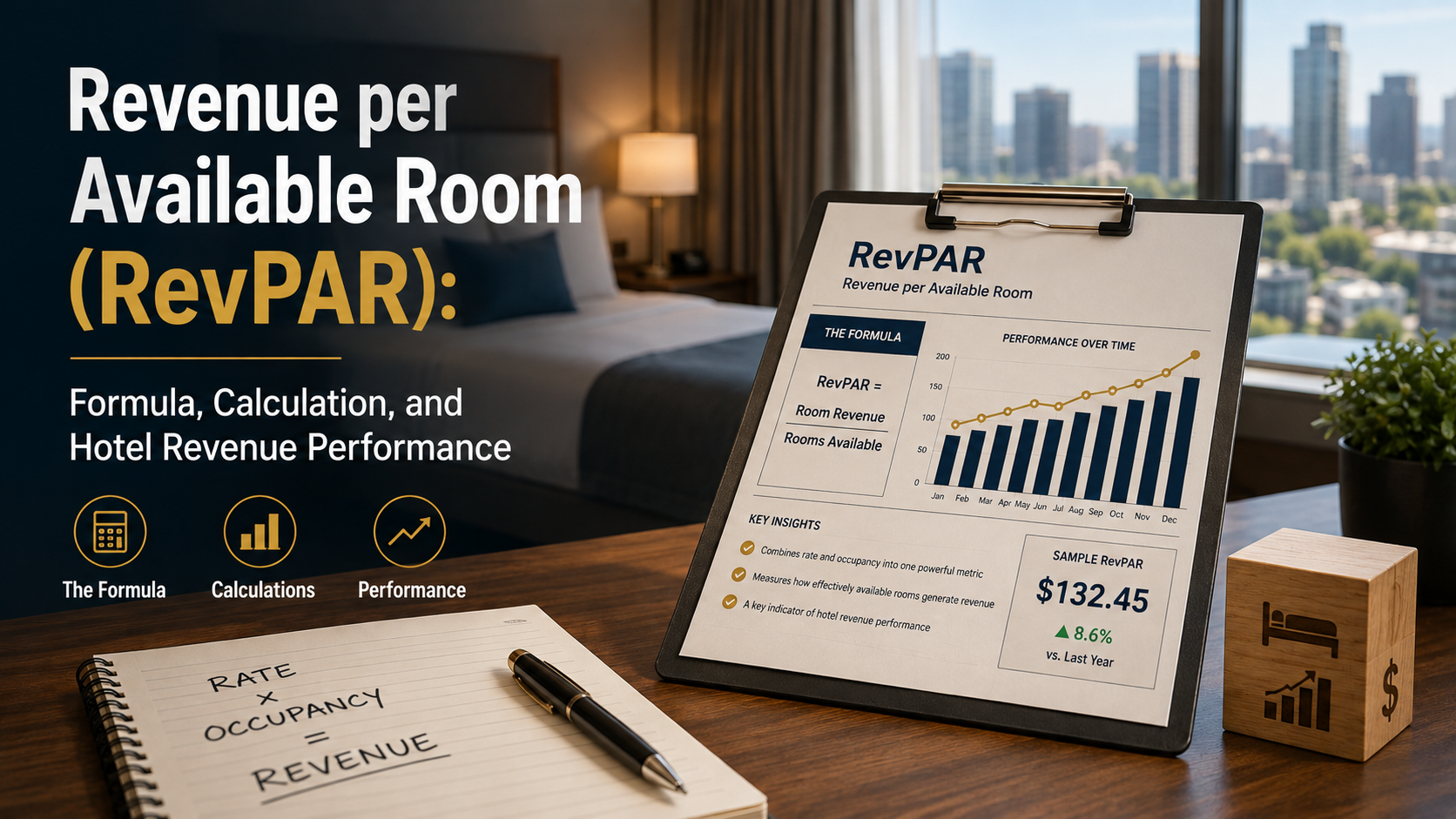
RevPAR measures room revenue generated for each available room and can be calculated using either room revenue and available rooms or ADR and occupancy.
The relationship can be expressed as:
ADR × Occupancy Rate = RevPAR
For example, if a hotel has:
- ADR: $200
- Occupancy: 75%
Then:
RevPAR = $200 × 75% = $150
This demonstrates why occupancy and ADR must be considered together. Increasing occupancy alone does not guarantee a proportional increase in RevPAR.
Hotel Performance Relationship
| Metric | What It Measures | Primary Question |
|---|---|---|
| Occupancy | Percentage of available rooms sold | How full is the hotel? |
| ADR | Average rate for rooms sold | What price are guests paying? |
| RevPAR | Revenue generated per available room | How effectively is room inventory generating revenue? |
This relationship creates an important foundation for hotel revenue management.
Factors That Influence Hotel Occupancy Rate
Occupancy does not move independently. Several factors can affect the number of rooms a hotel sells during a given period.
Demand
Demand is one of the strongest influences on hotel occupancy. When more travelers want accommodation in a destination, hotels may experience stronger booking activity and higher occupancy.
Demand can be affected by tourism activity, business travel, events, holidays, economic conditions, and destination popularity.
Seasonality
Seasonality can cause significant changes in occupancy.
Hotels in leisure destinations may experience higher occupancy during peak travel periods and lower occupancy during shoulder or off-season periods. Business hotels may experience different patterns based on weekdays, conferences, and corporate travel.
Comparing occupancy across the same season or period from year to year can provide more useful insight than comparing unrelated periods.
Pricing
Pricing directly affects a hotel's ability to attract bookings.
Pricing → influences → Occupancy
When demand is strong, hotels may increase rates because guests are willing to pay more for limited inventory. When demand is weaker, hotels may adjust rates to encourage bookings.
However, pricing should be evaluated alongside ADR and RevPAR rather than occupancy alone.
Discounting
Discounts can help hotels stimulate demand during slower periods. Promotional rates, packages, advance-purchase offers, and targeted discounts can encourage guests to book.
However, excessive discounting can create a different problem: occupancy may increase while ADR declines.
For example, a hotel could increase occupancy from 60% to 80% by significantly reducing room rates. If the additional room sales do not generate enough revenue to offset the lower ADR and associated costs, the strategy may not improve overall performance.
Distribution and Channel Mix
Distribution channels can influence occupancy by determining where and how potential guests find a hotel.
Hotels may receive bookings through:
- Direct hotel websites
- Online travel agencies
- Global distribution systems
- Corporate accounts
- Travel agents
- Group bookings
- Other booking partners
A strong distribution strategy can increase access to demand. However, hotels also need to consider commissions, acquisition costs, cancellation behavior, and the profitability of each channel.
Booking Window
The booking window refers to the amount of time between when a guest makes a reservation and the arrival date.
Some guests book months in advance, while others reserve rooms only days or hours before arrival.
Understanding booking windows helps hotels forecast demand and adjust availability and pricing. A property seeing strong pickup for a future date may have an opportunity to increase rates, while weak booking activity could signal a need for additional demand-generation efforts.
Length of Stay
Length of stay can affect occupancy patterns and inventory availability.
A guest staying for five nights occupies inventory for more nights than a guest staying for one night. Longer stays can provide greater booking stability, while shorter stays may create more opportunities to sell individual nights.
Revenue managers may therefore consider length-of-stay patterns when managing room availability, restrictions, and pricing.
Market Positioning
A hotel's market positioning can influence the type of demand it attracts and the rates guests are willing to pay.
Luxury hotels, upscale properties, boutique properties, select-service hotels, and budget accommodations may have different occupancy patterns because they serve different guest segments.
Strong positioning can help a hotel compete on value rather than relying entirely on discounts to generate bookings.
Occupancy and Revenue Management
Revenue management balances demand, pricing, inventory, and booking behavior to improve hotel performance.
The central relationship is:
Revenue Management → balances → ADR + Occupancy
Revenue managers monitor occupancy forecasts, booking pace, market demand, competitor pricing, historical performance, booking windows, distribution channels, and other variables when making pricing and inventory decisions.
The objective is not necessarily to sell every room at any price. Instead, the objective is to sell the right room to the right guest, through the right channel, at the right price and at the right time.
Why 100% Occupancy Is Not Always Optimal
A hotel reaching 100% occupancy might appear to be performing perfectly, but maximum occupancy is not always the best financial outcome.
If a hotel sells every room at heavily discounted rates, it may generate less revenue than it could have earned with a slightly lower occupancy rate and higher ADR.
For example:
| Scenario | Occupancy | ADR | RevPAR |
|---|---|---|---|
| A | 100% | $120 | $120 |
| B | 85% | $160 | $136 |
| C | 75% | $200 | $150 |
Scenario A has the highest occupancy, but Scenario C produces the highest RevPAR.
This illustrates an important principle:
Higher occupancy ≠ better performance.
A hotel should evaluate how much revenue each occupied room generates, not simply how many rooms are filled.
Why Increasing Occupancy Can Decrease ADR
Hotels sometimes use lower rates to stimulate additional bookings.
As more rooms become occupied, however, the average rate may decline if a significant share of those bookings comes from discounted segments.
For example, a hotel could initially sell rooms at $180. If demand slows, management might introduce a $120 promotional rate to attract additional guests.
The result could be:
Higher occupancy + lower ADR
Whether that is a successful strategy depends on the resulting RevPAR, room revenue, distribution costs, and operating expenses.
This is why hotel revenue management must continuously evaluate the tradeoff between rate and occupancy.
Why High Occupancy Does Not Necessarily Mean High Profitability
Occupancy measures room utilization, not profit.
A hotel with high occupancy can still experience weaker profitability if it has:
- Low room rates
- High distribution commissions
- High labor costs
- High cleaning and housekeeping costs
- High utility expenses
- Significant maintenance expenses
- High promotional costs
Some operating costs increase as occupancy rises because more occupied rooms require more cleaning, laundry, amenities, utilities, and labor.
Therefore:
Occupancy → influences → Revenue + Variable Operating Costs
Higher occupancy can increase revenue, but it can also increase certain operating expenses.
Occupancy, Operating Costs, and NOI
Hotel performance ultimately extends beyond room sales.
As occupancy increases, variable operating costs may also increase. Additional occupied rooms can require more housekeeping labor, laundry, guest supplies, utilities, and other services.
At the same time, stronger room revenue can contribute to covering fixed operating expenses.
This creates the following relationship:
Revenue and Expenses → influence → NOI
Net operating income (NOI) considers the income remaining after applicable operating expenses. A hotel with lower occupancy but strong ADR and controlled expenses may potentially produce better NOI than a hotel with higher occupancy but weak pricing and inefficient costs.
For this reason, occupancy is an important operating KPI, but it should be connected to financial performance rather than treated as a standalone measure of success.
Occupancy as Part of the Hotel Performance Framework
The relationship among these metrics can be summarized as follows:
| Business Factor | Direct Relationship | Performance Impact |
|---|---|---|
| Demand | Demand → Occupancy | More or fewer rooms may be sold |
| Pricing | Pricing → Occupancy | Rate changes can affect booking behavior |
| Distribution | Distribution → Occupancy | Channels influence access to demand |
| Revenue Management | Revenue Management → ADR + Occupancy | Balances rate and room volume |
| ADR + Occupancy | ADR × Occupancy → RevPAR | Connects pricing and utilization |
| Occupancy | Occupancy → Revenue + Variable Costs | More occupied rooms affect both |
| Revenue + Expenses | Revenue and Expenses → NOI | Determines operating profitability |
This framework shows why hotel occupancy should be interpreted as part of a larger revenue-management system.
Limitations of Hotel Occupancy Rate as a Standalone KPI
Occupancy is useful, but it does not provide a complete picture of hotel performance.
A high occupancy rate does not reveal the average price paid by guests. It also does not show distribution costs, operating expenses, profitability, or whether the rooms were sold through profitable channels.
For example, two hotels could both report 80% occupancy while having very different ADRs, RevPAR, operating expenses, and NOI.
Occupancy also does not explain why rooms were sold. A change in occupancy could result from demand, pricing, promotions, events, seasonality, distribution, market conditions, or changes in booking behavior.
Therefore, hotel managers should evaluate occupancy alongside ADR, RevPAR, revenue, expenses, and profitability metrics.
Final Thoughts
Hotel occupancy rate provides a straightforward way to measure how effectively a hotel is filling its available room inventory. However, occupancy alone does not determine whether a hotel is performing well. Pricing, demand, seasonality, distribution, booking behavior, length of stay, and market positioning can all affect occupancy and the financial results behind it.
The most useful approach is to view occupancy as part of a broader revenue-management framework. Revenue management balances ADR and occupancy, while ADR and occupancy together determine RevPAR. From there, revenue and operating expenses influence profitability and NOI. By evaluating these relationships together, hotel managers can make better decisions about pricing, inventory, distribution, and demand rather than simply trying to achieve the highest possible occupancy.
Frequently Asked Questions
What is a good hotel occupancy rate?
There is no universal occupancy rate that is ideal for every hotel. A reasonable target depends on the property's market, location, segment, seasonality, competitive set, pricing strategy, and operating model.
What is the formula for hotel occupancy rate?
The standard formula is:
Occupancy Rate = (Rooms Sold ÷ Rooms Available) × 100
For example, selling 80 of 100 available rooms results in an 80% occupancy rate.
What is the difference between occupancy and ADR?
Occupancy measures the percentage of available rooms sold, while ADR measures the average room rate paid for rooms sold. Both metrics should be considered together when evaluating hotel performance.
How is occupancy related to RevPAR?
RevPAR connects room pricing with room utilization. It can be calculated using:
RevPAR = ADR × Occupancy Rate
For example, a $200 ADR and 75% occupancy produce a $150 RevPAR.
Can a hotel have high occupancy but low revenue?
Yes. A hotel can achieve high occupancy through discounted rates while generating less room revenue than a property with slightly lower occupancy and substantially higher ADR.
Is 100% occupancy always the goal?
No. Selling every available room is not necessarily optimal if doing so requires significant discounting or creates high acquisition and operating costs. Hotels generally need to balance occupancy with ADR and RevPAR.
How does seasonality affect hotel occupancy?
Seasonality can cause occupancy to rise or fall based on travel patterns, holidays, weather, events, and destination demand. Comparing occupancy across comparable periods can help identify meaningful trends.
Why should hotels track occupancy with other KPIs?
Occupancy does not measure room pricing, distribution costs, operating expenses, or profitability. Combining occupancy with ADR, RevPAR, revenue, expenses, and NOI provides a more complete view of hotel performance.
More Recent Articles