Average Daily Rate (ADR)
Hotel Average Daily Rate (ADR): Formula, Calculation & Performance

Average Daily Rate (ADR): A Complete Guide for Hotels
Average Daily Rate (ADR) is a hotel performance metric that measures the average room revenue earned per occupied room during a defined period. It helps hotel owners and operators understand how much revenue their property is realizing from rooms that are actually sold.
ADR is closely connected to occupancy, RevPAR, demand, pricing strategy, hotel positioning, room mix, distribution, revenue management, and guest experience. These relationships are important because ADR does not tell the complete story of hotel performance on its own.
A property can achieve a strong ADR while leaving a significant amount of inventory unsold. Likewise, a lower ADR can sometimes produce stronger overall room-revenue performance when it is accompanied by substantially higher occupancy. Understanding ADR therefore requires looking at both the metric itself and how it interacts with the broader hotel revenue model.
What Is Average Daily Rate (ADR)? Average Room Revenue Explained
Average Daily Rate (ADR) is the average room revenue earned per occupied room over a specific period. The metric focuses on rooms that were sold and the room revenue generated from those rooms. It can be calculated for a single day, a month, a quarter, a season, or another defined period.
For hotel owners and operators, ADR primarily measures price realization. It answers a basic question:
How much room revenue did the property earn, on average, for each occupied room?
ADR can help identify changes in pricing performance over time. Comparing ADR across similar periods can reveal patterns related to seasonality, demand, room mix, promotions, and pricing decisions.
However, ADR should not be interpreted as a standalone measure of profitability. It does not account for unsold rooms, operating expenses, or the costs associated with acquiring and servicing bookings.
How to Calculate ADR
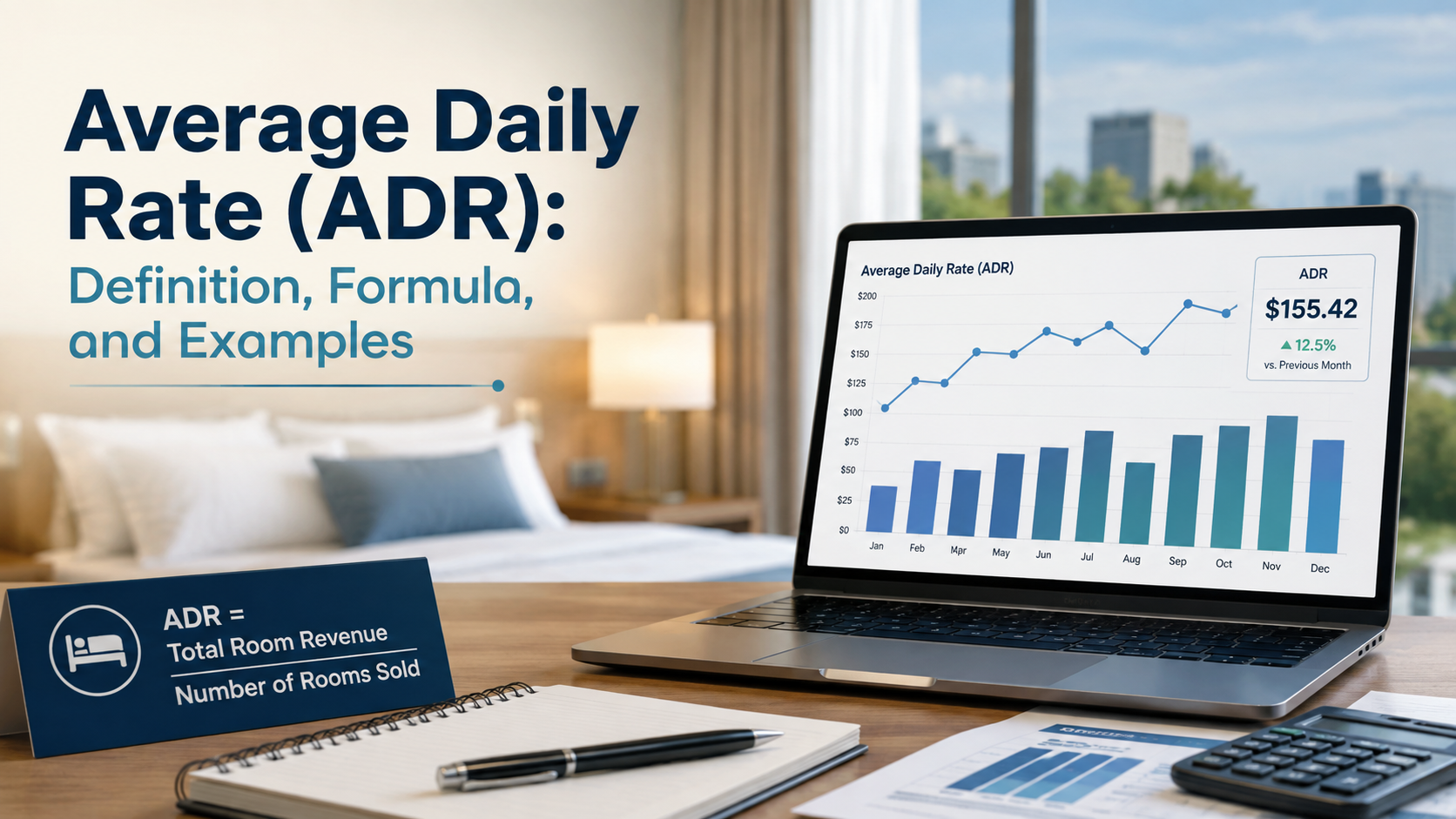
The standard Average Daily Rate formula is:
ADR = Room Revenue ÷ Rooms Sold
For example, suppose a hotel generates $24,000 in room revenue and sells 120 rooms during a particular period.
The calculation is:
$24,000 ÷ 120 = $200
The hotel's ADR is therefore $200.
This means the property earned an average of $200 in room revenue for every occupied room included in the calculation.
The same formula can be used for different reporting periods, provided the room revenue and rooms sold cover the same period.
What Counts as Rooms Sold?
ADR is based on revenue-generating occupied rooms. Complimentary rooms and staff accommodations are generally excluded when they do not generate room revenue.
The exact reporting treatment can depend on a hotel's accounting and performance-reporting standards, so owners should apply a consistent methodology when comparing ADR across periods.
ADR Calculation Example
Consider a hotel that sells rooms at several different rates during one night:
- 20 rooms at $220 = $4,400
- 25 rooms at $180 = $4,500
- 15 rooms at $140 = $2,100
The hotel sells 60 rooms and generates $11,000 in room revenue.
The ADR is:
$11,000 ÷ 60 = $183.33
The hotel did not sell every room at $183.33. Instead, $183.33 represents the average realized room revenue across the rooms sold.
This is an important distinction between ADR and an individual room rate.
What Counts as Room Revenue in ADR?
ADR is specifically concerned with room revenue, not total hotel revenue.
A hotel may generate revenue from many sources, including:
- Guest rooms
- Food and beverage
- Spa services
- Parking
- Events
- Resort activities
- Retail
- Other ancillary services
These sources can contribute to overall hotel revenue, but they are not what ADR is designed to measure.
For example, if a guest pays $250 for a room and another $100 for dinner and spa services, the $250 room charge contributes to room revenue used in ADR, while the additional $100 belongs to other revenue categories.
Keeping these revenue sources separate allows ADR to remain a consistent measure of room pricing performance.
What Does ADR Tell Hotel Owners and Operators?
ADR provides insight into the average amount of room revenue a property realizes from its occupied rooms.
It can help owners and operators evaluate:
- Pricing performance
- Rate realization
- Changes in guest purchasing behavior
- Seasonal pricing patterns
- Room-type performance
- Effects of discounts and promotions
- Demand-driven rate changes
- Positioning relative to comparable properties
A rising ADR can indicate stronger pricing power or improved demand. But an increase can also result from a change in room mix, such as a greater proportion of suite bookings.
For that reason, ADR should be analyzed in context.
A hotel that increases ADR by selling more premium rooms is experiencing a different situation from one that increases ADR because guests are accepting higher rates across its standard inventory.
What ADR Does Not Tell You
ADR does not account for unsold inventory.
Consider two 100-room hotels:
Hotel A
- 40 rooms sold
- $300 ADR
- Room revenue: $12,000
Hotel B
- 80 rooms sold
- $220 ADR
- Room revenue: $17,600
Hotel A has the higher ADR, but Hotel B generates significantly more room revenue on that night.
This illustrates why a high ADR does not automatically mean stronger overall room performance.
ADR also does not tell an owner:
- How many rooms remained vacant
- Total hotel revenue
- Distribution costs
- Operating expenses
- Net operating income
- Overall profitability
ADR is therefore a room-revenue performance metric, not a complete financial-health metric.
ADR vs. Room Rate
ADR and room rate are related but represent different concepts.
A room rate is the price associated with an individual booking, room type, or rate plan.
ADR is a property-level performance metric calculated from actual room revenue and rooms sold.
A hotel might sell one standard room for $150, a premium room for $200, and a suite for $350. The property's ADR reflects the average realized revenue across the rooms included in the calculation.
This means ADR is not necessarily the same as the hotel's advertised standard rate.
A property's ADR can change because of different rates, discounts, room types, guest segments, and booking patterns.
ADR vs. Occupancy
ADR measures price realization, while occupancy measures inventory utilization.
Occupancy is generally calculated as:
Occupancy Rate = Rooms Sold ÷ Available Rooms × 100
These metrics answer different questions.
ADR asks:
How much revenue did we earn per occupied room?
Occupancy asks:
What percentage of our available rooms did we sell?
The two metrics can move in opposite directions.
A hotel may increase its rates and achieve a higher ADR while selling fewer rooms. It may also reduce rates and increase occupancy.
Neither outcome is automatically better. The appropriate balance depends on demand, market conditions, property positioning, inventory, and revenue objectives.
For example, a 100-room hotel might generate:
Scenario A
- 40 rooms sold
- $300 ADR
- $12,000 room revenue
Scenario B
- 70 rooms sold
- $220 ADR
- $15,400 room revenue
Scenario A has the higher ADR, but Scenario B generates more room revenue because more rooms are occupied.
ADR vs. RevPAR
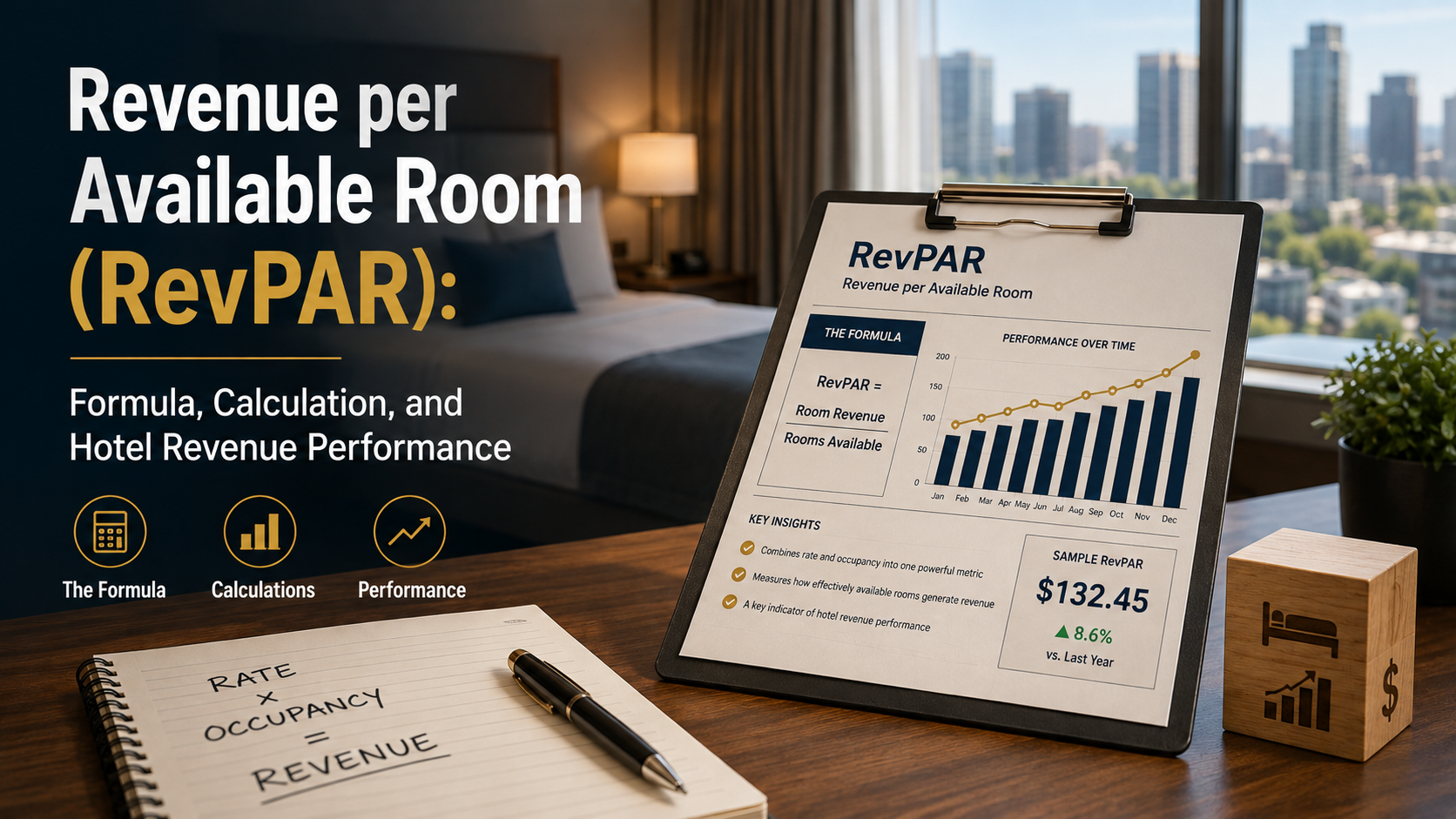
Revenue per Available Room (RevPAR) combines ADR and occupancy to provide a broader view of room-revenue performance.
The mathematical relationship is:
RevPAR = ADR × Occupancy Rate
Occupancy should be expressed as a decimal.
For example:
- ADR = $200
- Occupancy = 75%
- RevPAR = $200 × 0.75
- RevPAR = $150
RevPAR can also be calculated directly:
RevPAR = Room Revenue ÷ Available Rooms
This relationship explains why a higher ADR does not necessarily produce higher RevPAR.
Suppose a hotel has two pricing scenarios:
Scenario A
- ADR = $300
- Occupancy = 40%
- RevPAR = $120
Scenario B
- ADR = $250
- Occupancy = 70%
- RevPAR = $175
Scenario A has a higher ADR, but Scenario B produces a higher RevPAR.
The reason is that RevPAR accounts for both the price realized from occupied rooms and the proportion of available inventory that was sold.
ADR and occupancy therefore work together to provide a clearer picture of hotel room performance.
ADR and Pricing Strategy
Pricing strategy is one of the factors that can influence ADR.
Hotels may adjust rates based on:
- Demand
- Booking pace
- Seasonality
- Day of week
- Local events
- Remaining inventory
- Guest segments
- Market conditions
- Room type
Dynamic pricing allows rates to change as these conditions change.
Hotels may also use:
- Rate fences
- Discounts
- Packages
- Minimum-stay requirements
- Promotional offers
- Premium-room pricing
- Targeted rates for specific guest segments
The purpose is not simply to establish the highest possible room rate.
A rate that is too high can reduce demand, while excessive discounting can reduce the revenue the property could have captured from guests willing to pay more.
ADR therefore reflects the outcome of pricing decisions rather than being a pricing strategy itself.
ADR and Demand
Demand is a major influence on ADR.
Hotel demand can vary based on:
- Seasonality
- Day of week
- Holidays
- Local events
- Conferences
- Festivals
- Sporting events
- Booking windows
- Business travel
- Leisure travel
- Market compression
When demand increases and available inventory becomes limited, hotels may have greater pricing power.
For example, a hotel near a major convention may experience significantly stronger demand during the event than during an ordinary week. That increased demand can support higher room rates and potentially a higher ADR.
Demand works in the opposite direction during slower periods. Hotels may use targeted offers or adjusted rates to attract bookings when fewer guests are competing for available rooms.
This is why ADR comparisons are more meaningful when the periods being compared have similar demand conditions.
A hotel's ADR during a major event should not necessarily be compared directly with its ADR during a low-demand week without considering the underlying market conditions.
ADR and Hotel Positioning
Hotel positioning can influence the ADR a property is capable of achieving.
Luxury, upscale, boutique, lifestyle, midscale, and budget properties may target different guest segments and offer different levels of service, design, amenities, location, and perceived value.
A property's positioning can support a rate premium when the guest experience justifies it.
For example, a luxury hotel may command higher rates because guests value its service, accommodations, amenities, exclusivity, location, or overall experience.
However, a property's label alone does not create pricing power.
Calling a property luxury or boutique does not automatically justify a premium ADR. Guests must perceive enough value in the product and experience to support the price.
Research examining hotel class, guest motivations, ADR, RevPAR, and occupancy also suggests that hotel classification and guest-related factors can play a role in hotel revenue outcomes.
The relationship can therefore be expressed as:
Hotel Positioning → influences → ADR
ADR and Room/Product Mix
ADR can change because of the types of rooms guests choose, not simply because room rates increase.
A property may have:
- Standard rooms
- Deluxe rooms
- Premium rooms
- Suites
- Rooms with upgraded views
- Larger accommodations
- Specialty rooms
Suppose a hotel normally sells mostly standard rooms but experiences an unusually high number of suite bookings during a particular weekend.
Even if the property's individual room rates remain unchanged, the greater proportion of premium-room sales can increase the overall ADR.
This is why owners should examine room mix when interpreting ADR changes.
A higher ADR may reflect stronger pricing, stronger demand for premium products, a shift in guest segments, or a combination of these factors.
ADR and Discounts, Promotions, and Groups
Discounts and promotions can influence realized ADR.
If a room normally sells for $200 but is booked for $150 through a promotion, the lower realized rate affects the average room revenue represented by ADR.
However, a lower ADR is not necessarily a negative outcome.
A discounted booking may fill inventory that otherwise would have remained vacant. The value of that booking therefore needs to be considered alongside occupancy and RevPAR.
Group bookings provide another example.
A wedding, conference, or corporate group may negotiate rates below the hotel's usual transient rate. This can lower ADR, but the group may still generate substantial room revenue by occupying a large number of rooms.
Revenue management therefore considers the broader value of the booking rather than treating the highest possible ADR as the only objective.
ADR and Distribution
Distribution channels can affect the economics behind ADR.
Hotels may receive bookings through:
- Direct websites
- Brand channels
- Online travel agencies
- Group sales
- Wholesale partners
- Other third-party channels
Two bookings can produce the same ADR while creating different financial outcomes for the property.
For example, a direct booking and a third-party booking may generate the same room revenue, but the third-party booking may involve commission or other acquisition costs.
This leads to an important distinction:
ADR measures room revenue, not net revenue after distribution costs.
Owners should therefore consider ADR alongside channel mix and distribution economics when evaluating the quality of room revenue.
ADR and Revenue Management
The relationship can be summarized as:
Revenue Management → influences → ADR
Revenue management is the broader process of using data and market information to make decisions about pricing, inventory, demand, and guest segments.
Revenue-management decisions can consider:
- Historical performance
- Current occupancy
- Booking pace
- Forecasted demand
- Market events
- Competitor conditions
- Room availability
- Guest segments
- Booking channels
- Lead times
ADR is one of the performance metrics used to evaluate the results of these decisions.
A revenue-management strategy should not focus on maximizing ADR in isolation. It should seek an effective balance between rate, occupancy, demand, inventory, and revenue.
ADR and Guest Experience
Guest experience can support a hotel's pricing power.
Guests do not evaluate a room based solely on its physical space. They may also consider:
- Service quality
- Cleanliness
- Amenities
- Design
- Convenience
- Location
- Personalization
- Reputation
- Consistency
- Overall value
When guests perceive greater value, they may be more willing to pay a premium for the experience.
This relationship can be expressed as:
Guest Experience → supports → Pricing Power → supports → ADR
Online reviews can also influence how prospective guests perceive a hotel's value before booking. Positive guest experiences can strengthen a property's reputation and help support demand.
Recent hospitality research examining guest motivations, hotel class, online reviews, ADR, RevPAR, and occupancy provides additional support for considering guest-related factors when examining hotel revenue performance.
The relationship should not be interpreted as a guarantee that better guest experiences automatically produce a specific ADR. Instead, guest experience is one factor that can contribute to the perceived value and pricing power supporting ADR.
ADR and Market Positioning
ADR is also useful when evaluating a hotel's position relative to comparable properties.
Owners may compare ADR with properties that have similar:
- Locations
- Room counts
- Target markets
- Property types
- Service levels
- Guest segments
- Amenities
A hotel's ADR may be lower than a competitor's because of differences in product quality, positioning, demand, room mix, or pricing strategy.
Competitive comparison is therefore more useful when the properties being compared are genuinely comparable.
Simply having a lower ADR than another hotel does not automatically mean the property is underperforming.
ADR and Room Revenue
ADR directly contributes to room revenue through the number of rooms sold.
The basic relationship is:
ADR × Rooms Sold = Room Revenue
For example:
- ADR = $200
- Rooms sold = 100
- Room revenue = $20,000
This demonstrates why ADR cannot be separated completely from occupancy or rooms sold.
A property needs both rate and demand to convert its room inventory into meaningful room revenue.
ADR and NOI
ADR can contribute to revenue growth, but ADR itself is not profitability.
The broader relationship is:
ADR → contributes to → Room Revenue → contributes to → NOI
Net Operating Income (NOI) is influenced by the property's operating revenue and operating expenses.
Those expenses can include:
- Labor
- Utilities
- Maintenance
- Distribution costs
- Management expenses
- Property operations
- Other operating costs
A hotel that increases ADR may generate additional room revenue, but the resulting effect on NOI depends on occupancy, variable costs, distribution expenses, and the property's overall operating structure.
Therefore:
Higher ADR does not automatically mean higher NOI.
ADR should be viewed as one contributor to the property's financial performance rather than a direct measure of profitability.
How to Improve ADR
Improving ADR does not simply mean raising every room rate.
The more sustainable approach is to improve the property's ability to capture the value guests are willing to pay for.
Strengthen Willingness to Pay
Improve the product, service, amenities, and guest experience so the price is supported by perceived value.
Strengthen Positioning
Clearly communicate what differentiates the property and why its experience justifies its target market position.
Respond to Demand
Adjust pricing according to seasonality, booking pace, day of week, events, market compression, and available inventory.
Improve Segmentation
Different guest segments may have different booking patterns and willingness to pay. Understanding those differences can support more precise pricing decisions.
Improve Room and Product Merchandising
Premium rooms, suites, upgraded views, packages, and room enhancements can create additional opportunities to capture higher realized revenue.
Use Revenue Management
Revenue-management processes can help connect pricing decisions with demand, inventory, booking patterns, and market conditions.
The objective is not simply to maximize the advertised room rate. It is to capture the right price from the right demand at the right time.
Limitations of ADR
ADR is useful, but it has several important limitations.
ADR Does Not Measure Unsold Inventory
ADR only considers rooms that were sold. It does not show how much available inventory remained vacant.
ADR Does Not Measure Occupancy
A property can have a high ADR and low occupancy or a lower ADR and high occupancy.
ADR Does Not Equal RevPAR
RevPAR incorporates occupancy and therefore provides a broader measure of room-revenue performance.
ADR Does Not Measure Profitability
ADR does not subtract labor, maintenance, utilities, distribution expenses, or other operating costs.
ADR Does Not Include All Hotel Revenue
Food and beverage, spa, events, parking, and other ancillary revenues are outside the core ADR calculation.
ADR Can Change Because of Room Mix
More premium-room or suite bookings can increase ADR even if individual room rates have not broadly increased.
ADR Can Hide Distribution Economics
Two bookings with identical ADRs may have different financial value if one carries higher acquisition or distribution costs.
ADR Can Be Misleading Without Context
A hotel's ADR should be evaluated in relation to demand, seasonality, occupancy, room mix, market positioning, and comparable properties.
For these reasons, ADR should never be interpreted alone.
ADR, Occupancy, and RevPAR: How the Metrics Work Together
ADR, occupancy, and RevPAR provide complementary views of hotel room performance.
ADR measures the average room revenue earned from occupied rooms.
Occupancy measures the proportion of available rooms that were sold.
RevPAR combines the two.
RevPAR = ADR × Occupancy Rate
This relationship is useful because it prevents owners from treating either price or occupancy as the sole measure of success.
For example, a hotel may achieve a higher ADR by accepting fewer bookings. During a period of exceptionally strong demand, this may be a sound strategy.
During a weak-demand period, however, a lower rate that generates significantly more occupancy may produce stronger RevPAR and room revenue.
The appropriate strategy depends on the property's market, positioning, demand, inventory, and operating economics.
ADR is therefore best understood as one part of the broader hotel revenue-management system.
Final Thoughts
Average Daily Rate is a fundamental hotel performance metric for understanding the average room revenue earned from occupied rooms. It provides insight into price realization, but its meaning becomes much clearer when considered alongside occupancy, RevPAR, demand, room mix, distribution, hotel positioning, and guest experience.
The broader relationship is straightforward:
revenue management, demand, and hotel positioning influence ADR; guest experience can support pricing power; ADR and occupancy determine RevPAR; and ADR contributes to room revenue, which can contribute to NOI. Understanding these relationships allows hotel owners and operators to evaluate ADR as part of the complete revenue picture rather than treating a higher room rate as the goal by itself.
Frequently Asked Questions
What does ADR mean in hotels?
ADR stands for Average Daily Rate. It measures the average room revenue earned per occupied room during a defined period.
What is the formula for ADR?
The standard formula is:
ADR = Room Revenue ÷ Rooms Sold
Is ADR the same as the room rate?
No. A room rate is the price associated with an individual booking or rate plan. ADR is a property-level performance metric calculated from actual room revenue and rooms sold.
Is a higher ADR always better?
No. A higher ADR may be accompanied by lower occupancy. ADR should be evaluated alongside occupancy and RevPAR to determine whether the property's overall room-revenue performance improved.
What is the difference between ADR and RevPAR?
ADR measures average room revenue from occupied rooms. RevPAR accounts for both ADR and occupancy.
RevPAR = ADR × Occupancy Rate
Does ADR include food and beverage revenue?
No. ADR is focused on room revenue. Food and beverage, spa, parking, events, and other ancillary revenue are separate revenue categories.
Can room mix affect ADR?
Yes. A higher proportion of suite, premium-room, or upgraded-room bookings can increase ADR even when the property's base room rates have not changed significantly.
How does demand affect ADR?
Higher demand can give a hotel greater pricing power, while weaker demand may require lower rates, promotions, or other strategies to attract bookings.
Does guest experience affect ADR?
Guest experience can support pricing power by influencing perceived value and willingness to pay. However, ADR is also influenced by demand, positioning, room mix, pricing, and other factors.
Does ADR measure hotel profitability?
No. ADR measures room-revenue performance. It does not account for operating expenses, distribution costs, or other factors required to evaluate profitability and NOI.
More Recent Articles