How to Own a Hotel Franchise
How to Own a Hotel Franchise: Costs & Alternatives


How to Own a Hotel Franchise: Franchise vs. Independent Ownership
Hotel franchising is one of the most common ways to enter hotel ownership. A brand lends you its name, reservation system and standards; you own the real estate and pay for the privilege. For many owners, it is the right model. For others, especially owners of distinctive boutique properties, independent ownership with professional management offers more control and more upside.
This guide is written for investors and owners. It explains how to own a hotel franchise step by step, what a hotel franchise really costs, how the franchise model compares with independent ownership, and how to get professional operations without a brand.
How to Own a Hotel Franchise: Step by Step
Whether you buy a franchised hotel, convert an existing property, or build new, the path follows the same sequence.
- Define your investment goals. Market, segment, budget, hold period, and how involved you want to be. These decide which brand tiers make sense.
- Research hotel franchise opportunities. Compare brands by tier, fee structure, loyalty contribution, design standards, and how many hotels they already have in your market.
- Submit a franchise application. Franchisors review your experience, net worth, liquidity, and the site. Expect site approval, market studies, and impact reviews.
- Review the Franchise Disclosure Document. Under the FTC Franchise Rule (16 CFR Part 436), the franchisor must give you the FDD "at least 14 calendar days before the prospective franchisee signs a binding agreement with, or makes any payment." The FDD has 23 items; Item 7 sets out the estimated total initial investment.
- Negotiate the franchise agreement. Term, territory protection, fees, renovation requirements, and exit or termination provisions all matter. Have a hospitality attorney review it.
- Secure financing. Lenders weigh both the property and the brand.
- Buy, convert, or develop the hotel. Each route carries a different capital requirement and timeline.
- Set up operations and management. Decide whether you will operate the hotel yourself or hire a management company.
The U.S. Small Business Administration's guide to
buying an existing business or franchise offers a blunt summary of the trade-off: "Franchising gives you more guidance but less control." It also notes that "the contract between the two parties usually benefits the franchisor more than the franchisee." Go in with that in mind.
What does buying a franchise provide a hotel owner with? A recognized brand, a reservation and loyalty system, operating standards and training, and often easier access to financing.
What it does not provide is the hotel itself, the capital to run it, or day-to-day management; those remain the owner's responsibility.
How Much Does a Hotel Franchise Cost?
The cost to buy a hotel franchise has two parts: the initial investment and the ongoing fee stack.
Initial costs include the initial franchise or application fee, the property itself, renovation or construction to brand standards, technology, and opening costs. Item 7 of the FDD gives the franchisor's estimate for its brand.
Ongoing hotel franchise fees are where most of the cost sits. HVS's free
Hotel Franchise Fee Guide 2020 lays out the typical fee stack:
Royalty fee (the largest component)- Loyalty program fees
- Marketing fees
- Sales and reservation fees
- Miscellaneous fees
- Initial fee
In that 2020 study, "franchise costs comprise 10.8% of rooms revenue over an initial ten years." The guide is older, so use it to understand the structure, not current levels.
Franchise Fees by Brand Tier
More current figures come from the HVS U.S. Franchise Fee Guide 2025 (paid), as reported secondhand by HOTELS magazine (September 2026): "Economy brands averaged the lowest total franchise cost, at 9.6% of rooms revenue, while high-end brands averaged the highest, at 12.9%. By product type, median costs ranged from 10.9% for extended-stay hotels to 12.5% for full-service hotels." The royalty fee is "calculated on a percentage of revenue, not profit," so you pay it in good years and bad.
What these figures mean:
The 9.6% and 12.9% are the total franchise cost load (royalty, loyalty, marketing, reservation and other brand fees combined) expressed as a share of rooms revenue, not profit. They come secondhand: HOTELS magazine is reporting results from HVS's paywalled 2025 guide, which covers 93 brands and, as HVS notes, measures "only the costs" of affiliation, not its benefits. For an owner weighing franchise versus independent, that load is the hurdle the brand's distribution and loyalty demand must clear before it pays for itself, money an independent hotel would instead spend on its own marketing, technology, and direct booking.
These fees are also rising. CBRE's
All Eyes on Operating Costs in 2025 found franchise-related fees rose 3.9% in 2024, with loyalty charges up the most.
Beyond fees, franchised owners must fund
property improvement plans (PIPs): brand-mandated renovations at purchase, conversion or renewal. No free, current source reports typical PIP cost per key, so get the brand's PIP in writing before you commit.
When comparing hotel franchise cost by brand, look past the headline royalty. Compare the full fee stack as a percentage of rooms revenue, the PIP exposure, and how much business the loyalty program actually delivers in your market. That is how owners choose the best hotel franchise to own: on clear criteria, not on rankings.
Franchise vs. Independent Hotel: Control, Costs and Returns
Here is how the two ownership models compare on the factors that matter most to owners:
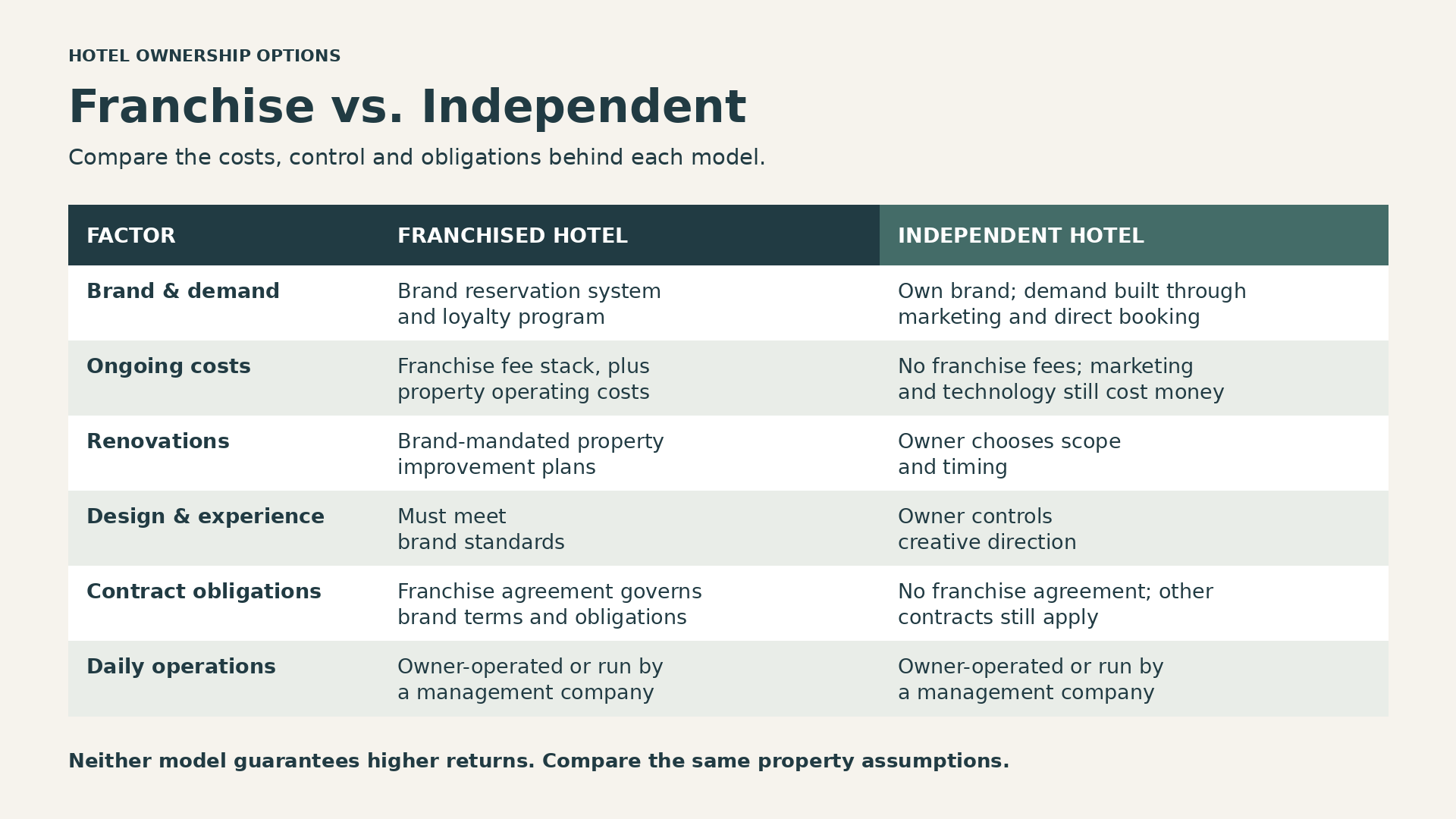
Independent ownership is not automatically more profitable. It removes the fee stack but places the full burden of demand generation on the owner and operator. Independent hotels win when they are genuinely distinctive and professionally run, with strong marketing and SEO for independent hotels, disciplined revenue management and a clear identity. If you are weighing what makes a property a natural independent, start with what makes a hotel a boutique hotel.
Franchise Agreement vs. Management Agreement
These are often confused. A franchise agreement licenses a brand: its name, systems, and standards. A management agreement hires an operator to run the hotel day-to-day. They are separate decisions. A franchised hotel still needs management, either by the owner or by a management company, and an independent hotel can hire a professional operator with no brand involved. For management terms, read what to look for in a management agreement, and for how the two operating styles differ, see boutique vs. traditional hotel management.
Financing a Franchise
Brand affiliation affects lending. Per the SBA, brands meeting the FTC franchise definition "must be in the directory to obtain SBA financing," so check the SBA Franchise Directory first. For loan types and how to qualify, see our full hotel financing guide.
Which Hotel Ownership Model Is Right for Your Investment?
The right answer depends on the asset and the owner, not on ideology. A few questions help clarify the decision:
Is the property distinctive? A historic building, a design-forward conversion, or a hotel in a character neighborhood often has more value as an independent. A highway-adjacent property serving business travelers may benefit more from a brand's loyalty base.- Where does demand come from? If most of your market's guests book through a brand loyalty program, a flag may be worth its cost. If guests seek out unique stays, independence can be an advantage.
- How much control do you want? Franchise agreements are long, and brand standards shape design, renovations, and operations for years.
- What does your exit look like? An unencumbered independent hotel gives a future buyer the option to flag it or keep it independent. A franchised hotel carries the agreement and any pending PIP into the sale.
- Who will run it? Neither model works without excellent operations. Owners who will not manage the hotel themselves need a strong operator either way.
Run the numbers both ways with the same property assumptions: projected revenue, the full franchise fee stack and PIP for the branded case, and the marketing, distribution and technology budget for the independent case. The model that produces the stronger, more resilient NOI for your specific hotel is the right one.
Can You Own an Independent Hotel Without Operating It Yourself?
Yes. Ownership and management are separate decisions. Many investors want professional operations, revenue management, distribution, and marketing without paying a brand's fee stack or giving up creative control. A third-party management company makes that possible.
That is the space Roam Hospitality works in. We provide
independent boutique hotel management for owners of properties from 15 to 50 keys and larger: hands-on operations, revenue strategy, and in-house marketing, combined with the design-led thinking that makes an independent hotel worth choosing. Where vision meets execution, independence becomes a competitive advantage rather than a risk to manage.
Considering a franchise, or an independent alternative?
Talk to an independent operator and discuss your property's potential with our team.
Frequently Asked Questions
How much money do you need to own a hotel franchise?
It depends on the brand tier, the property and how it is acquired. Item 7 of each brand's FDD gives the estimated initial investment; on top of that, budget for ongoing fees of roughly 9.6% to 12.9% of rooms revenue (HVS 2025, via HOTELS) and any PIP.
Can you own a hotel franchise without managing it yourself?
Yes. Many franchisees hire a management company to operate the hotel under the brand's standards.
Are independent hotels more profitable than franchises?
Not automatically. Independents avoid franchise fees but must generate their own demand. A distinctive, well-run independent hotel can compete strongly; a poorly marketed one struggles. No free current data reliably measures the difference.
What are the disadvantages of owning a hotel franchise?
Fees calculated on revenue rather than profit, mandatory PIPs, limited design and operational freedom, and a franchise agreement that, as the SBA notes, "usually benefits the franchisor more than the franchisee.
Can an independent hotel compete with major hotel brands?
Yes, with a clear identity, strong direct marketing, disciplined revenue management and professional operations.
More Recent Articles