What to Look for in a Boutique Hotel Management Agreement
What to Look for in a Boutique Hotel Management Agreement
By Elliott Caldwell — Published | Updated

Before signing a boutique hotel management agreement, examine the operator’s responsibilities, total compensation, owner approval rights, reporting requirements, performance standards, and exit provisions. The contract should also establish how the property’s identity, digital assets, and guest relationships will be protected.
Read these provisions together. A competitive fee means less if additional charges are unclear. A performance target offers limited protection if the conditions for acting on it are difficult to meet.
The goal is a workable relationship: enough authority for the operator to run the property effectively, with clear accountability to ownership.
What a Hotel Management Agreement Should Establish
The agreement appoints an operator to run the business on the owner’s behalf. It should define the services provided, the authority delegated, and the responsibilities ownership retains.
Define the Operator’s Scope and the Owner’s Responsibilities
Included Services, Exclusions, and Outsourced Functions
Confirm whether the scope includes staffing, housekeeping, maintenance coordination, revenue strategy, distribution, marketing, accounting, and guest communications.
Ask which services are delivered by the property team and which depend on a central office or outside provider. For each excluded service, identify who arranges it and whether the hotel pays a separate charge.
Responsibilities That Remain With Ownership
Clarify who funds operating shortfalls, approves capital projects, maintains required insurance, and handles obligations associated with the real estate.
Request a schedule of owner obligations and the notice required for funding requests. This helps ownership plan for cash needs rather than discovering them after a bill becomes due.
Use a responsibility matrix to expose gaps. The following is an illustrative review tool; the proposed contract determines the actual allocation.
| Function | Operator responsibility to clarify | Owner approval to clarify | Funding responsibility to clarify |
|---|---|---|---|
| Staffing | Recruitment, supervision, scheduling | Senior appointments and staffing plan | Payroll, benefits, recruitment costs |
| Pricing | Rates, promotions, distribution | Any agreed restrictions | Distribution and related system costs |
| Marketing | Campaigns, content, reporting | Annual plan and material changes | Advertising, production, outside services |
| Maintenance | Inspections, repairs, vendors | Spending above delegated limits | Routine repairs and emergency work |
| Capital improvements | Planning and project coordination | Project scope and expenditure | Renovations and replacements |
Separate Operational Authority From Ownership Oversight
Daily decisions need room to move. Significant financial commitments and strategic changes need an agreed approval process.
Specify which decisions the operator can make independently, which require consultation, and which require written consent. This distinction matters most when an owner holds multiple properties and cannot review every operational detail.
Understand Fees, Incentives, and the Operating Budget
Evaluate the full financial relationship, including compensation, additional charges, and what the owner must provide in cash.
Examine the Full Cost of the Relationship
Base Management Fee and Revenue Definitions
Identify the revenue used to calculate the base fee. Confirm how the contract treats taxes, refunds, cancellations, ancillary income, and other adjustments.
The percentage alone cannot tell you the cost without a clear definition of its calculation base.
Incentive Compensation and Profit Calculations
An incentive fee is additional compensation tied to agreed results, such as operating profit. Examine which expenses are deducted before calculating it and whether the base fee is deducted too.
If ownership must receive a defined return before an incentive fee becomes payable, specify how that return is calculated. This determines when the operator earns the additional compensation.
Profit-based compensation can support alignment, but its effectiveness depends on the formula.
Shared Services, Reimbursements, and Additional Charges
Ask for a complete schedule of technology, accounting, marketing, procurement, travel, and other charges. Establish how shared costs are allocated and whether affiliated vendors or purchasing rebates must be disclosed.
Consider this
hypothetical comparison, using identical annual revenue and underlying operating expenses:
| Calculation | Proposal A | Proposal B |
|---|---|---|
| Defined annual revenue | $2,000,000 | $2,000,000 |
| Operating expenses before operator charges | $1,400,000 | $1,400,000 |
| Base compensation | 3% = $60,000 | 4% = $80,000 |
| Additional operator charges | $50,000 | $0 |
| Profit before incentive compensation | $490,000 | $520,000 |
| Incentive: 10% of that profit | $49,000 | $52,000 |
| Total operator compensation and charges | $159,000 | $132,000 |
| Remaining operating profit | $441,000 | $468,000 |
These figures illustrate contract mechanics, not market rates or ROAM pricing. Here, the lower base percentage produces higher total operator charges. Remaining operating profit is before debt service, capital expenditure, ownership taxes, and other excluded costs.
Clarify Funding and Spending Obligations
Working Capital and Operating Accounts
Establish how much operating cash must be maintained, who controls the accounts, when additional funding can be requested, and when available cash is distributed.
Furniture, Fixtures, and Equipment Reserves
Ask what information must accompany a request for additional cash, including the reason, amount, and payment deadline. Distinguish temporary working-capital needs from recurring operating losses.
A furniture, fixtures, and equipment reserve, often called an FF&E reserve, sets aside money for items such as furnishings, equipment, and replacements.
Specify how much goes into the reserve, what it can fund, and who approves spending. Money placed in the reserve is not available for routine distributions to ownership.
Capital Improvements and Unexpected Expenses
Ask how reserve spending appears in owner reports and what happens to the remaining balance when management ends. A contribution percentage alone does not explain who controls the funds.
Distinguish routine operating expenses from major improvements. Clarify who recommends projects, approves costs, and oversees delivery, including any separate project fees.
For a planned renovation, clarify who manages contractors, tracks changes, and reports progress. Establish whether project oversight is included in management compensation or charged separately.
Planning a Renovation or Your Hotel’s Next Chapter?
ROAM supports boutique hotels throughout their lifecycle, from renovation planning and project oversight to daily operations and long-term performance.
Talk with our team about your plans and how these services can work together for your property.
Discuss Your Hotel Project With ROAMEstablish Owner Approval Rights and Financial Transparency
Approval rights define your authority. Reporting and records access help you exercise it.
Identify Decisions That Require Consent
Annual Plans, Spending Limits, and Budget Variances
Specify approval rights over the annual plan and spending outside it. Define how far actual spending may depart from approved amounts before further consent is needed.
Key Appointments and Major Vendor Contracts
Ask whether approval of the annual budget also authorizes every expense within it. A budgeted amount and permission to enter a long-term supplier commitment may need separate treatment.
Identify which leadership appointments and supplier commitments require approval. Consider contract duration and cancellation costs as well as the initial expense.
Approval Deadlines and Emergency Authority
Clarify what happens if an owner rejects a proposed general manager or major vendor. The agreement should provide a decision process that avoids leaving the position or service unresolved.
Set response deadlines and explain what happens when ownership does not respond. Define emergency authority and the documentation required afterward.
Specify where approval requests must be sent and who can respond for ownership. Clear delivery and escalation procedures make approval deadlines easier to administer.
For example, suppose an unplanned equipment replacement exceeds the operator’s spending limit. The contract should establish whether approval is required before ordering it. If immediate action is needed to protect guests or prevent damage, an emergency provision may permit the work while requiring prompt notice and supporting invoices.
Receiving a report afterward is different from approving the expenditure beforehand.
Specify Reporting, Records Access, and Review Procedures
Financial Statements and Performance Review Meetings
Agree on reporting deadlines, required statements, explanations of material variances, and review meetings. Reports should help ownership understand both results and the decisions behind them.
Supporting Records, Audit Rights, and Disputed Charges
Request a sample owner report before agreeing to the reporting package. Check whether it separates revenue, operating expenses, operator charges, reserve movements, and cash available for distribution.
Clarify access to invoices, account records, and supporting calculations. Establish how ownership can investigate discrepancies and challenge charges without disrupting routine operations.
Ask whether ownership receives direct access to records or must request them through the operator. Clarify how long records remain available and how access continues during a dispute or transition.
Connect Performance Standards to Meaningful Accountability
A useful performance provision defines success and explains what happens when results fall short.
Define Success Using Measurable Benchmarks
Revenue Performance Against an Appropriate Competitive Set
A competitive set is the group of comparable properties used to assess market performance. Its relevance depends on location, positioning, amenities, and guest demand.
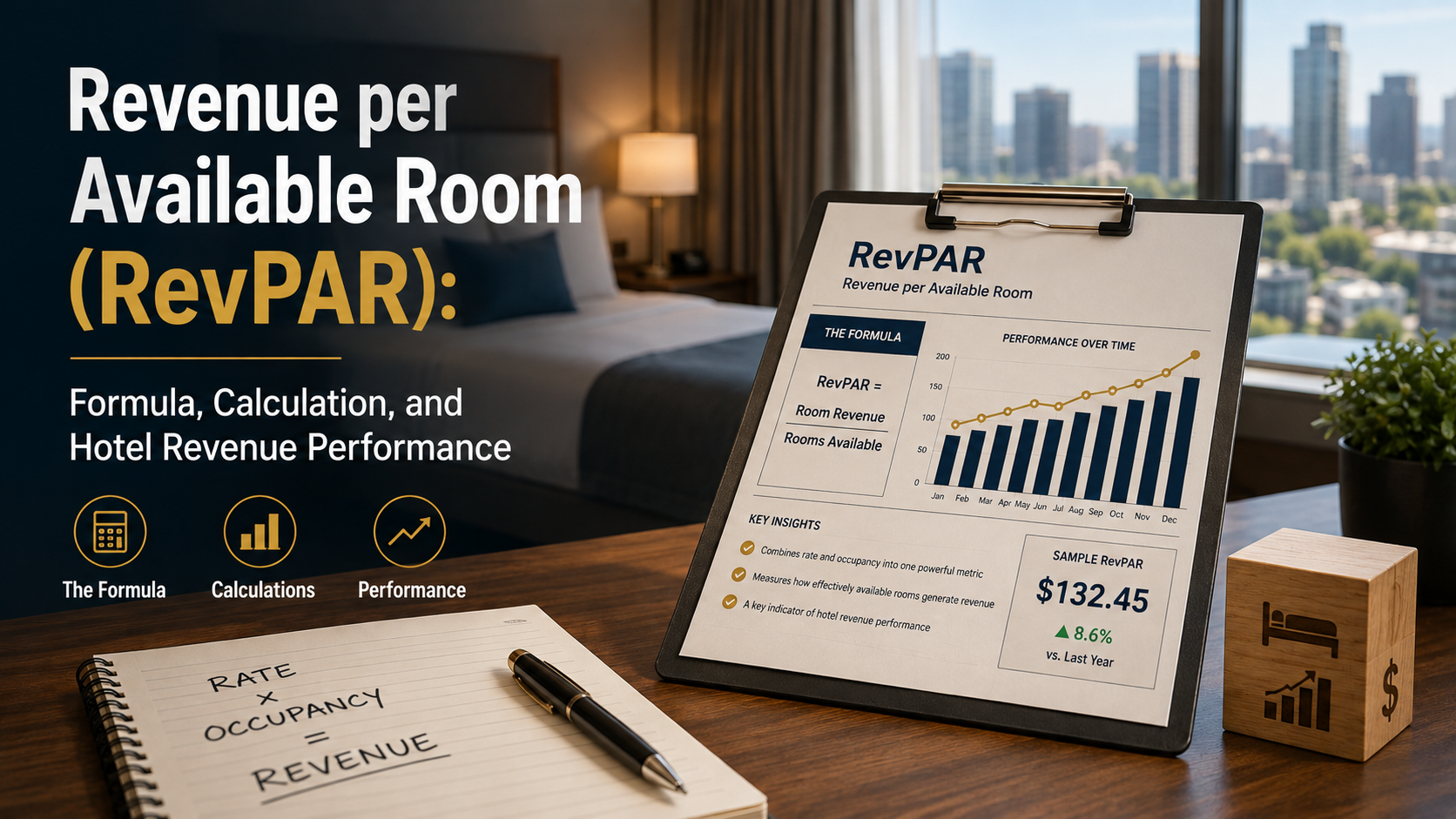
Revenue per available room, or RevPAR, is room revenue divided by the number of room nights available for sale. It reflects both occupancy and room rates.
If the contract uses RevPAR to assess performance, specify the comparison method and how the competitive set can change.
Operating Profit and Agreed Financial Targets
Revenue measures should be considered alongside profitability. Define the financial target, accounting treatment, and relationship to the approved plan.
Service Quality and Guest Experience Expectations
Document service expectations and how concerns are reviewed. Clarify whether guest satisfaction measures support routine oversight, corrective action, or specific contractual remedies.
Explain What Happens When Results Fall Short
Testing Periods and Consecutive Failures
Identify when formal testing begins, how often it occurs, and whether failure must persist across multiple periods.
Exceptions, Cure Rights, and Corrective Action
Exceptions may exclude specified events from testing. A cure right allows the operator to remedy a failure before further action becomes available.
Both can materially affect the protection.
When Underperformance Can Trigger Termination
Follow the provision through to its outcome. Consider this
hypothetical structure:
| Element | Illustrative provision |
|---|---|
| Benchmark | A defined revenue comparison and operating-profit threshold |
| Testing period | Annual assessment beginning after an agreed stabilization period |
| Failure condition | Both thresholds missed for two consecutive testing years |
| Exceptions | Specified events assessed under defined adjustment rules |
| Cure opportunity | A contractual opportunity to remedy the qualifying failure |
| Remedy | Owner termination rights if the failure remains uncured and notice requirements are met |
Under this example, missing one target in one year would not trigger termination. That is why owners must evaluate the entire mechanism rather than the benchmark alone.
Protect the Identity and Guest Relationships of Boutique Hotels
Distinctive design, service, and local connections are part of the investment. The agreement should explain how decisions affecting them are governed.
Translate Brand Standards Into Clear Decision Rights
Property Name, Design, Amenities, and Service Changes
Identify which changes require consent, particularly those affecting positioning, guest expectations, or significant expenditure.
Local Partnerships, Programming, and Purchasing Flexibility
Consider whether the approval process covers changes to the hotel’s name, visual identity, room design, or signature amenities. These decisions can affect the reason guests choose the property.
Clarify the operator’s freedom to introduce local partnerships and experiences, along with any required suppliers or purchasing programs.
For example, a mandatory purchasing program could replace the local bakery supplying a boutique hotel’s breakfast. Ask whether ownership can retain that supplier and who approves a substitution. This is an illustrative scenario, not a ROAM case study.
Evaluate the financial effect separately: identify how a supplier change would affect purchasing costs, any operator rebates, and the amount charged to the property.
Use the proposed contract to test promises made during operator selection:
| Operator promise | What to clarify |
|---|---|
| “We’ll preserve your identity.” | Approval rights over material changes to branding, design, service, and programming |
| “You’ll retain visibility.” | Reports, delivery schedules, system access, and supporting records |
| “Our incentives are aligned.” | Compensation formulas, profit definitions, thresholds, and additional charges |
| “We offer flexibility.” | Initial term, renewal rights, notice, exit costs, and transition support |
Clarify Access to Digital Assets, Systems, and Guest Data
Website, Domain, Content, and Marketing Accounts
Record who owns each asset, who administers it, and what rights continue after termination. Ownership, licensing, and account access can differ.
Reservation Systems, Data Access, and Export Procedures
Specify the records ownership can access and receive during a transition. Confirm export formats, timing, costs, and platform restrictions.
Permitted Data Use and Privacy Responsibilities
Clarify how each party may use guest information and who handles privacy and security obligations. Transferability depends on contractual rights, platform rules, and applicable law.
Clarify Staffing and Hospitality Risk Responsibilities
Determine which entity employs the team and who handles hiring, supervision, payroll, benefits, and employment claims.
Review insurance and indemnification—the provisions allocating responsibility for certain claims and losses—with hospitality counsel. Confirm how the contract addresses incidents, compliance failures, and conduct outside the operator’s authority.
For each responsibility, ask three questions: Who performs it, who pays, and who bears the consequences if something goes wrong?
Review Contract Length, Renewal, and Exit Provisions
Assess the commitment against your investment horizon, including a potential sale or change in strategy.
Assess the Initial Commitment and Renewal Process
Renewal Options and Notice Deadlines
Identify who can renew, whether renewal is automatic, and when notice must be delivered. Review any changes in compensation or other terms upon renewal.
Sale, Assignment, and Changes in Control
Record notice dates in the owner’s contract calendar and identify the person responsible for responding. A renewal decision should leave time to assess performance and alternatives.
Clarify whether a sale permits termination, requires consent, or leaves the contract in place. Address changes in ownership of the operating company as well as the property.
Ask how the operator will cooperate with a proposed sale, including access to records and communication with a buyer. Review any consent conditions or transfer costs before assuming the agreement can move with the asset.
Understand Termination Rights and Transition Obligations
Termination Grounds, Notice, and Exit Costs
Separate termination for contractual breach or underperformance from any right to end the relationship without cause. Examine notice, cure periods, fees, and other conditions.
Existing Reservations, Deposits, and Final Accounting
Establish responsibility for future bookings, guest communications, deposits, outstanding payments, and reconciliation.
Staff, Vendor, System, and Account Handover
Before signing, confirm that the transition provisions address:
- Continued service for existing reservations.
- Delivery of financial and operational records.
- Reconciliation of deposits, payments, and outstanding charges.
- Transfer or replacement of permitted account and system access.
- Guest-data exports consistent with applicable rights and obligations.
- Staff and vendor arrangements.
- Transition assistance, deadlines, and associated costs.
An exit right is more useful when the property can continue operating through the change.
Questions to Ask Before Signing
Before committing, make sure you can answer:
- What is included, and what costs extra?
- Which decisions require my approval?
- What records and systems can ownership access?
- How is performance measured, and what remedies are available?
- What operating cash and capital must ownership provide?
- How are the property’s identity and guest relationships protected?
- What happens if the property sells or the relationship ends?
The proposed terms should support how you intend to own the asset, oversee performance, and plan for its future.
Choosing a Management Partner for Your Boutique Hotel?
Talk with ROAM about your hotel’s goals, operating needs, and what you’re looking for in a management partnership.
Discuss Your Hotel With ROAMFrequently Asked Questions
How Do Hotel Management Agreements Differ From a Franchise or Lease?
Hotel management agreements appoint a company to run the business on behalf of its owner. A franchise generally provides access to a brand and its systems, while the owner arranges hotel management separately. Under a lease, a tenant typically pays rent to the owner and runs the business under the agreed terms.
What Should an Owner Compare Between Hotel Management Proposals?
Compare the scope, total charges, reporting commitments, approval process, and exit conditions. A lower management fee does not necessarily mean a lower total cost. The owner should request a calculation showing the amount payable under the same revenue assumptions for each proposal.
Can an Owner Stay Involved After Hiring a Hotel Management Company?
Yes. The management agreement should establish how the owner participates in major decisions while delegating daily work. Regular financial reviews and direct access to records help the owner stay informed without becoming involved in every operational detail.
Which Operating Standards Should an Independent Hotel Accept?
Owners should examine which standards are mandatory, what they cost, and whether they suit the hotel’s positioning. Hotel operators may propose shared purchasing or service requirements, but the owner should understand how these affect the guest experience and the freedom to retain local character.
What Makes a Hotel Management Performance Test Useful?
A performance test needs a defined benchmark, a testing period, relevant exceptions, and a clear consequence if the threshold is missed. The owner should understand when the test applies and what remedy becomes available under the management agreement.
What Should an Owner Clarify About Capital Contributions?
The owner should understand how capital needs are identified, approved, and funded. Ask how reserve contributions are calculated and when additional funding may be required.
These commitments can affect cash available to ownership even when the hotel is meeting its revenue targets.
How Should Owners Evaluate Whether a Management Approach Fits Their Hotels?
Ask the prospective operator how staffing, seasonality, amenities, and renovation plans would shape its approach to your property.
For a portfolio, request property-level reporting and a clear method for allocating shared costs.
Walk through a spending request, a missed target, and a potential sale to test whether the proposed agreement fits your investment strategy.
What Should Owners Resolve Before Moving From a Proposal to a Signed Contract?
Compare the final contract and schedules with the proposal. Every material promise about services, fees, support, and flexibility should have a clear contractual counterpart.
Confirm who leads onboarding, which decisions require owner involvement, and when reporting begins.
Have hospitality counsel resolve inconsistencies before signing so both parties understand their obligations.
More Recent Articles