How Much Does It Cost to Build a Hotel? (2026 Guide)
How Much Does It Cost to Build a Hotel? (2026 Guide)

How Much Does It Cost to Build a Hotel? A Boutique Hotel Guide
Building a hotel is one of the most capital-intensive decisions an investor can make, and one of the most creative. Before the first sketch, you need a realistic view of the total project cost: land, construction, design, furniture, financing, and the money needed to open the doors and carry the hotel until it stabilizes.
This guide is for developers, owners, and investors. It uses the most widely cited U.S. benchmark, explains the cost drivers, gives an illustrative range for a boutique hotel, and shows when building makes more sense than buying.
The Average Cost to Build a Hotel in 2025
So, how much does it cost to build a hotel? The best free benchmark is the HVS U.S. Hotel Development Cost Survey 2025, based on budgets "from hotel projects proposed or under construction during the 2024 calendar year," including both ground-up and conversion projects. Across all properties, the median development cost was $219,000 per room.
That average hides a wide range. A limited-service hotel and a luxury resort are entirely different buildings, and the cost to build a hotel rises steeply with service level, amenities, and finish.
Hotel Construction Cost per Room (per Key)
Developers and lenders compare hotels by cost per key, because it normalizes projects of different sizes. HVS's 2025 medians per room:
| Hotel type (HVS category) | Median development cost per room |
|---|---|
| Limited-service and midscale extended-stay | $167,000 to $169,000 |
| Select-service | About $223,000 |
| Upscale extended-stay | About $265,000 |
| Full-service | $409,000 |
| Luxury | Over $1,057,000 |
| All properties | $219,000 |
What Does a 100-Room Hotel Cost to Build?
Multiply by keys for a rough total. At the all-property median, a 100-room hotel would be about $21.9 million; at the select-service median, about $22.3 million; and at the full-service median, about $40.9 million. These are starting points derived from medians, not quotes.
What About Cost per Square Foot?
Per-square-foot figures depend heavily on room size and public space, so per-key benchmarks are more useful at the feasibility stage. For hard costs per square foot, HVS's own advice applies: "Construction and FF&E design and procurement firms are the best sources for obtaining hard costs."
Costs by Hotel Type: Boutique, Luxury and Small Hotels
Boutique Hotel Development Cost
HVS has no "boutique" category. A boutique hotel of 20 to 60 keys usually falls between select-service and full-service, or into luxury, depending on F&B, amenities, and the level of finish. The sensible way to frame its cost is as a range rather than a single number.
Where your project lands in that range depends on a few choices: whether you include a full restaurant and bar or a lighter café concept, how much meeting or event space you plan, the room size, and the quality of finishes and custom millwork. Each of those choices also changes how the hotel will be staffed and how much rate it can command, so cost and revenue should be modeled together from the start.
Extrapolation, not published data: boutique build costs are not published separately; the range below is extrapolated from the HVS 2025 per-room segment medians above. We bracket it with the select-service median ($223,000 per key) as the floor, because a boutique hotel with a lighter café concept and limited meeting space is built much like a select-service property, and the full-service median ($409,000 per key) as the upper case, because a full restaurant, bar, and event space push it into full-service territory. Design-led luxury boutiques with custom finishes trend toward the luxury median (over $1,057,000 per key). Treat these as sourced segment figures applied to a boutique format, not a boutique benchmark.
Illustrative example (derived from HVS 2025 medians, not a quote): a 30-room boutique hotel would be roughly
$6.7 million at the select-service median ($223,000 × 30) and roughly
$12.3 million at the full-service median ($409,000 × 30). A design-intensive luxury boutique could exceed $31.7 million (over $1,057,000 × 30).
Luxury and 5-Star Hotels
A luxury or five-star hotel carries the highest cost per key in the survey, over $1,057,000. Larger rooms, premium materials, spa, and multiple F&B outlets all add up.
Small Hotels
Smaller hotels do not always cost less per key. Fixed elements, such as the lobby, kitchen, back-of-house, elevators, and systems, are spread over fewer rooms, so the cost per room can rise as the room count falls.
Hard Costs, Soft Costs, Land and Pre-Opening
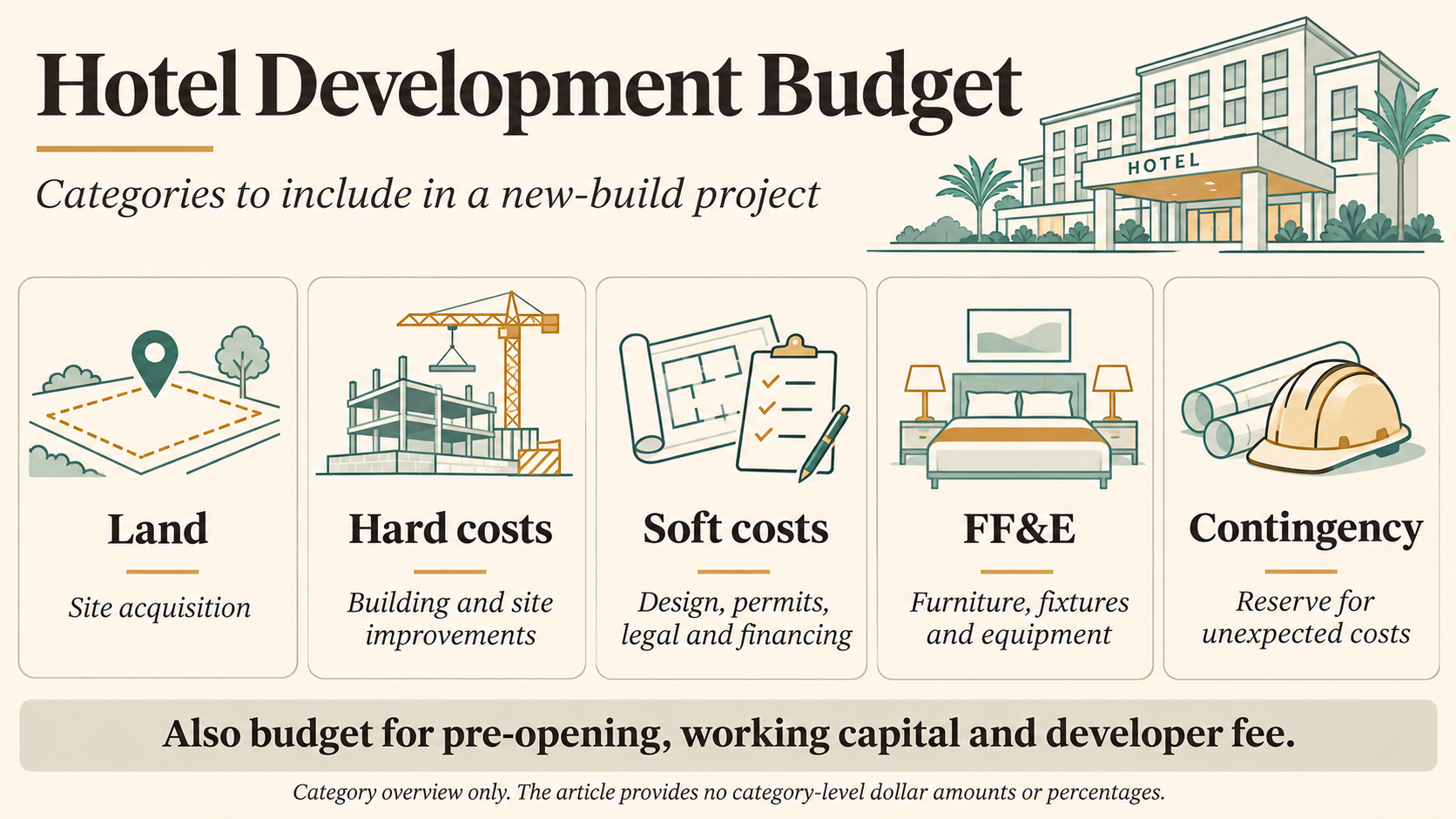
HVS breaks development budgets into six categories. Understanding each one is how you avoid surprises.
Land Cost
Land varies more than any other line. Location drives rate, but it also drives land cost, and zoning determines what you can build. Review boutique hotel zoning requirements early.
Hard Costs: Building, Site Improvements and FF&E
Building and site improvements are the largest share of the budget: structure, systems, finishes and site work. Furniture, fixtures and equipment (FF&E) covers everything from beds to kitchen equipment. For a design-led boutique hotel, FF&E and finishes are where the guest experience is built, and where budgets most often stretch.
Soft Costs
Architecture, interior design, engineering, permits, legal, insurance during construction, and financing costs. Debt costs matter: HVS notes "the high cost of debt and capital, coupled with elevated construction costs, continues to weigh heavily on new hotel development activity," with lenders "often requiring more equity and applying conservative underwriting standards." For loan options, see our hotel financing guide.
Pre-Opening and Working Capital
Pre-opening costs cover hiring and training, systems, launch marketing, and opening supplies. Working capital carries the hotel through its ramp-up, often a year or more before it stabilizes. Many first-time developers underestimate this line.
Developer Fee
The final HVS category compensates the developer for managing the project.
Key Cost Drivers to Watch
- Location and land: urban sites cost more but can support higher rates
- Service level: F&B, meeting space and spa are expensive to build and staff
- Design and finish: the boutique premium lives here
- Construction market: Cushman & Wakefield's European Hotel Investor Compass 2026 reports that "68% of investors identify rising construction costs as the most significant challenge" (European survey)
- Timeline: HVS notes "the typical hotel development process can last three to five years," so budgets should be adjusted for inflation
A final caution from HVS itself: the survey "should not be relied upon to determine the cost of actual hotel projects." Use it to frame feasibility, then get real estimates.
Common Budget Mistakes in Hotel Development
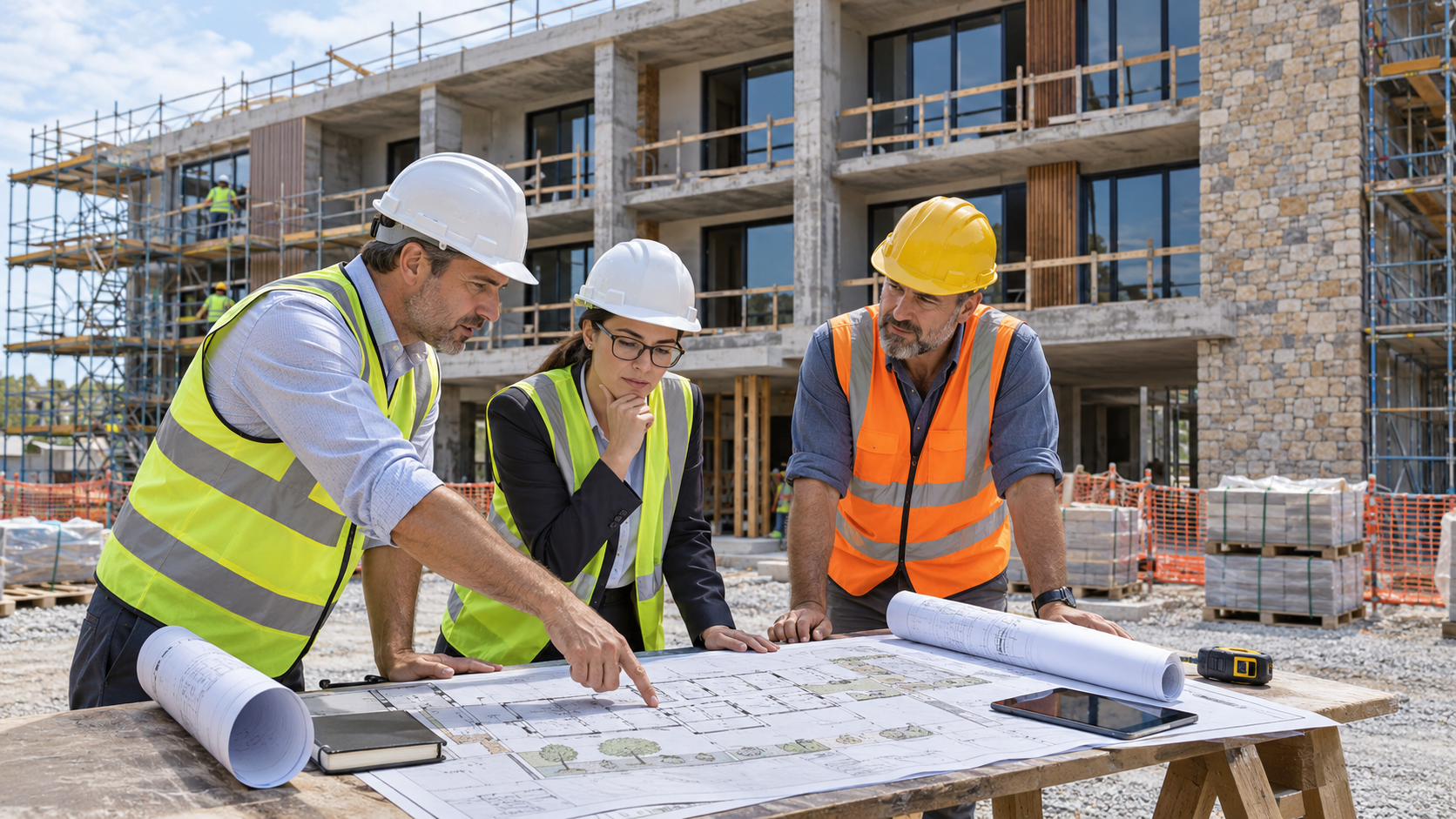
Even experienced developers get caught by the same issues. Watch for these when you build your total project budget:
- Using today's prices for a project that opens in three to five years. Escalate hard costs for the full timeline.
- Underfunding FF&E and design. In a boutique hotel, the interiors are the product. Cutting them late in the process undermines the rate you underwrote.
- Treating pre-opening as an afterthought. Hiring, training, systems, and launch marketing need their own line and their own schedule.
- Thin contingency. Conversions and historic buildings in particular hide surprises behind the walls.
- Designing without the operating model. A layout that needs extra staff on every shift adds cost every day the hotel is open.
- Ignoring the ramp-up. Revenue rarely starts at stabilized levels; working capital bridges the gap.
A disciplined budget does not limit creative vision. It protects it, so the design you planned is the design you open.
Build vs. Buy: What an Existing Hotel Building Costs
Building is not the only route. JLL's 2025 U.S. Hotel Investment Trends release (January 2026) points to "the historic discount to replacement costs," meaning existing hotels are often trading for less than it would cost to build them. Converting an existing building is a third path; see our guide to converting an existing building into a boutique hotel, or consider buying an existing boutique hotel instead. For what a hotel building costs to buy and how returns compare, see our guide on whether a hotel is a good investment.
Building still makes sense when the market lacks the product you want to create, when land is available at the right price, and when
boutique hotel market demand supports a new, distinctive hotel.
Construction Sets the Investment; Operations Decide the Return
Decisions made before opening shape the hotel for decades: staffing levels, back-of-house flow, F&B layout, energy systems, and the guest experience that supports ADR. That is why experienced owners line up the operator who will run the hotel well before it opens.
Roam Hospitality is not a construction company. We are a boutique and independent hotel management company that owners bring in to run the hotel, with services such as
food & beverage concept development.
Building or acquiring a boutique hotel?
Partner with Roam Hospitality to have an experienced operator run your hotel.
Frequently Asked Questions
How much does it cost to build a 20-room boutique hotel?
As an illustration derived from HVS 2025 medians, roughly $4.5 million at the select-service median ($223,000 × 20) to about $8.2 million at the full-service median ($409,000 × 20), before market-specific land costs and design choices. Get real estimates for your site.
What is the average hotel construction cost per room?
HVS puts the 2025 median development cost at $219,000 per room across all hotel types, from $167,000 to $169,000 for limited-service to over $1,057,000 for luxury.
Is it cheaper to build a hotel or renovate an existing property?
Often renovating or converting is cheaper and faster, especially when existing hotels trade below replacement cost, as JLL reported for 2025. The answer depends on the building's condition and what the market needs.
How much working capital does a new hotel need?
Enough to cover operating shortfalls until the hotel stabilizes. HVS includes pre-opening and working capital as a separate budget category; size it with your lender and operator.
What is a hotel building management system?
A building management system (BMS) controls HVAC, lighting, and energy use. Specifying one during construction can lower long-term operating costs.
More Recent Articles