Short-Term Rental Zoning Laws vs Boutique Hotel Zoning: Where Each Can Operate
Short-Term Rental Zoning Laws vs Boutique Hotel Zoning: Where Each Can Operate
By Elliott Caldwell —
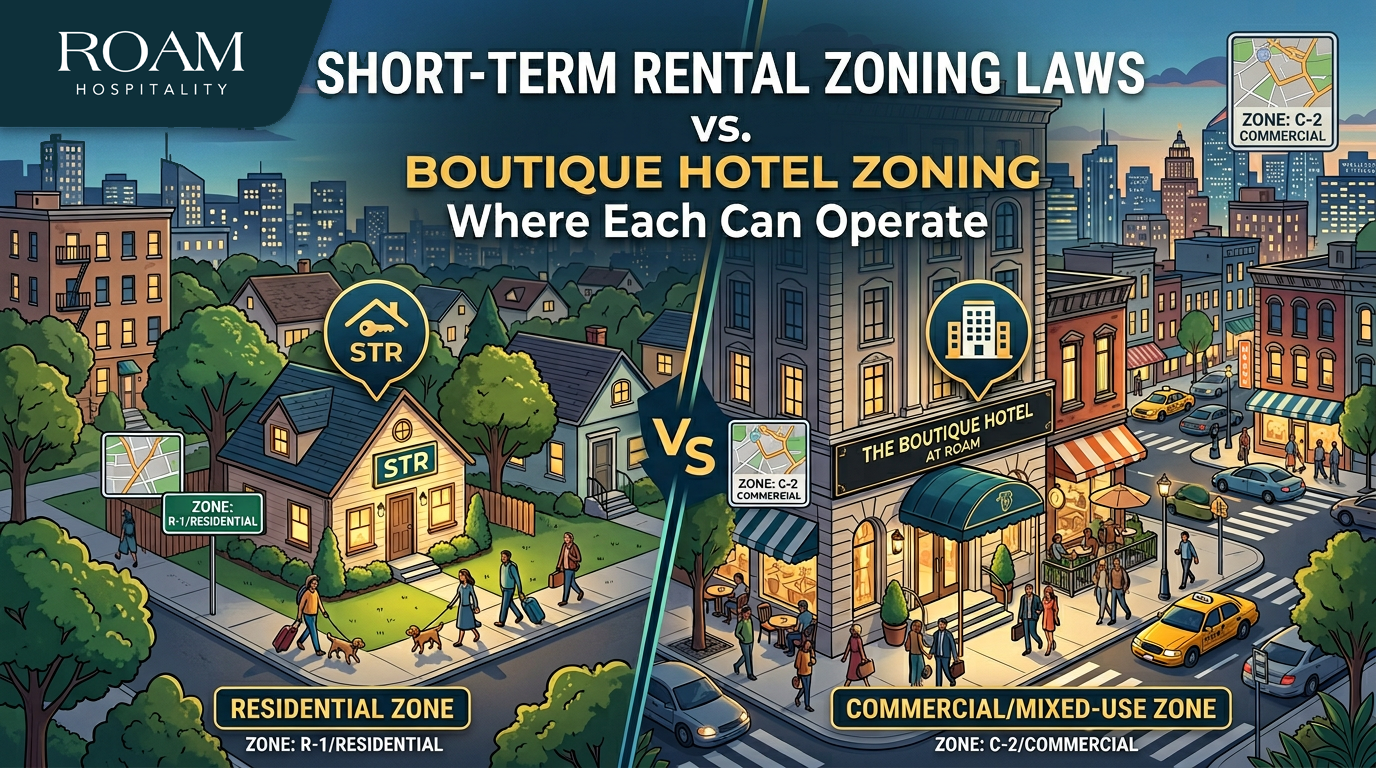
Boutique hotels and short-term rentals operate under completely different zoning frameworks, and that difference determines where each model can legally operate, scale, and succeed.
These differences are shaped by local zoning regulations, including short-term rental zoning laws, permitting requirements, zoning overlays, and STR regulations that determine where each type of hospitality use is allowed.
Short-term rentals typically exist within residential zoning, where they are often restricted, capped, or limited to primary residences. Boutique hotels, by contrast, operate within commercial zoning, where hospitality is an expected and permitted use.
In practice, this means housing regulations often limit short-term rentals, while boutique hotels face clearer — but more demanding — commercial requirements, including permitting, insurance, and compliance with established zoning regulations.
Most investors compare these models based on revenue potential or operational complexity. But those factors only matter after one critical question is answered:
Is this strategy actually viable in the market you’re entering?
That answer depends on how local regulations treat residential versus commercial hospitality. In some markets, short-term rentals can scale quickly with minimal restrictions. In others, regulations effectively prevent investor-owned STR portfolios altogether. Boutique hotels, while more complex to develop, often operate within clearer regulatory pathways once approved.
Understanding this difference is what allows investors to evaluate not just which model performs better, but which one can actually be executed.
Why Short-Term Rentals Are Restricted in Urban Markets
Short-term rental zoning laws are often shaped by one primary concern: protecting residential housing from being converted into full-time hospitality use.
Because short-term rentals operate within residential zoning, cities frequently treat them as an exception rather than a permitted use. As demand for short-term rentals has grown, many urban markets have introduced regulations to limit their impact on housing supply, neighborhood stability, and local infrastructure.
These restrictions commonly include:
- Primary residence requirements
- Limits on the number of nights a property can be rented
- Caps on non-owner-occupied STR permits
- Geographic bans in specific neighborhoods or districts
In cities like Santa Monica and Los Angeles, short-term rental zoning laws often require that a property be the owner’s primary residence, along with registration, permits, and proof of insurance. In Santa Monica, for example, short-term rentals are limited to home-sharing arrangements, effectively preventing full-time investor-owned STR properties.
These types of zoning regulations make it difficult — if not impossible — to scale a portfolio in highly regulated urban markets.
What this means for investors
These policies aren’t just regulatory hurdles — they directly limit how short-term rentals can be used as an investment strategy.
Primary residence requirements, in particular, restrict the ability to build a scalable portfolio. Even in markets where STRs are technically allowed, the structure of the regulations can make long-term expansion difficult or impossible.
In many urban markets, short-term rental zoning laws don’t just regulate STRs—they limit investor participation altogether.
This is why understanding how a city treats residential hospitality use is critical before evaluating revenue potential or
operational strategy.
Boutique Hotel Zoning and the Core Structural Difference
Why Boutique Hotels Operate Within Clearer Commercial Frameworks
Boutique hotels are classified as commercial lodging, which means they operate within zoning frameworks specifically designed for hospitality use.
In most markets, hotels are permitted in:
- Commercial districts
- Mixed-use developments
- Tourism or hospitality zones
- Transit-oriented development areas
Because of this, cities typically plan for hotel development as part of broader economic and tourism strategies. Rather than being treated as an exception, hotels are integrated into how a market is designed to accommodate visitors.
In areas like Bend, hotel development has expanded alongside retail, dining, and entertainment infrastructure—reflecting how hospitality is often aligned with commercial growth rather than restricted by residential limitations.
What this means for investors
Boutique hotels operate within a more predictable regulatory structure. The pathway is clearer—but also more demanding.
Compared to short-term rentals, hotels typically require:
- Commercial zoning approval
- Compliance with building and safety codes
- Higher upfront capital and planning
While this creates a higher barrier to entry, it also removes many of the limitations that affect residential properties.
Boutique hotels are not easier to develop, but they are often easier to scale once approved.
Once a project is operational, performance depends heavily on how the asset is managed, priced, and positioned within the market — factors that extend beyond zoning into areas like boutique hotel asset management, revenue management, and day-to-day operations.
The Core Difference: Residential vs Commercial Zoning
The most important distinction between boutique hotels and short-term rentals isn’t operational — it’s structural.
Short-term rentals exist within residential zoning, where they are often restricted, capped, or treated as exceptions.
Boutique hotels operate within commercial zoning, where hospitality is an intended and permitted use.
Short-term rental zoning laws govern exceptions within residential areas, while boutique hotels operate within established commercial frameworks.
Why this matters
This distinction determines:
- Where you can operate
- How many units you can control
- Whether you can scale your investment
- How predictable your long-term strategy will be
It’s not just a regulatory detail—it’s a constraint that shapes the entire investment model.
Short-Term Rentals vs Boutique Hotels: Zoning Comparison
To understand how zoning impacts each model, it helps to look at the differences side by side.
- Zoning Type
Short-term rentals operate within residential zoning, where they are often treated as exceptions and governed by short-term rental zoning laws and STR regulations. Boutique hotels operate within commercial zoning, where hospitality is a permitted and expected use. - Regulatory Structure
Short-term rentals typically require permits, licensing, and compliance with zoning overlays that define where they can operate. Boutique hotels must meet zoning regulations, building codes, permitting processes, and insurance requirements tied to commercial development. - Scalability
Short-term rentals are often limited by permit caps, primary residence requirements, and geographic restrictions. Boutique hotels, while more complex to develop, are generally easier to scale once approved within a commercial framework. - Speed to Market
Short-term rentals can often be launched quickly in STR-friendly markets. Boutique hotels require longer development timelines due to zoning approval, construction, and planning requirements. - Primary Constraint
Short-term rentals are constrained by regulatory limitations within residential areas. Boutique hotels are constrained primarily by capital, development complexity, and approval processes.
This comparison highlights a key takeaway: short-term rentals are easier to start but harder to scale in regulated markets, while boutique hotels are harder to start but often easier to scale once established.
Where Short-Term Rentals Are Easier to Operate
Where Short-Term Rental Zoning Laws Are More Favorable
While short-term rental zoning laws restrict investor activity in many urban markets, there are still areas where STRs are widely permitted and can be operated with relatively few limitations.
These tend to include:
- Lower-density markets with less housing pressure
- Tourism-driven destinations where short-term rentals support the local economy
- Secondary cities with fewer restrictions on residential use
In these types of markets, short-term rentals are often treated as a natural extension of residential real estate rather than a competing use. This allows investors to acquire and operate multiple properties without the same level of regulatory friction found in larger cities.
Locations such as Gatlinburg and Flagstaff are often cited as examples where STR activity is more accessible, with fewer permit restrictions, more flexible zoning overlays, and stronger alignment with local tourism demand.
What this means for investors
In STR-friendly markets, the model becomes significantly easier to execute.
Investors can:
- Launch properties faster without complex development timelines
- Scale by acquiring multiple units across a defined area
- Operate within residential frameworks that allow for flexibility
However, this advantage is entirely dependent on location. A strategy that works in one city may not be viable in another, even if demand and pricing look similar on the surface.
The ease of operating short-term rentals is not universal—it is tied directly to how a city structures its zoning and development priorities.
When Boutique Hotels Become the More Viable Strategy
Boutique hotels become a stronger option in markets where short-term rental activity is limited by residential constraints or enforcement.
This is especially true in:
- Dense urban areas where housing supply is protected
- Markets with strict permit caps or zoning restrictions
- Cities that prioritize commercial hospitality development
In these environments, hospitality is expected to take place within designated commercial space rather than residential neighborhoods.
Because of this, a hotel project can often move forward through a defined approval process, even if that process involves more planning, documentation, and coordination with a local zoning board.
What this means for investors
For investors evaluating real estate opportunities at a higher level, boutique hotels offer a different kind of advantage.
Instead of navigating restrictions on residential use, the focus shifts to:
- Securing the right location within a commercial area
- Aligning with land development expectations
- Moving through a structured zoning application process
This often involves working through development regulations and building regulations that are more detailed than those required for residential properties, but also more consistent from one project to the next.
In markets where STRs are restricted, boutique hotels are not just an alternative — they are often the only way to operate a
scalable hospitality business.
How City Development and Zoning Decisions Shape Opportunity
Every city approaches hospitality differently, and those decisions directly impact what investors can build.
Some cities prioritize residential preservation, limiting short-term rental activity. Others actively support hospitality development through designated commercial corridors, mixed-use planning, and infrastructure investments tied to tourism.
In certain cases, a zoning request or zoning application may be required to move a project forward, particularly when converting an existing building or developing a new hotel building within a specific area.
These decisions don’t just affect compliance—they determine:
- What type of property can be developed
- How much space can be allocated to hospitality use
- Whether supporting uses like restaurant space or shared amenities are permitted
For investors, this reinforces a key principle:
Real estate strategy is not just about demand — it’s about what a city is willing to approve, support, and sustain over time.
How to Choose Between Short-Term Rentals and Boutique Hotels Based on Zoning
For investors evaluating hospitality opportunities, the decision between short-term rentals and boutique hotels often comes down to how a specific market structures its zoning regulations and development priorities.
The following framework can help guide that decision:
- If short-term rental zoning laws are restrictive
In markets with primary residence requirements, permit caps, or strict zoning overlays, scaling a short-term rental portfolio may not be viable. In these cases, boutique hotels often provide a more stable and scalable path within commercial zoning. - If short-term rental regulations are flexible
In markets with fewer permit restrictions and more permissive residential zoning, short-term rentals can be launched quickly and scaled across multiple properties with less friction. - If the market prioritizes commercial development
Cities that invest in tourism infrastructure, mixed-use development, and hospitality corridors often create stronger long-term opportunities for boutique hotels. - If speed and lower upfront investment are priorities
Short-term rentals typically require less capital and can be operational much faster than hotel developments, making them more accessible in the early stages of investing. - If
long-term scalability and control are the goal
Boutique hotels, while more complex to develop, operate within clearer zoning frameworks that allow for more predictable scaling once approved.
Ultimately, the right strategy depends less on the model itself and more on how local zoning regulations, permits, and development policies shape what is actually possible in a given market.
Frequently Asked Questions
Where are short-term rentals and boutique hotels allowed to operate?
Short-term rentals are typically allowed within residential zoning, but often with restrictions such as primary residence requirements, permit limits, or zoning overlays that define where rental activity can occur. Boutique hotels, on the other hand, are generally permitted in commercial or mixed-use zones where hospitality is an expected use.
This means each model has access to different types of properties and locations depending on how a city structures its zoning laws.
What are short-term rental zoning laws, and how do they affect investors?
Short-term rental zoning laws are local zoning regulations that determine where short-term rentals are legally permitted and how they can operate within a specific area.
These laws often include requirements such as permits, licensing, insurance, and limits on non-owner-occupied properties. In many cities, short-term rentals are allowed but restricted in ways that reduce scalability for investors.
Do short-term rentals require permits or zoning approval?
Yes, most cities require permits or zoning approval to operate a short-term rental.
In many cases, each address used for short-term rental purposes must be registered and approved. Requirements may include compliance with zoning regulations, proof of insurance, and adherence to local rules related to parking, occupancy, and safety.
Why are short-term rentals restricted in some cities but hotels are not?
Short-term rentals are often restricted because they operate within residential zoning, where cities aim to preserve long-term housing and neighborhood stability.
Hotels, by contrast, are classified as commercial properties and are typically allowed in designated hospitality or mixed-use areas. This creates a situation where short-term rentals may be limited or capped, while hotels continue to operate within established zoning frameworks.
What are zoning overlays, and how do they affect short-term rentals?
Zoning overlays are additional zoning regulations that define where short-term rentals are permitted within a city.
These overlays may allow short-term rentals in certain districts while restricting them in others, often to manage tourism and protect residential areas. For investors, zoning overlays can determine whether a property is eligible for short-term rental use.
How do zoning regulations impact scalability for each model?
Zoning regulations affect how easily each model can grow.
Short-term rentals may be limited by permit caps, primary residence rules, or geographic restrictions, making it difficult to scale across multiple properties in certain cities. Boutique hotels, while more complex to develop, are often easier to scale once approved because they operate within commercial zoning.
Do zoning laws vary significantly by city?
Yes, zoning laws vary widely depending on the local government and its priorities.
For example, cities like Las Vegas have implemented structured short-term rental regulations that include permit caps, designated zoning overlays, enforcement mechanisms, and licensing requirements, creating a controlled framework that limits where and how STRs can operate.
Other cities may have more flexible approaches or different zoning frameworks depending on tourism demand and housing pressures.
Because of this, investors must evaluate how each city regulates both residential and commercial hospitality use before making a decision.
More Recent Articles