Hotel Investment Strategies: A Guide for Owners
Hotel Investment Strategies: A Guide for Owners


Hotel Investment Strategies: How Owners and Investors Maximize Returns

Hotels are more than buildings; they are operating businesses wrapped in real estate. That is what makes them both rewarding and demanding as investments. Two investors can buy the same property at the same price and end up with very different outcomes, because the strategy and the execution behind it decide the result.
This guide is for owners and investors acquiring, repositioning, and operating physical hotel assets, especially independent and boutique hotels. We cover the main hotel investment strategies, how value-add and repositioning plays work, how to build a hotel portfolio, how institutional capital approaches the sector, and how to evaluate a deal before you commit.
What Are Hotel Investment Strategies?
A hotel investment strategy is the plan that connects what you buy, what you do to it, and how you exit. It defines your risk tolerance, the capital you will need beyond the purchase price, your hold period, and the operating result the business plan depends on.
The market backdrop matters. JLL's
2025 U.S. Hotel Investment Trends report (January 2026) found that U.S. hotel transaction volume rose "17.5% year-over-year to reach $24 billion" in 2025. Investors cited "the historic discount to replacement costs and favorable yield profiles," and the cost of debt fell "by almost 300 basis points" since September 2024, enabling "positive leverage." JLL also expects supply growth to stay "well below the long-term average of 1.7%."
Performance was uneven. JLL describes 2025 RevPAR as "K-shaped": luxury up 3%, midscale down 2.8% and economy down 4.4%. Strategy has to account for which part of the market you are buying into.
The Main Hotel Investment Strategies: Core, Value-Add and Opportunistic
Most hotel investors use the same risk spectrum. Cushman & Wakefield's European Hotel Investor Compass 2026 (March 2026) defines it clearly: "CORE: fixed income, prime market & location ... VALUE-ADD: repositioning, moderate CAPEX, market upside; OPPORTUNISTIC: major capex, conversion/new development, emerging market." The survey respondents are European, but the definitions apply anywhere.
Core and Core-Plus
Core investors buy stabilized hotels in prime locations and earn steady income with limited upside. Core-plus adds a modest improvement, such as better revenue management or light refreshes. These hotel investments suit capital that values predictability over growth.
Value-Add
Value-add investors buy hotels with a fixable problem: tired design, weak distribution, poor management or deferred maintenance. They invest moderate capital and lift performance. In the Cushman & Wakefield survey, 80% of investors target value-add.
Opportunistic
Opportunistic investors take on major capital expenditure, conversions or new development. In the same survey, 58% target opportunistic strategies.
Expected Returns by Strategy
Higher risk is expected to earn higher returns. Cushman & Wakefield reports expected return on equity averaging 15.6%: 9.8% for core versus 21.2% for opportunistic, with North American investors expecting 17.4%. These are expectations from a 2026 survey, not guarantees. For ROI basics, cap rates, and how profitable hotels really are, see our guide on whether a hotel is a good investment.
Hotel Investment Strategy Comparison
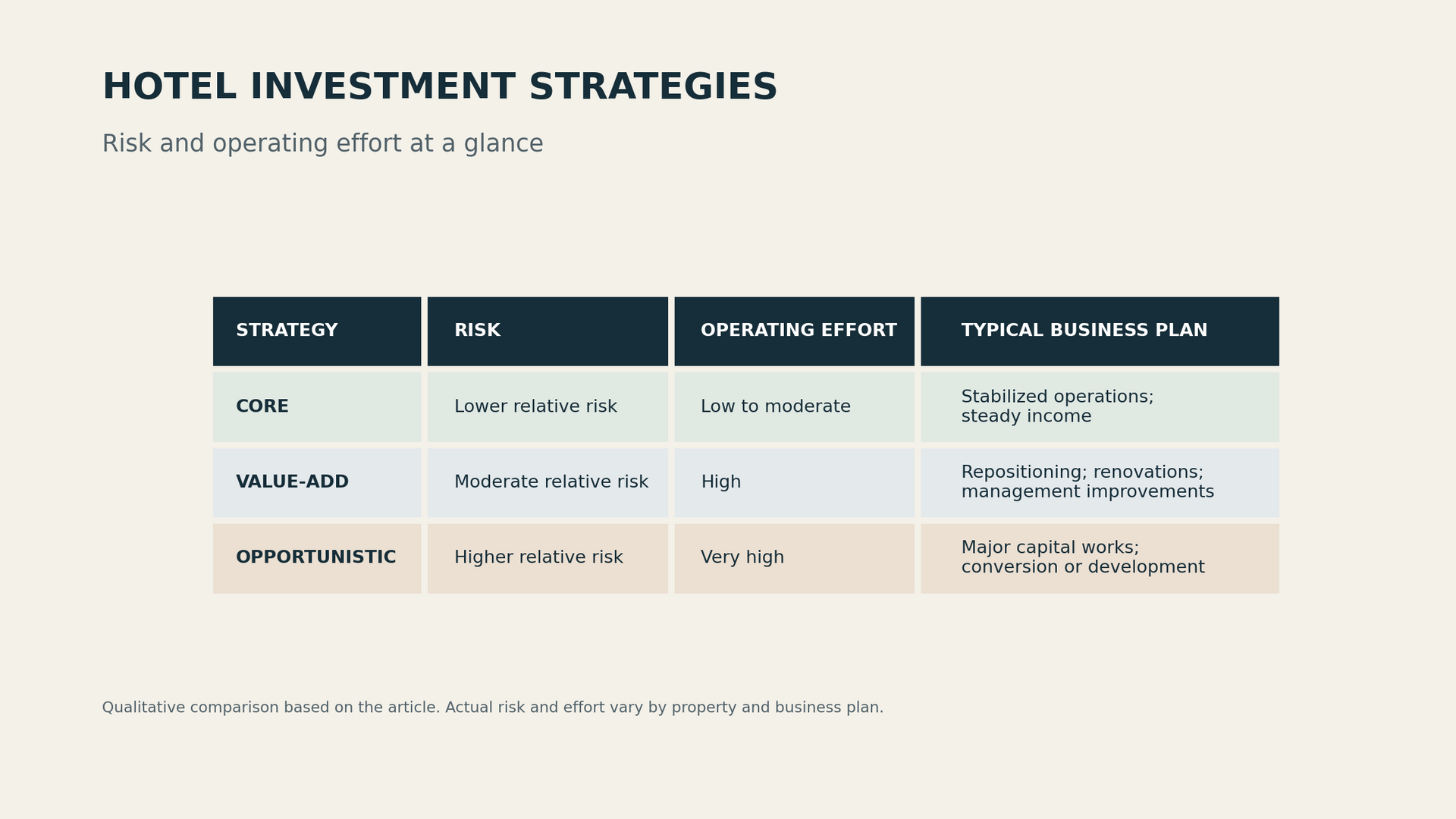
| Strategy | Capital beyond purchase | Operational complexity | Main return drivers | Major risks |
|---|---|---|---|---|
| Core / core-plus | Low | Low to moderate | Stable income, light operational gains | Low yield, overpaying for safety |
| Value-add | Moderate capex | High | Repositioning, management change, rate growth | Execution risk, renovation overruns |
| Boutique conversion | Moderate to high | High | Unique product, ADR premium | Zoning, construction, ramp-up time |
| Opportunistic / development | High | Very high | Creating a new asset below market value | Construction cost, lease-up, market timing |
Value-Add and Repositioning Plays

Value-add is where design-led operators and investors meet. The thesis is simple: buy below what the hotel could be worth, then close the gap through intelligent asset renovations and better operations.
Buy and Reposition an Underperforming Hotel
Repositioning means changing what the hotel is: its guest, its rate tier, its story. Common moves:
- Refresh rooms and public spaces around a clear brand identity
- Replace generic F&B with a concept that draws locals and lifts ADR
- Rebuild distribution to reduce reliance on commissioned channels
- Install revenue management discipline and a proper reporting cadence
- Address deferred maintenance before it becomes a capital emergency
Invest in Boutique Hotel Conversions
Converting an office, warehouse, or historic building into a boutique hotel can create a one-of-a-kind product. It also adds zoning, construction, and ramp-up risk. Our guide to adaptive reuse boutique hotel conversions covers what makes a building a good candidate.
Why Buying Below Replacement Cost Matters
When building new is expensive, existing hotels look attractive. The HVS U.S. Hotel Development Cost Survey 2025 (2024 data) puts the median development cost at $219,000 per room overall and $409,000 per room for full-service hotels. If you can acquire and reposition a hotel for well below that, you start with a margin of safety that a new build does not have.
Ground-Up Development
Development is the opportunistic end of the spectrum: you create a new asset, but you carry construction, entitlement, and lease-up risk. We cover the numbers in detail in our guide to how much it costs to build a hotel.
Building a Hotel Portfolio
One hotel is an investment; several hotels are a portfolio, and portfolio management is a different discipline.
Portfolio Construction and Asset Allocation
Investors building a hotel portfolio typically balance:
- Risk profile: a mix of stabilized core assets and value-add projects
- Geography: markets with different demand drivers and seasonality
- Segment: recognizing the K-shaped market JLL describes, where luxury and midscale moved in opposite directions in 2025
- Hold period: staggered exits so the portfolio is not forced to sell into a weak market
Hotel Portfolio Management and P&L Insights
The value of a portfolio comes from comparable data. Standardized reporting across properties shows which assets are outperforming, which need capital, and which should be sold. A clear boutique hotel asset management framework turns that data into decisions.
Knowing When to Hold, Refinance or Sell
Portfolio strategy also means deciding what to do with each asset once its business plan is complete. A repositioned hotel with stabilized NOI may be worth more to a core buyer than it is to you, since core investors accept lower returns for lower risk. On the other hand, a lower cost of debt, such as the decline of almost 300 basis points JLL reports since September 2024, can make refinancing and holding more attractive than selling. Review every asset at least annually against three questions: has it achieved its plan, what would a buyer pay today, and what would the capital earn if redeployed elsewhere in the portfolio?
How REITs, Funds and Endowments Invest in Hotels
Institutional investors, including REITs, private equity funds, family offices and endowments, usually separate ownership from operations. They set the investment strategy and hire an operator to execute it. That structure is increasingly available to private owners too. Roam Hospitality offers an integrated hotel investment and operating partnership for institutional owners, covering acquisition support, design and repositioning, branding, revenue strategy, operations, and launch and stabilization.
Boutique vs. Branded Hotel Investment Strategies
The choice between an independent boutique hotel and a branded property shapes almost every other decision in your strategy.
Branded hotels bring a reservation system, a loyalty program, and a familiar product. In exchange, owners pay a stack of fees calculated on revenue and must fund brand-mandated renovations. Lenders often find them easier to underwrite, and exit buyers understand them.
Independent and boutique hotels trade that system for control. You set the design, the guest experience, the F&B concept, and the rate strategy. There are no brand fees or brand-mandated renovation plans, but you must build your own demand engine through marketing, distribution, and direct booking. Done well, a distinctive independent hotel can earn a rate premium for being one of a kind; done poorly, it disappears in search results.
For investors, the question is not which model is better in general, but which fits the asset, the market and the business plan. A character-rich building in a design-conscious market often has more upside as an independent. We compare the two models in depth in our guide to franchise versus independent hotels.
How to Evaluate a Hotel Investment
NOI, Cap Rate and Cash-on-Cash Return
Net operating income (NOI) is the starting point. Cap rate is NOI divided by price; cash-on-cash return is annual cash flow after debt service divided by your equity. For context, MMCG Invest's analysis of U.S. hotel cap rates in 2025 (data as of August 2025) put cap rates at "about 8.1% for Luxury & Upper Upscale hotels, 9.5% for Upscale & Upper Midscale and 10.5% for Midscale & Economy."
Occupancy, ADR, RevPAR and GOP
Check whether the seller's results come from rate or volume, how RevPAR compares with the local competitive set, and how much of revenue converts to gross operating profit. Weak GOP conversion with healthy RevPAR often signals a management problem, which is a value-add opportunity.
Capital Expenditures, Debt Service and Cash Reserves
Budget for the renovation plan, a contingency, and an FF&E reserve, and stress-test debt service against a softer year. Financing structure can make or break a strategy; see our hotel financing guide for loan types.
Hotel Investment Risks and How to Mitigate Them
- Seasonality and market demand: underwrite the slow months, not the average. Review boutique hotel market demand data for your market.
- Labor and operating expenses: costs have been rising faster than revenue; budget conservatively.
- Deferred maintenance: commission a property condition assessment before closing.
- Execution risk: a repositioning plan is only as good as the team carrying it out.
Building a Long-Term Hotel Investment Strategy
The investors who do best in hotels tend to follow a repeatable process rather than chasing individual deals:
Define your thesis. Which strategy (core, value-add, or opportunistic), which markets, and which segments? Write it down.- Set your capital stack. Decide how much equity you will commit, how much leverage you can tolerate, and how much reserve you will hold for capital needs.
- Build the underwriting model before you see deals. Standard assumptions for occupancy, ADR, operating costs, and capex make deals comparable.
- Assemble the team early. Broker, lender, attorney, designer, and operator. An operator involved before closing can spot both risks and upside the seller's numbers hide.
- Plan the first 100 days. Repositioning plans fail most often in the transition: staffing, systems, reservations, and brand identity all change at once.
- Measure relentlessly. Monthly reporting on RevPAR, GOP, NOI, and progress against the business plan.
- Plan the exit from day one. Know what a buyer will pay for and build toward it.
Hotel investing rewards patience and discipline. Markets cycle, costs rise and fall, and the investors with a clear strategy and the right operating partner are the ones positioned to act when an opportunity appears.
How Professional Hotel Management Improves Investment Returns
A profitable acquisition is only the beginning; operating performance decides whether the thesis succeeds. Better revenue management, staffing, cost control, and guest experience can lift NOI, and since hotels are valued on income, a higher NOI can support a higher asset value. No operator can guarantee a return, but the gap between average and excellent execution is where value-add strategies are won.
This is where vision meets execution. Roam Hospitality works with owners and investors in independent and boutique hotels to turn an investment thesis into measurable results, combining design-led repositioning with the operational precision that protects your returns.
Investing in an independent or boutique hotel?
Partner with Roam Hospitality to discuss your hotel investment strategy with our team.
Frequently Asked Questions
What is the most profitable hotel investment strategy?
There is no single answer. Opportunistic strategies carry the highest expected returns (21.2% expected ROE in Cushman & Wakefield's 2026 survey) and the highest risk. Value-add is the most popular, targeted by 80% of surveyed investors.
Are boutique hotels a good investment?
They can be, when bought at the right price and run well. Boutique hotels can command rate premiums but rely heavily on execution. We answer it in full in our guide on whether a hotel is a good investment.
What is a good ROI for a hotel investment?
Expectations vary by strategy: surveyed investors expected about 9.8% ROE for core and 21.2% for opportunistic (Cushman & Wakefield, 2026). Your target should reflect the risk you are taking.
How do you evaluate an underperforming hotel before buying it?
Separate market problems from management problems. Compare RevPAR with the competitive set, review GOP conversion, inspect the building's condition, and model the capital needed. A management problem in a healthy market is the classic value-add opportunity.
How do I start investing in hotels?
Define your strategy and capital first, then build a team: broker, lender, attorney, and operator. Our guide on how to buy a boutique hotel walks through the process.
More Recent Articles