How Much Does It Cost to Run a Hotel Per Day?
How Much Does It Cost to Run a Hotel Per Day?


How Much Does It Cost to Run a Hotel Per Day? A Boutique Hotel Breakdown
Every owner eventually asks the same question: what does this hotel actually cost to keep open, every single day, whether the rooms are full or not? The honest answer is that no published survey gives a reliable per-day figure for a boutique hotel. What the industry does publish is something more useful: how hotel costs move as a share of revenue. Once you understand those ratios, you can build a daily cost for your own property in minutes, and you can see exactly where the margin is won or lost.
This guide is written for hotel owners and investors, not guests. We walk through the benchmarks, build an
illustrative daily budget for a 30-room independent boutique hotel, separate fixed from variable costs, show the cost per occupied room and break-even math, and close with the levers that lower operating costs without eroding the guest experience that justifies your rate.
How Much Does It Cost to Run a Hotel Per Day?
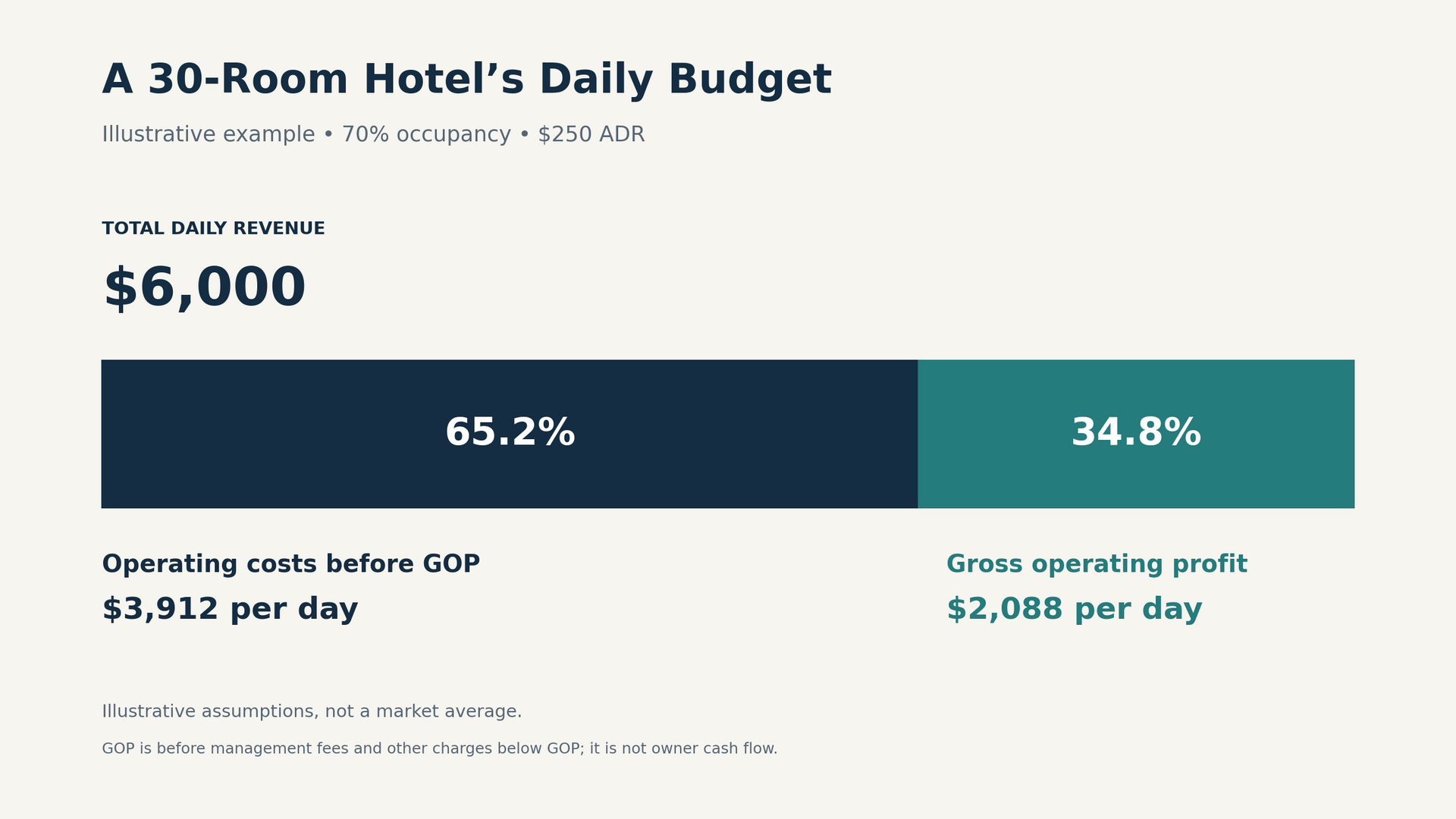
Start with the most recent benchmark. According to CBRE data reported by LODGING in Profitability Under Pressure (May 2026), the average U.S. hotel earned a gross operating profit (GOP) margin of 34.8% in 2025, down from 35.1% in 2024, and an EBITDA margin of 22.8%, down from 23.3%. Revenue rose 2.6% in 2025 while total expenses rose 3.1%.
Put simply: roughly 65 cents of every revenue dollar goes to operating costs before GOP, and about 77 cents is spent by the time you reach EBITDA, once management fees, insurance, property taxes, and reserves are paid. That ratio is the foundation of any daily cost estimate.
So how much does it cost to run a hotel per day? For a typical property, take your expected daily revenue and multiply by roughly 0.65 for operating costs, or roughly 0.77 for all costs down to EBITDA. The worked example below shows how that plays out.
Daily Operating Costs for a Small Boutique Hotel
The example below is illustrative only. The revenue inputs are assumptions we chose to make the math easy to follow; the cost percentages come from the cited sources. Substitute your own ADR, occupancy, and room count.
Illustrative assumptions (not market data):
30 rooms- 70% occupancy (21 occupied rooms per night)
- $250 average daily rate (ADR)
- Rooms revenue of $5,250 per day, plus $750 per day of food, beverage, and other revenue
- Total revenue of $6,000 per day
Example Operating Budget for a 30-Room Hotel
| Line (illustrative, per day) | Basis | Daily amount |
|---|---|---|
| Total revenue | Assumption | $6,000 |
| Operating costs before GOP | 65.2% of revenue (100% minus the 34.8% GOP margin, CBRE 2025) | $3,912 |
| Of which labor | 30–40% of revenue (CBRE's Robert Mandelbaum, 2025) | $1,800–$2,400 |
| Base management fee | 2–4% of gross revenue (HVS) | $120–$240 |
| FF&E reserve | 4.17% of revenue (HVS Canada, 2020) | $250 |
| Total costs before EBITDA | 77.2% of revenue (100% minus the 22.8% EBITDA margin, CBRE 2025) | $4,632 |
| EBITDA | 22.8% of revenue | $1,368 |
On these assumptions, our illustrative 30-room boutique hotel spends about $3,900 per day to operate before GOP and about $4,600 per day once fees and fixed charges are included. Note that management fees and the reserve sit below GOP, so they overlap with the step from $3,912 to $4,632 rather than adding to it.
How Much Does It Cost to Run a Hotel Per Year?
Multiply the daily figure by 365. Our illustrative property spends roughly $1.43 million a year on operating costs before GOP ($3,912 × 365) and roughly $1.69 million a year on all costs down to EBITDA ($4,632 × 365). Scale the revenue assumption up or down, and the costs follow the same ratios, until fixed costs start to bite, which is where the next sections matter.
Per Room, Per Day
Divide by keys, and the same illustrative hotel costs about $130 per available room per day before GOP ($3,912 ÷ 30). That number is useful for comparing your property with your own budget year over year, but it hides the effect of occupancy. That is why operators also track cost per occupied room, covered below.
Hotel Operating Cost Breakdown by Department
The Uniform System of Accounts for the Lodging Industry (USALI) organizes hotel operating costs into departments. The free, department-by-department percentage tables are paywalled, so we focus on what the published research says about each cost line and how it is moving. CBRE's All Eyes on Operating Costs in 2025 (May 2025) studied a sample of 2,600 U.S. hotels and found that in 2024 "the expenses above GOP ... increased by 4.1% year-over-year," against 2.3% revenue growth. Costs are rising faster than the top line, which is the central challenge of running a hotel right now.
Staffing, Payroll and Employee Benefits

Labor is "the largest operating expense for a hotel," according to CBRE. In 2024, salaries, wages, and benefits rose 4.8%. Hours worked are "down 7.4% since 2019, while the dollars paid for compensation are up 22.1%."
CBRE's Robert Mandelbaum, quoted by
Actabl (May 2025), puts it in revenue terms: "labor typically accounts for 30 to 40 percent of hotel revenue, or about half of total operating expenses." In a boutique hotel with a lean team, every role carries more weight, so scheduling and cross-training matter more than in a large property.
Rooms, Housekeeping and Guest Supplies
The rooms department carries housekeeping labor, linens, amenities and laundry, plus the cost of selling the room. CBRE found that agency commissions rose 6.0% in 2024, one of the faster-growing lines. For an independent hotel, the balance between direct bookings and third-party distribution shows up here every night.
Utilities, Maintenance and Property Operations
Maintenance rose 5.0% and utilities 2.0% in 2024, per CBRE. Older buildings and adaptive-reuse properties, which many boutique hotels are, can run higher here. Preventive maintenance is cheaper than emergency repair, and it protects the guest reviews that support your rate.
Technology, Marketing and Distribution Costs
Information technology rose 5.1% and credit-card commissions 4.4% in 2024. Franchise fees rose 3.9% for branded hotels. Independent hotels avoid franchise fees but must fund their own marketing, website, and booking engine. A well-designed technology stack keeps those costs contained instead of letting subscriptions sprawl.
Insurance, Property Taxes and Management Fees
Below GOP, the fastest-rising line in CBRE's study was insurance, up 17.4% in 2024. Property taxes rose 4.3% and management fees 1.1%. HVS puts a typical base management fee "ranging typically from 2% to 4%" of gross operating revenue, with an incentive fee of 8–10% of adjusted GOP (a European benchmark), in its review of hotel management contracts (European data). For the full fee picture, see our guide to hotel management company fees.
Food, Beverage and Additional Amenities
A restaurant, bar, spa or event space adds revenue and adds cost: cooks, servers, cost of goods and equipment. Many boutique hotels treat F&B as part of the brand story rather than a profit center. That can be the right call, as long as the owner knows what the amenity costs per day and what it adds to ADR.
What is the biggest operating expense for a hotel? Labor, by a wide margin. If you only manage one cost line closely, manage that one.
Operating Expenses as a Percentage of Revenue
Percentages are how owners, lenders, and operators compare hotels of different sizes. These are the benchmarks the cited research supports:
GOP margin: 34.8% of revenue in 2025 (CBRE via LODGING), so operating costs above GOP run about 65% of revenue- EBITDA margin: 22.8% in 2025 (CBRE via LODGING)
- Labor: 30–40% of revenue, or about half of operating expenses (CBRE's Robert Mandelbaum via Actabl, 2025)
- Base management fee: 2–4% of gross revenue (HVS)
- FF&E reserve: 4.17% of revenue (HVS Canada, 2020)
Your own ratios will vary with service level, F&B, market, and building age. Track them monthly against budget and against your own history. For how these flow down to the bottom line, see our
hotel net operating income benchmarks.
Fixed vs. Variable Hotel Costs
Not every dollar moves with occupancy. Splitting costs into fixed and variable is what lets you forecast a slow month accurately.
Costs That Stay the Same Regardless of Occupancy
- Insurance and property taxes
- Core salaried management and minimum staffing for front desk and security
- Base utilities, software subscriptions, and maintenance contracts
- Debt service and ground or building lease payments (below EBITDA)
Costs That Rise With Occupied Rooms
These variable costs scale with each occupied room:
Housekeeping hours, laundry and guest amenities- Agency and credit-card commissions
- Incremental utilities and F&B cost of goods
- Revenue-based fees such as management fees and franchise fees for branded hotels
A boutique hotel usually has a higher share of fixed costs per key than a large hotel, because a minimum team is needed whether you have 15 rooms or 50. That is why occupancy and rate discipline matter so much in smaller properties.
Cost per Occupied Room and the Break-Even Formula
Daily Operating Cost per Available Room
Cost per available room = total daily operating cost ÷ total rooms. In the illustrative example: $3,912 ÷ 30 = about $130.
Cost per Occupied Room (CPOR)
CPOR = total daily operating cost ÷ occupied rooms. In the illustrative example: $3,912 ÷ 21 = about $186. Operators often calculate CPOR for the rooms department alone to judge housekeeping efficiency, and for the whole hotel to judge pricing.
Break-Even Occupancy
A simple break-even test: break-even occupied rooms = daily fixed costs ÷ (ADR − variable cost per occupied room). If, illustratively, fixed costs were $2,000 a day and variable cost were $60 per occupied room, a $250 ADR would need about 10.5 occupied rooms ($2,000 ÷ $190) to cover operating costs, or 35% occupancy in a 30-room hotel. Plug in your own numbers; the structure is what matters.
How Occupancy, ADR and RevPAR Affect Profitability
RevPAR (revenue per available room) combines occupancy and ADR. Because a large share of costs is fixed, each extra occupied room at a healthy rate drops a disproportionate amount to GOP. A rate increase drops through even more, since it adds revenue without adding housekeeping hours. This is why revenue strategy and cost control should be managed together.
Why Boutique Hotels Have Different Operating Economics
Staffing Efficiency and Smaller Room Inventories
With 15 to 50 keys, there is less room to absorb idle hours. Cross-trained teams, smart scheduling, and the right technology make a lean model work. Our overview of what running a boutique hotel involves day to day covers the roles in more detail.
Personalized Service and Amenity Expectations

Boutique guests pay for design, character, and service. Cut too deep, and you lose the premium that makes the model work. The goal is not the lowest cost per day; it is the best relationship between cost, guest experience, and profit.
Design is strategy here, too. Decisions made in the build or renovation phase, such as back-of-house layout, durable finishes, laundry on-site or outsourced, and energy-efficient systems, set the running costs for years. A beautiful lobby that needs two extra staff on every shift is a design choice with a daily price tag. The best boutique hotels are designed with the operating model in mind from the first sketch.
How to Reduce Hotel Operating Costs Without Hurting the Guest Experience
Cost efficiency in hotel operations is about precision, not austerity. Practical levers:
- Labor scheduling: forecast-driven schedules tied to occupancy and arrivals, not fixed rotas
- Distribution mix: shift share from commissioned channels to direct bookings
- Vendor oversight: rebid linen, waste, insurance, and software contracts annually
- Preventive maintenance: planned work orders instead of emergency calls
- Energy management: controls in unoccupied rooms and back-of-house areas
- Revenue management: a rate strategy that protects ADR, because rate drops straight through to profit
An owner who cuts housekeeping hours but loses review scores may lose more in rate than was saved. An owner who invests in direct marketing may raise costs on one line and still lift net operating income. Our
boutique hotel operations framework explains how to judge the whole operation rather than each expense in isolation.
Startup Costs vs. Running Costs: Don't Mix Them Up
Owners sometimes blend two very different numbers. Startup costs are one-time: acquisition or construction, FF&E, pre-opening payroll, initial marketing, and working capital to carry the hotel until it stabilizes. Running costs are what this article measures: the recurring daily, monthly, and yearly expense of operating the hotel once the doors are open.
Keeping them separate matters for three reasons:
Underwriting. Lenders and investors judge a hotel on stabilized operating performance. Folding pre-opening spend into year-one operating costs makes the business look weaker than it is.- Forecasting. Running costs follow occupancy and rate; startup costs follow the development or renovation schedule. They need different budgets and different owners.
- Decision-making. When you know exactly what the hotel costs to run per day, you can test a renovation, a new F&B concept, or a rate change against a clean baseline.
A practical habit: keep a one-page daily cost report that shows revenue, operating costs above GOP, labor as a percentage of revenue, and CPOR for the previous day and month-to-date. If those four numbers are visible every morning, surprises at month-end become rare.
When Should a Boutique Hotel Owner Consider Professional Management?
Self-management works until it doesn't. The signs are familiar: costs rising faster than revenue, the owner covering shifts, no clear daily cost report, and rate decisions made by instinct. Our guide on when boutique hotels outgrow self-management walks through the trade-off, including what a management fee costs against what better operations can return.
This is where vision meets execution. Roam Hospitality manages independent and boutique hotels from 15 to 50 keys and larger, combining hands-on
operations management, revenue strategy, and in-house marketing under one roof. We look at your full P&L, not one line at a time, and focus on measurable results: GOP, NOI, and long-term asset value.
Know what your hotel costs to run, and what it should be earning.
Partner with Roam Hospitality for a review of your property's operating costs.
Frequently Asked Questions
How much does it cost to operate a 30-room boutique hotel per day?
It depends on revenue, service level, and market. As an illustration only: a 30-room hotel at 70% occupancy and a $250 ADR, with $6,000 of total daily revenue, would spend about $3,900 a day before GOP and about $4,600 a day down to EBITDA, using CBRE's 2025 margins of 34.8% GOP and 22.8% EBITDA.
How much does it cost to own a hotel?
Owning adds costs on top of operations: debt service, capital expenditures, and your equity. Operating costs typically consume about 77% of revenue down to EBITDA (CBRE, 2025). What you pay to buy or build the hotel is a separate question; see our guide to how much it costs to build a hotel.
What is the biggest operating expense for a hotel?
Labor. CBRE calls it "the largest operating expense for a hotel," and it typically runs 30–40% of revenue.
How do you calculate cost per occupied room?
Divide total operating cost for the period by the number of occupied room nights. Calculate it for the Rooms Department and for the whole hotel.
Can a hotel management company reduce operating expenses?
A capable operator can lower costs through scheduling, purchasing, distribution, and maintenance, but the bigger win is usually the balance between costs and revenue. Results vary by property, and no operator should promise a fixed saving.
More Recent Articles