Boutique Hotel Operations Framework: Systems, Staffing & Performance Execution
Boutique Hotel Operations Framework: Systems, Staffing & Performance Execution
Executive Overview: Boutique Operational Architecture
Boutique hotel operations require more than creativity and personalized service. They depend on a structured management approach that aligns guest experience, staffing efficiency, cost discipline, and revenue execution into a unified performance system. While boutique properties are known for distinctive design and curated hospitality, long-term success is determined by the strength of their operational architecture.
Unlike large, flag-affiliated hotels that rely on scale and standardized brand playbooks, boutique hotels operate with leaner teams, tighter margins, and elevated guest expectations. This environment demands precision. Clear execution layers, cross-trained staffing models, disciplined vendor oversight, and integrated technology systems must work together to protect both brand identity and financial performance.
Professional boutique hotel operations framework focuses on three core objectives:
- Delivering consistent, high-quality guest experiences without sacrificing individuality
- Maintaining operational efficiency and labor discipline in smaller team structures
- Translating structured execution into measurable financial outcomes
When boutique hotel operations are designed and managed systematically, they influence every major performance metric — from RevPAR and GOPPAR to labor ratios, guest satisfaction scores, and long-term asset value. When they are loosely managed, boutique properties often experience margin erosion, service inconsistency, and brand dilution.
The framework outlined below defines the operational systems required to run a high-performing boutique property. It establishes how professional management integrates staffing, technology, logistics, and service design into a cohesive performance engine.
This structured approach forms the operational foundation of effective Operations Management within a broader boutique hotel management strategy.
The Three-Layer Boutique Hotel Operations Management Model
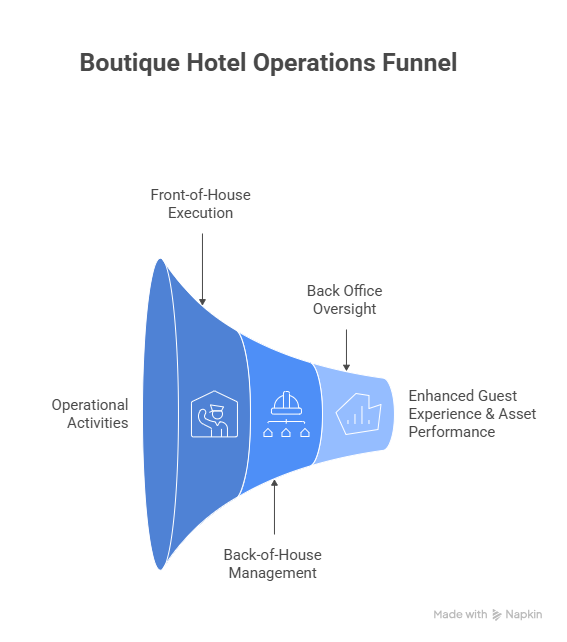
Effective boutique hotel operations are built on a structured, three-layer execution model. While all hotels share similar functional departments, boutique properties require tighter integration between guest-facing service, operational logistics, and financial oversight. With smaller teams and elevated service expectations, operational clarity is essential.
The three-layer model ensures that every operational activity supports both guest experience and asset performance.
1. Front-of-House: Experience Execution
The front-of-house layer governs all direct guest interactions. In boutique environments, this layer must balance personalization with operational consistency.
Key responsibilities include:
- Check-in and check-out systems
- Concierge and local experience coordination
- In-stay guest communication
- Service recovery protocols
- Review and reputation management
In boutique hotel operations, front-of-house performance is not left to personality alone. It is supported by defined service standards, response time benchmarks, and guest preference tracking systems. Personalization becomes structured rather than improvised.
When front-of-house execution is disciplined, it directly impacts:
- Guest satisfaction scores
- Online review performance
- Repeat visitation rates
- Average daily rate resilience
2. Back-of-House Property Management & Maintenance Systems
The back-of-house layer supports the physical and logistical execution of the property. This includes housekeeping, maintenance, vendor coordination, and inventory control.
In boutique settings, where staffing is leaner, operational inefficiencies are amplified. Structured workflows and cross-functional clarity become critical.
Core components include:
- Housekeeping scheduling & room turnover optimization
- Preventative maintenance systems
- Vendor oversight and contract management
- Inventory and procurement controls
- Quality assurance checklists
A disciplined back-of-house structure protects margins and preserves asset condition. Without operational control at this level, boutique hotel operations often experience rising labor costs, maintenance backlogs, and service inconsistencies that erode profitability.
3. Back Office: Strategic Oversight & Performance Monitoring
The third layer provides financial and strategic visibility. This is where boutique hotel operations connect to revenue management, asset management, and ownership reporting.
Back office oversight includes:
- Budgeting and cost forecasting
- KPI monitoring and performance benchmarking
- Labor ratio tracking
- Reporting dashboards
- Compliance and risk management
This layer ensures that daily operational decisions align with long-term performance objectives. It transforms hospitality execution into measurable business performance.
Why the Three-Layer Model Matters
In boutique hotel operations, these layers cannot operate independently. Front-of-house performance affects pricing power. Back-of-house efficiency influences operating margins. Back office oversight determines whether strategic adjustments occur quickly or too late.
When integrated properly, the three-layer model creates:
- Operational clarity
- Cost discipline
- Brand consistency
- Stronger NOI performance
This model provides the structural foundation for professional Operations Management within boutique hotel management services.
Guest Experience Systems: Engineering Consistency Without Losing Character
In boutique hotel operations, guest experience is often described as “personal” or “intuitive.” However, sustainable performance requires that personalization be systematized rather than improvised. Professional operators do not rely solely on individual staff talent; they build structured experience systems that allow consistency without sacrificing uniqueness.
Effective guest experience execution is built around three components:
1. Experience Design Architecture
Experience design begins before the guest arrives. It includes:
- Defined brand touchpoints from booking through post-stay
- Structured pre-arrival communication workflows
- Guest preference tracking within the PMS
- Local experience integration planning
Rather than relying on ad hoc gestures, the boutique hotel operations framework establishes repeatable experience standards. This ensures that personalization scales without becoming inconsistent.
2. Service Delivery Protocols
Service excellence in boutique hotels must be codified.
Key operational elements include:
- Response time benchmarks for guest requests
- Service recovery escalation paths
- Defined communication tone and scripting guidelines
- Daily briefing systems to align staff on VIP arrivals and special requests
These protocols allow smaller teams to operate with clarity. When staff understand both expectations and decision boundaries, service becomes proactive rather than reactive.
3. Reputation & Loyalty Feedback Loops
Guest experience extends beyond checkout. Structured feedback and reputation management systems ensure that operational adjustments are data-informed.
This includes:
- Automated post-stay surveys
- Online review monitoring dashboards
- Defined response standards
- Loyalty segmentation for repeat guest targeting
By closing the feedback loop, boutique hotel operations transform subjective experience into measurable performance indicators.
Why This Matters Operationally
When guest experience systems are engineered properly:
- Online review averages improve
- Direct booking conversion increases
- Pricing power strengthens
- Brand equity compounds over time
In contrast, when personalization is unstructured, service quality fluctuates, staff burnout increases, and brand consistency deteriorates.
Professional operations management transforms boutique hospitality from an art form into a repeatable performance discipline.
Staffing Structure & the Role of the Boutique Hotel Operations Manager
In boutique hotel operations, staffing is both the greatest asset and the most volatile cost center. With smaller room counts and leaner organizational structures, labor inefficiencies have an immediate impact on profitability. At the same time, boutique service expectations demand attentiveness, personalization, and adaptability.
Professional operations management approaches staffing as an economic model, not simply a hiring function.
Lean Team Architecture
Boutique properties typically operate with compressed hierarchies. This requires:
- Clearly defined role accountability
- Cross-functional capability within departments
- Scheduling precision aligned with occupancy patterns
- Real-time labor percentage tracking
Rather than duplicating roles across departments, boutique hotel operations rely on structured flexibility. Team members are trained to operate across service functions while maintaining defined performance standards.
Cross-Training as Margin Protection
Cross-training is not a cultural perk; it is a financial control mechanism.
When properly implemented, cross-training allows:
- Front desk staff to assist concierge functions
- Managers to support peak service periods
- Housekeeping leads to coordinate minor maintenance reporting
- F&B staff to support event-based revenue initiatives
This flexibility reduces overstaffing during slower periods and prevents service breakdown during peak demand.
Labor becomes elastic rather than rigid.
Culture as Operational Leverage
While structure is critical, boutique hotel operations must also preserve authenticity. Empowerment frameworks, recognition systems, and growth pathways improve retention — reducing turnover costs and preserving institutional knowledge.
High turnover in boutique environments disrupts brand consistency and increases training expenses. Stable staffing structures directly contribute to service continuity and cost control.
Operational Impact
Disciplined staffing architecture influences:
- Labor cost as a percentage of revenue
- Guest satisfaction scores
- Service response time
- Long-term operational scalability
In boutique hotel operations, staffing is not merely a human resource issue. It is a performance lever that directly shapes profitability.
Technology Infrastructure & Integrated Management Systems
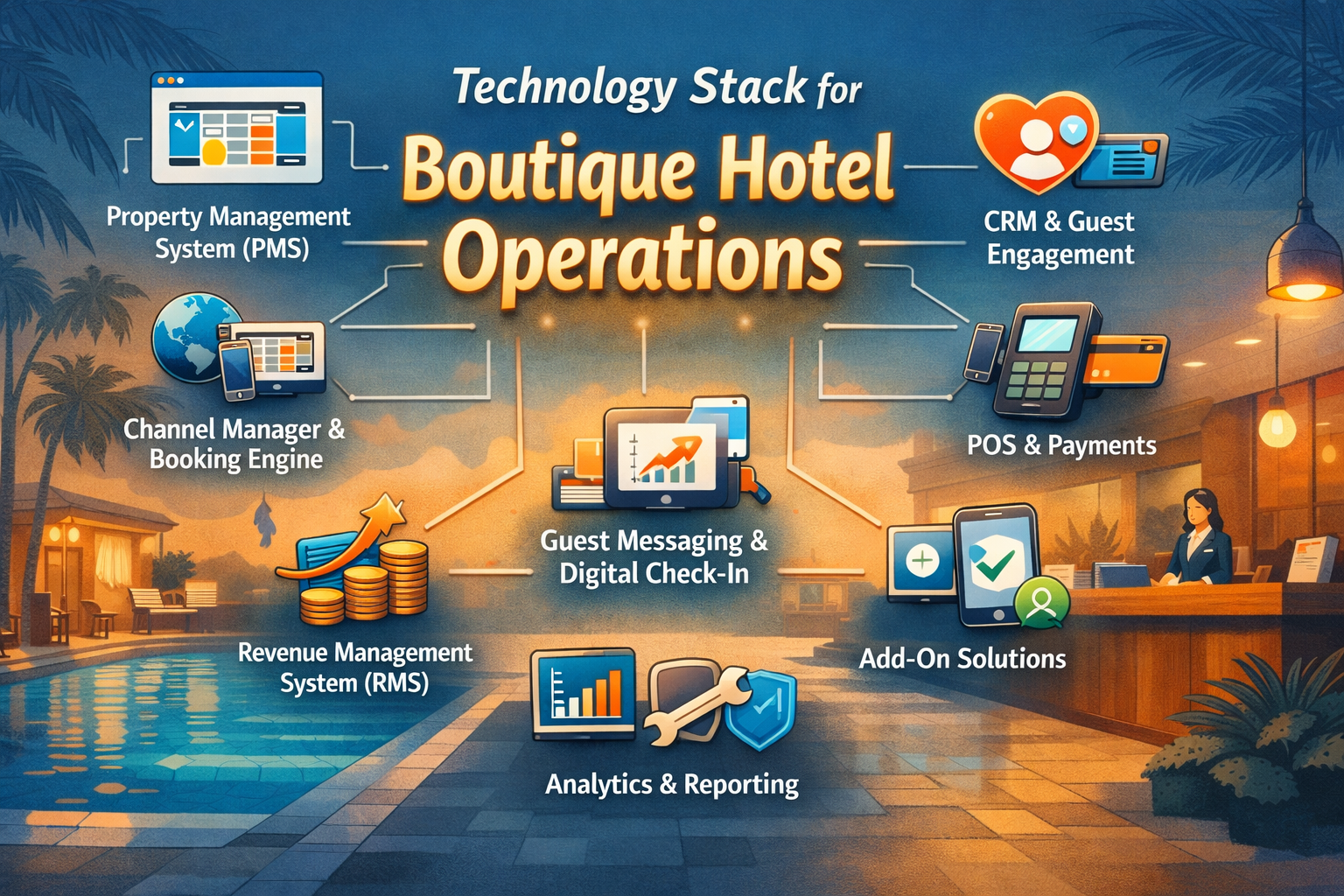
Modern boutique hotel operations rely on integrated management systems that connect departments, automate workflows, and provide operational visibility in real time. In lean service environments, technology functions as the coordination platform that aligns front-of-house execution with back-of-house control and financial oversight.
A centralized management system typically integrates:
- Property management modules for reservations, room inventory, and guest data
- Point-of-sale tracking for food and beverage revenue
- Maintenance scheduling and property management controls
- Revenue management tools for dynamic pricing adjustments
- Reporting dashboards that deliver performance insights to ownership
These systems streamline operations by reducing manual coordination and minimizing communication gaps between departments. When hotel operations involve every department — from housekeeping to finance — technology ensures alignment across processes without increasing administrative burden.
For the operations manager, these platforms are decision-support tools. Rather than reacting to issues after they occur, managers can monitor occupancy trends, staffing ratios, maintenance workflows, and guest behavior in real time.
Effective use of technology allows boutique hotels to:
- Track service features and guest preferences systematically
- Improve communication between teams
- Provide owners with transparent reporting
- Identify inefficiencies before they affect profitability
Technology does not replace hospitality. Instead, it supports disciplined execution while preserving the distinct identity of the property.
When integrated properly, management systems create consistency, accountability, and scalability within boutique hotel operations.
Seasonality, Demand Cycles & Operational Load Balancing
Every boutique property operates within demand cycles. Seasonality affects staffing levels, pricing flexibility, service intensity, and capital planning. Professional operations management requires anticipating these fluctuations rather than reacting to them.
Effective hotel operators learn to adjust both service features and cost structures based on occupancy patterns. During peak demand periods, the focus shifts toward throughput efficiency and guest flow control. During shoulder or low seasons, emphasis moves toward cost discipline, preventative maintenance, and strategic marketing coordination.
Seasonal execution involves:
- Managing staffing schedules based on forecasted occupancy
- Adjusting service features to match guest volume without overextending the team
- Prioritizing maintenance projects during slower periods
- Coordinating with revenue management to align pricing strategy with operational capacity
Hotel operations involve every department when responding to demand shifts. Front-of-house communication, housekeeping processes, and back-office reporting must operate in alignment. Without coordination, service breakdowns occur during peak periods and unnecessary labor costs accumulate during slower months.
Owners benefit when seasonal planning is embedded into operational systems rather than improvised each quarter. By forecasting demand accurately and aligning labor models accordingly, operators protect margins while maintaining service standards for guests.
For independent properties especially, structured demand planning reduces volatility. Instead of overreacting to short-term booking trends, management teams rely on historical data and operational insights to guide staffing and expenditure decisions.
This disciplined approach ensures that performance remains stable even when demand fluctuates.
Food & Beverage as an Operational Revenue Lever
Food and beverage operations are often treated as a creative extension of hospitality, but within a disciplined management structure, they function as a strategic revenue lever. In boutique environments, F&B must support both brand positioning and financial performance.
Effective hotel operations require aligning culinary offerings with operational capacity. Menu design, vendor relationships, staffing levels, and inventory control must operate within defined cost parameters. Without structure, food and beverage departments can quickly erode margins through labor inefficiencies and inconsistent procurement processes.
From an operational standpoint, F&B success depends on:
- Clear cost controls and margin tracking
- Vendor coordination and property management oversight
- Staffing models aligned with occupancy patterns
- Event-based revenue planning
- Integration with the broader management system
Managing F&B in smaller properties requires precision. Lean teams must coordinate across service periods while maintaining consistent quality standards. When executed correctly, food and beverage operations enhance the guest experience, strengthen brand differentiation, and increase total revenue per available room.
For owners, structured F&B oversight provides transparency. Reporting dashboards should connect restaurant performance to overall property profitability, ensuring that ancillary revenue contributes positively to NOI rather than creating hidden expense burdens.
When integrated into a broader operational framework, food and beverage become more than a hospitality feature. It becomes a controllable performance engine that supports long-term asset stability.
Operational KPIs & Performance Measurement
Operational discipline has value only when it translates into measurable outcomes. In professional hotel environments, structured reporting connects daily execution to financial performance. Without defined metrics, even well-designed systems lose accountability.
Effective performance monitoring includes both service-level indicators and financial ratios.
Key operational KPIs include:
- Revenue per Available Room (RevPAR)
- Gross Operating Profit per Available Room (GOPPAR)
- Labor cost as a percentage of revenue
- Cost per occupied room
- Room turnover time
- Guest satisfaction and review scores
- Maintenance response time
These indicators provide insight into how well operational processes are functioning across departments.
For example, elevated labor percentages may signal scheduling inefficiencies or misalignment between staffing levels and occupancy forecasts. Slower room turnover times can reveal breakdowns in housekeeping coordination. Declining review scores often indicate inconsistency in service delivery or communication gaps between teams.
The operations manager plays a critical role in interpreting these metrics. Rather than viewing KPIs as static numbers, experienced managers use them to refine workflows, adjust staffing, and improve coordination between departments.
Owners rely on this reporting structure to understand whether operational performance is protecting asset value. Clear dashboards and regular performance reviews ensure transparency and create accountability within the management system.
Hotel management school programs often teach individual performance metrics in isolation. However, effective operators understand that these indicators function as an interconnected system. Operational adjustments in one area frequently influence results in another.
Through disciplined measurement and continuous refinement, structured operations management becomes a measurable driver of NOI rather than a cost center.
Integrated Performance Model: How Operations Drive Revenue & Asset Value
Structured execution inside a hotel does not exist in isolation. Operational discipline influences pricing power, brand perception, and long-term asset performance. When integrated correctly, operations management becomes the foundation that supports both revenue growth and valuation stability.
Consistent service delivery strengthens reputation. Strong reputation increases pricing resilience and direct booking conversion. Stable revenue improves NOI. Sustained NOI enhances asset value.
This interconnected relationship is what separates informal management from institutional execution.
In high-performing properties:
- Operations systems protect service consistency
- Technology platforms provide performance visibility
- Staffing models preserve margin control
- Seasonal planning reduces volatility
- KPI monitoring ensures accountability
Together, these components form a unified operating model.
For ownership groups, this structure reduces risk. Instead of relying on personality-driven service or reactive management, the property operates within defined processes and measurable performance standards. Operational refinement becomes continuous rather than episodic.
When boutique hotel operations are engineered rather than improvised, the result is not only elevated guest satisfaction but sustained financial performance.
Conclusion: The Discipline Behind Distinctive Hospitality
Boutique hospitality is often associated with creativity and individuality. However, long-term success depends on structured execution beneath the surface. Distinct design and personalized service must be supported by disciplined systems, measurable processes, and integrated management oversight.
The framework outlined above demonstrates how professional operations management transforms daily activity into predictable performance. By aligning guest service, staffing architecture, technology infrastructure, seasonal planning, and KPI monitoring, independent properties can compete effectively while preserving brand identity.
For owners and investors, structured operations provide clarity. For teams, they create direction. For guests, they deliver consistency.
Within a comprehensive boutique hotel management strategy, disciplined operations are not merely supportive — they are foundational.
Frequently Asked Questions
What Are Boutique Hotel Operations?
Boutique hotel operations are the structured systems and daily execution processes that keep a boutique property running efficiently.
They include:
- Front-of-house service coordination
- Housekeeping management
- Maintenance oversight
- Staffing models
- Technology integration
- Performance monitoring
Unlike large chains, boutique hotels operate with leaner teams. That requires tighter cross-department coordination and stronger operational discipline.
How Do Boutique Hotel Operations Differ from Chain Hotels?
The core difference is scale vs. integration.
Chain hotels rely on:
- Corporate-standardized operating procedures
- Centralized infrastructure
- Brand-level systems
Boutique hotels rely on:
- Smaller teams
- Customized service execution
- Distinct brand identity
While both share similar departments (front desk, housekeeping, maintenance), boutique properties require closer alignment between guest experience, cost control, and management oversight.
Why Are Structured Management Systems Important?
Structured systems reduce friction and improve financial visibility.
Integrated systems connect:
- Reservations
- Housekeeping
- Maintenance
- Financial reporting
When these functions operate within one ecosystem, operators can:
- Reduce labor inefficiencies
- Improve communication
- Deliver transparent reporting
- Measure performance in real time
Structure turns hospitality into measurable operations.
What Does an Operations Manager Do?
An operations manager connects daily execution to long-term profitability.
Core responsibilities include:
- Aligning staffing with occupancy forecasts
- Overseeing service standards
- Coordinating maintenance response
- Monitoring performance dashboards
- Ensuring financial accuracy
The role is both tactical (daily oversight) and strategic (performance alignment).
How Do Boutique Hotels Manage Seasonality?
Professional operators plan for seasonality rather than react to it.
They use:
- Historical performance data
- Demand forecasting tools
- Labor modeling
- Expense planning frameworks
Proactive planning protects margins during slow periods and maintains service efficiency during peak occupancy.
How Do Operations Impact Profitability?
Operational discipline directly influences NOI and asset value.
Improvements in:
- Room turnover time
- Service consistency
- Labor ratios
- Cost control
- Impact key metrics such as:
- RevPAR
- GOPPAR
- Guest satisfaction
Over time, operational efficiency strengthens income performance and long-term asset value.
When Should a Boutique Hotel Hire Professional Operations Management?
Independent properties often consider professional oversight when:
- Growth increases operational complexity
- Staffing inefficiencies rise
- Service consistency declines
- Financial performance becomes unpredictable
Structured management introduces accountability, reporting clarity, and long-term stability.